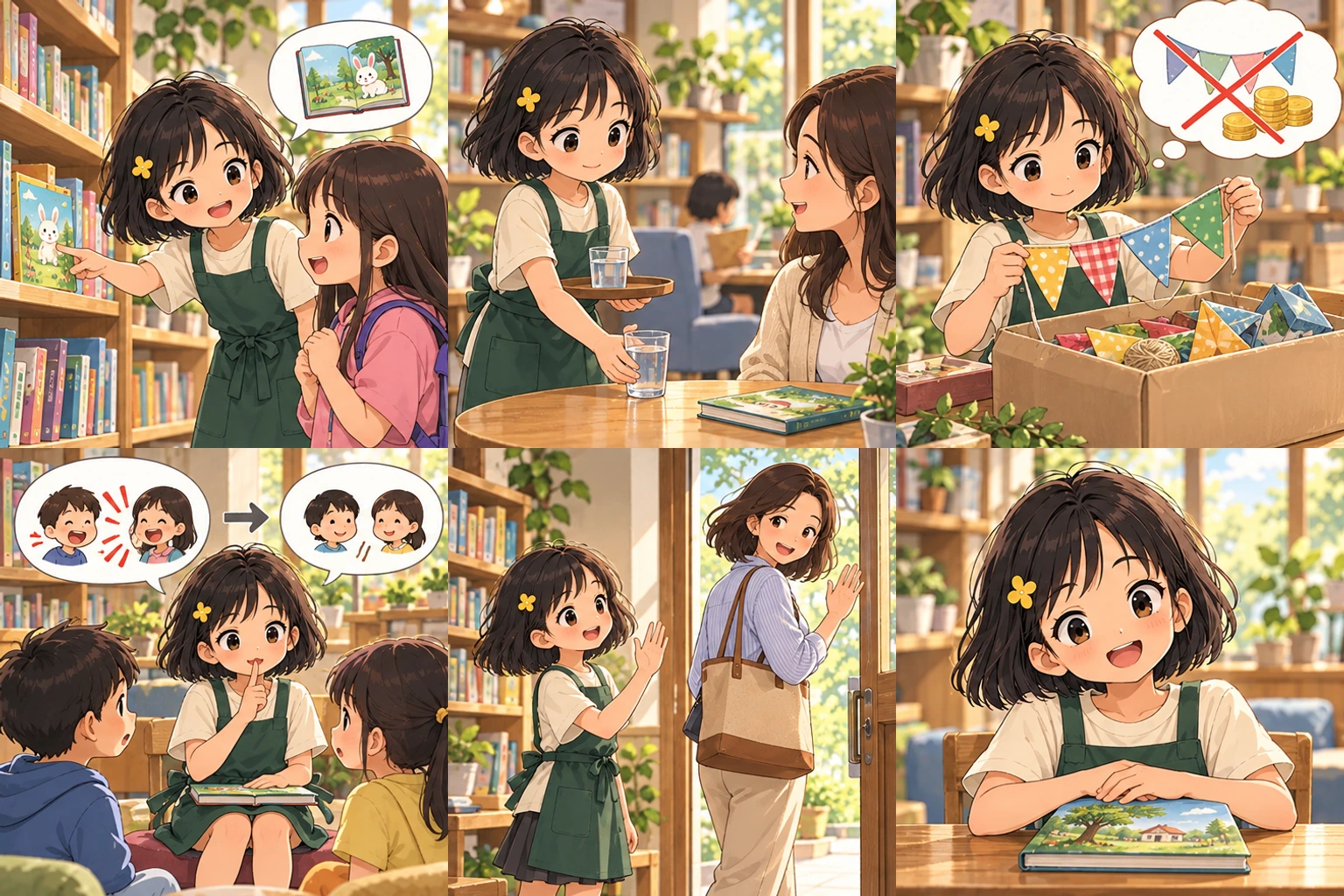
An reuses stored decorations instead of buying new ones to keep costs low.
keep down
She kept the event costs down by reusing decorations.
Read the example again
She kept the event costs down by reusing decorations.
Buying only what we need helps keep costs down.
Read the example again
Buying only what we need helps keep costs down.
View meaning & usage
Keep something at a low level
keep something downkeep costs down
Emphasises keeping a low level. It does not mean everything is free; the past of “keep” is “kept”.
Haven't studied yet
An gently asks two chatting children to quieten down as story time starts.
pipe down
The children piped down when the reading began.
Read the example again
The children piped down when the reading began.
Please pipe down so everyone can hear the story.
Read the example again
Please pipe down so everyone can hear the story.
View meaning & usage
Become quieter or stop talking
pipe down
Informal and sometimes quite direct. “Please” can soften the request.
Haven't studied yet
An walks with a guest from the reading corner to the doorway and says goodbye.
see out
She saw the guests out after the event.
Read the example again
She saw the guests out after the event.
Thank you for coming. I will see you out.
Read the example again
Thank you for coming. I will see you out.
View meaning & usage
Accompany a guest to the exit
see someone outsee them out
Here it means accompanying a guest to the exit. “See something out” can also mean staying until a period ends.
Haven't studied yet
The examples were written for this course. Usage was checked against Matt Errey’s book, pages 8, 137, 71, 97, 112. A2–B1 is the course’s intended level.
Recall it · Use it
One step forward every day
Practice completed!
Your browser could not save your play history. Results from this session may be lost when you close the page.
Sentences using suggestions are counted as needing more practice. Review schedule based on each phrase's meaning.
Drag a wire from the dot beside a phrase to the dot beside its matching picture. You can also tap a phrase, then a picture. Drag again to change a pair before checking.
Read the picture descriptions for more context. Similar expressions are accepted when they fit the particular scene.
Phrases
Actions in the pictures
Picture description
An helps a visitor choose a suitable storybook from a low shelf.
The picture could not load. Try loading it again before matching.
Picture description
An sets a glass of water on the table for a seated reading guest.
The picture could not load. Try loading it again before matching.
Picture description
An reuses stored decorations instead of buying new ones to keep costs low.
The picture could not load. Try loading it again before matching.
Picture description
An gently asks two chatting children to quieten down as story time starts.
The picture could not load. Try loading it again before matching.
Picture description
An walks with a guest from the reading corner to the doorway and says goodbye.
The picture could not load. Try loading it again before matching.
Choose a phrase to begin.
Your browser could not save your play history. Results from this session may be lost when you close the page.
A conversation in context
Read the conversation and find the expressions you have learned.
Mai
Could you attend to the visitors at the door?
Read the example again
Could you attend to the visitors at the door?
Alex
Yes. I will wait on the tables once everyone is seated.
Read the example again
Yes. I will wait on the tables once everyone is seated.
Mai
Please keep the noise down while I see the first group out.
Read the example again
Please keep the noise down while I see the first group out.
Compare the uses
attend to / wait on
“Attend to” means deal with a need or task; “wait on” means serve someone, for example with food. The service setting clarifies the intended sense.
Practice and check your answers
Try answering before revealing the suggested answer. This practice is not scored.
The answers below are models. Other answers can also work if they preserve the facts, meaning and structure requested in the task.
A situation to apply what you have learned
A guest needs help finding a seat. Later a server brings food to the table, and a host accompanies guests to the door.
Describe dealing with the first request.
Show the answer and explanation
The host attends to the guest’s request for a seat.
The host “attends to the guest’s request” by dealing with the seating need, rather than merely looking at the guest.
Complete: The server will wait ___ the table.
Show the answer and explanation
on
“Wait on the table” means serve it; “on” distinguishes service from waiting for a table to become free.
Write the host’s offer at departure.
Show the answer and explanation
I will see you out when you are ready to leave.
“See you out” offers to accompany guests to the door when ready, rather than orders them to leave immediately.
The usage comparisons are checked against the Cambridge Dictionary entries linked beside the compared expressions. The additional conversations and exercises are written for this course.
Progress is saved on the device. Sign in with Google to save with the same account and continue on another device.