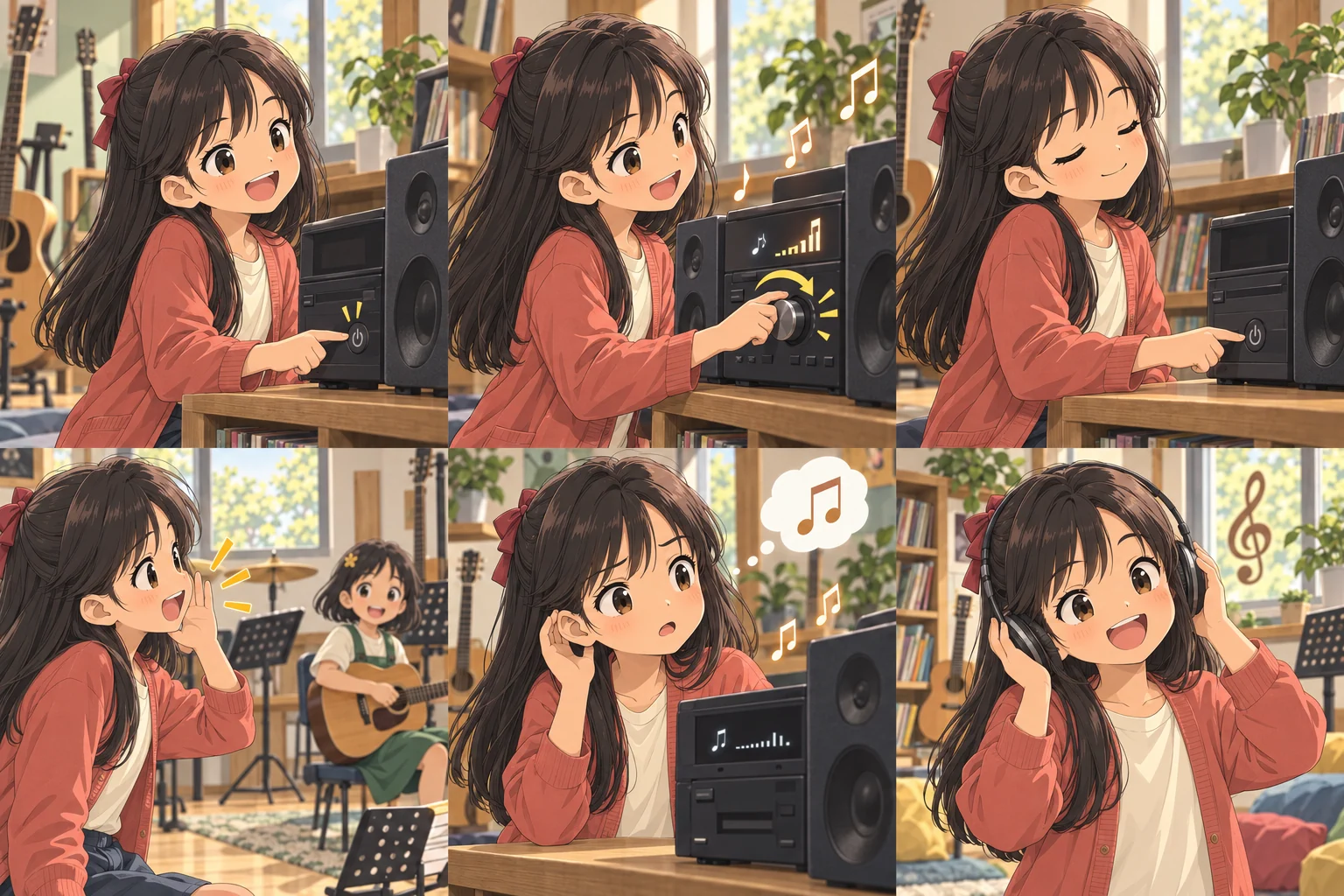
Vy calls out a friend’s name across the music room.
call out
I called out her name, and she waved at me.
Read the example again
I called out her name, and she waved at me.
Please raise your hand instead of calling out the answer.
Read the example again
Please raise your hand instead of calling out the answer.
View meaning & usage
Call / speak loudly for others to hear
call outcall out somethingcall something out
In the lesson, talk loudly; No need to call or cancel events in “call off”.
Haven't studied yet
Vy listened attentively to an unpleasant song from the music player.
make out
I cannot make out the last word in the song.
Read the example again
I cannot make out the last word in the song.
Can you make out what the singer is saying?
Read the example again
Can you make out what the singer is saying?
View meaning & usage
Recognize / hear clearly what is difficult to distinguish
make out somethingmake something outmake out what someone says
Used when hearing or seeing is difficult; “make it out” has the pronoun in the middle. Past tense “made”.
Haven't studied yet
The examples were written for this course. Usage was checked against Matt Errey’s book, pages 124, 134, 124, 19, 86. A2–B1 is the course’s intended level.
Recall it · Use it
One step forward every day
Practice completed!
Your browser could not save your play history. Results from this session may be lost when you close the page.
Sentences using suggestions are counted as needing more practice. Review schedule based on each phrase's meaning.
Drag a wire from the dot beside a phrase to the dot beside its matching picture. You can also tap a phrase, then a picture. Drag again to change a pair before checking.
Read the picture descriptions for more context. Similar expressions are accepted when they fit the particular scene.
Phrases
Actions in the pictures
Picture description
Vy presses the button to turn on the music player on the table.
The picture could not load. Try loading it again before matching.
Picture description
Vy turns the volume knob to make the music a little louder.
The picture could not load. Try loading it again before matching.
Picture description
Vy pressed the button to turn off the music player after finishing listening.
The picture could not load. Try loading it again before matching.
Picture description
Vy calls out a friend’s name across the music room.
The picture could not load. Try loading it again before matching.
Picture description
Vy listened attentively to an unpleasant song from the music player.
The picture could not load. Try loading it again before matching.
Choose a phrase to begin.
Your browser could not save your play history. Results from this session may be lost when you close the page.
A conversation in context
Read the conversation and find the expressions you have learned.
Mai
May I switch on the radio?
Read the example again
May I switch on the radio?
Alex
Yes, but do not turn it up too much.
Read the example again
Yes, but do not turn it up too much.
Mai
I will switch it off when you need to study.
Read the example again
I will switch it off when you need to study.
Compare the uses
switch on / switch off
“Switch on” starts a device; “switch off” stops it. “Turn up” increases a level such as volume, rather than necessarily starting a switched-off device.
Practice and check your answers
Try answering before revealing the suggested answer. This practice is not scored.
The answers below are models. Other answers can also work if they preserve the facts, meaning and structure requested in the task.
A situation to apply what you have learned
A radio is silent because it is off. Once started, its music is too loud for a nearby reader.
What action starts the radio?
Show the answer and explanation
Switch on the radio.
The radio is off, so “switch on” starts it; changing volume alone does not address its current state.
Replace “the radio” with “it”: Switch the radio off.
Show the answer and explanation
Switch it off.
Replacing “the radio” with “it” gives “switch it off”; the pronoun cannot follow “off”.
Explain why you will not turn the sound up.
Show the answer and explanation
I will not turn it up because someone is reading.
“Turn it up” increases volume; refusing it fits music that is already loud beside a reader.
The usage comparisons are checked against the Cambridge Dictionary entries linked beside the compared expressions. The additional conversations and exercises are written for this course.
Progress is saved on the device. Sign in with Google to save with the same account and continue on another device.