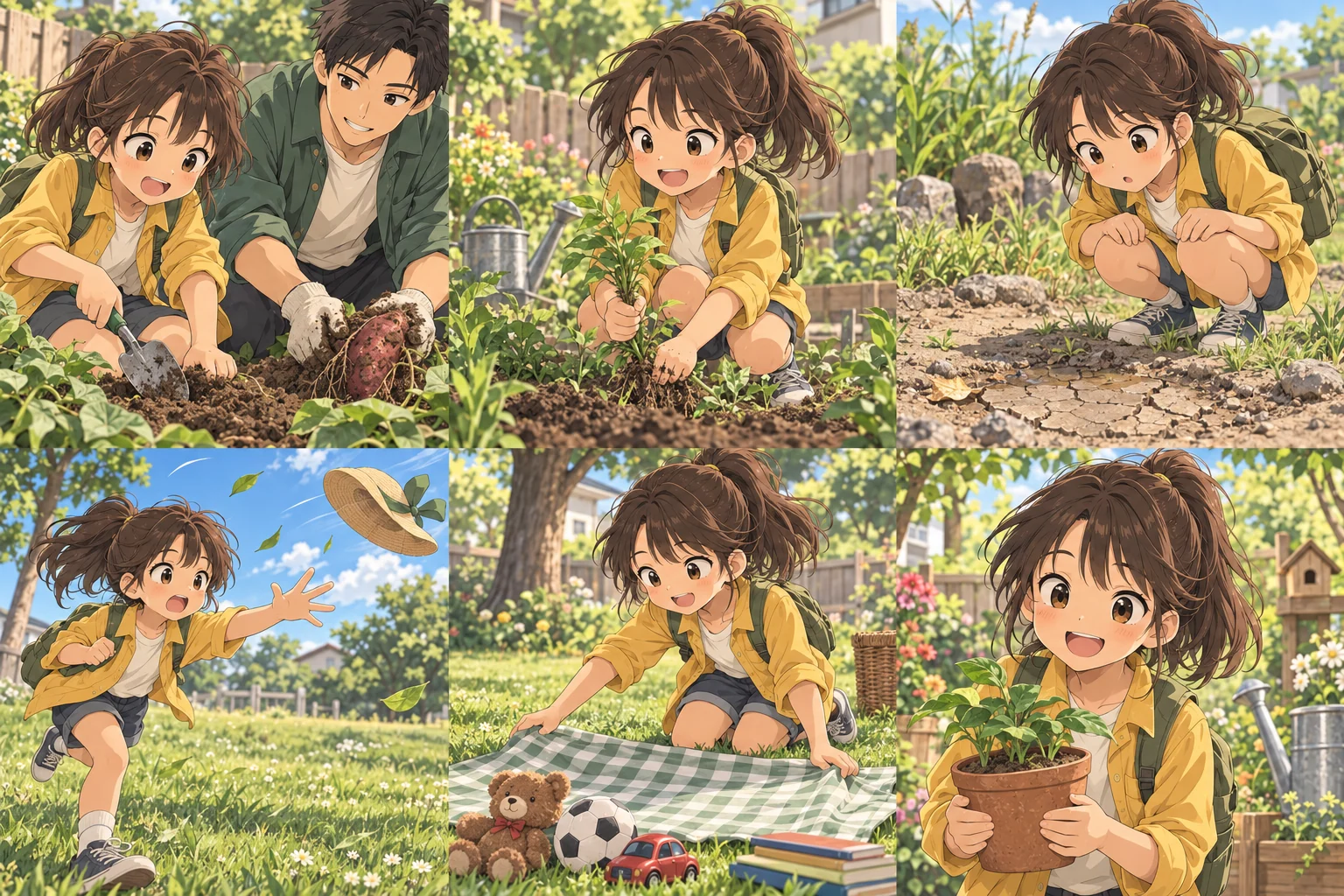
Hạ observed a small puddle of water that had dried after a sunny day.
dry up
The small puddle dried up in the sunshine.
Read the example again
The small puddle dried up in the sunshine.
The pond may dry up if there is no rain.
Read the example again
The pond may dry up if there is no rain.
View meaning & usage
Dry / run out of water
water / a pond dries up
Emphasize that the water is gone; don't have to wipe an object with a towel.
Haven't studied yet
Hạ's hat was blown away by the wind on the grass.
blow away
The wind blew my hat away.
Read the example again
The wind blew my hat away.
Hold the paper so it does not blow away.
Read the example again
Hold the paper so it does not blow away.
View meaning & usage
Blown away by the wind
something blows awaythe wind blows something away
The meaning here is that the wind makes things move. The past tense of “blow” is “blew”.
Haven't studied yet
Hạ spread a cloth on the grass to place her toys.
spread out
Spread out the cloth on the grass.
Read the example again
Spread out the cloth on the grass.
We spread the map out on the bench.
Read the example again
We spread the map out on the bench.
View meaning & usage
Spread out on a surface
spread out somethingspread something out
In the lesson, it means to open and spread out an object to make it wide or flat. The past is still “spread”.
Haven't studied yet
The examples were written for this course. Usage was checked against Matt Errey’s book, pages 36, 100, 38, 12, 120. A2–B1 is the course’s intended level.
Recall it · Use it
One step forward every day
Practice completed!
Your browser could not save your play history. Results from this session may be lost when you close the page.
Sentences using suggestions are counted as needing more practice. Review schedule based on each phrase's meaning.
Drag a wire from the dot beside a phrase to the dot beside its matching picture. You can also tap a phrase, then a picture. Drag again to change a pair before checking.
Read the picture descriptions for more context. Similar expressions are accepted when they fit the particular scene.
Phrases
Actions in the pictures
Picture description
Hạ and Minh used a small shovel to dig up the potato.
The picture could not load. Try loading it again before matching.
Picture description
Hạ pulled up a small plant in the garden.
The picture could not load. Try loading it again before matching.
Picture description
Hạ observed a small puddle of water that had dried after a sunny day.
The picture could not load. Try loading it again before matching.
Picture description
Hạ's hat was blown away by the wind on the grass.
The picture could not load. Try loading it again before matching.
Picture description
Hạ spread a cloth on the grass to place her toys.
The picture could not load. Try loading it again before matching.
Choose a phrase to begin.
Your browser could not save your play history. Results from this session may be lost when you close the page.
A conversation in context
Read the conversation and find the expressions you have learned.
Mai
We need to dig up these old roots.
Read the example again
We need to dig up these old roots.
Alex
I can pull up the small weeds first.
Read the example again
I can pull up the small weeds first.
Mai
Then spread out the plants so they have room to grow.
Read the example again
Then spread out the plants so they have room to grow.
Compare the uses
dig up / pull up
“Dig up” often involves removing something by digging; “pull up” stresses pulling a plant or object out. The method distinguishes the garden actions.
Practice and check your answers
Try answering before revealing the suggested answer. This practice is not scored.
The answers below are models. Other answers can also work if they preserve the facts, meaning and structure requested in the task.
A situation to apply what you have learned
A gardener finds buried stones and small weeds. A spade is needed for the stones, but the weeds pull out easily.
Describe removing the buried stones.
Show the answer and explanation
Dig up the stones with a spade.
The buried stones require a spade, so “dig up” fits rather than pulling weeds by hand.
Correct: Pull up them before planting the seeds.
Show the answer and explanation
Pull them up before planting the seeds.
“Them” replaces the weeds, so use “pull them up”; keep the instruction to do this before sowing.
Give a spacing instruction for the new plants.
Show the answer and explanation
Spread out the plants so each one has room.
“Spread out” places the plants apart so each has space, rather than clustering them together.
The usage comparisons are checked against the Cambridge Dictionary entries linked beside the compared expressions. The additional conversations and exercises are written for this course.
Progress is saved on the device. Sign in with Google to save with the same account and continue on another device.