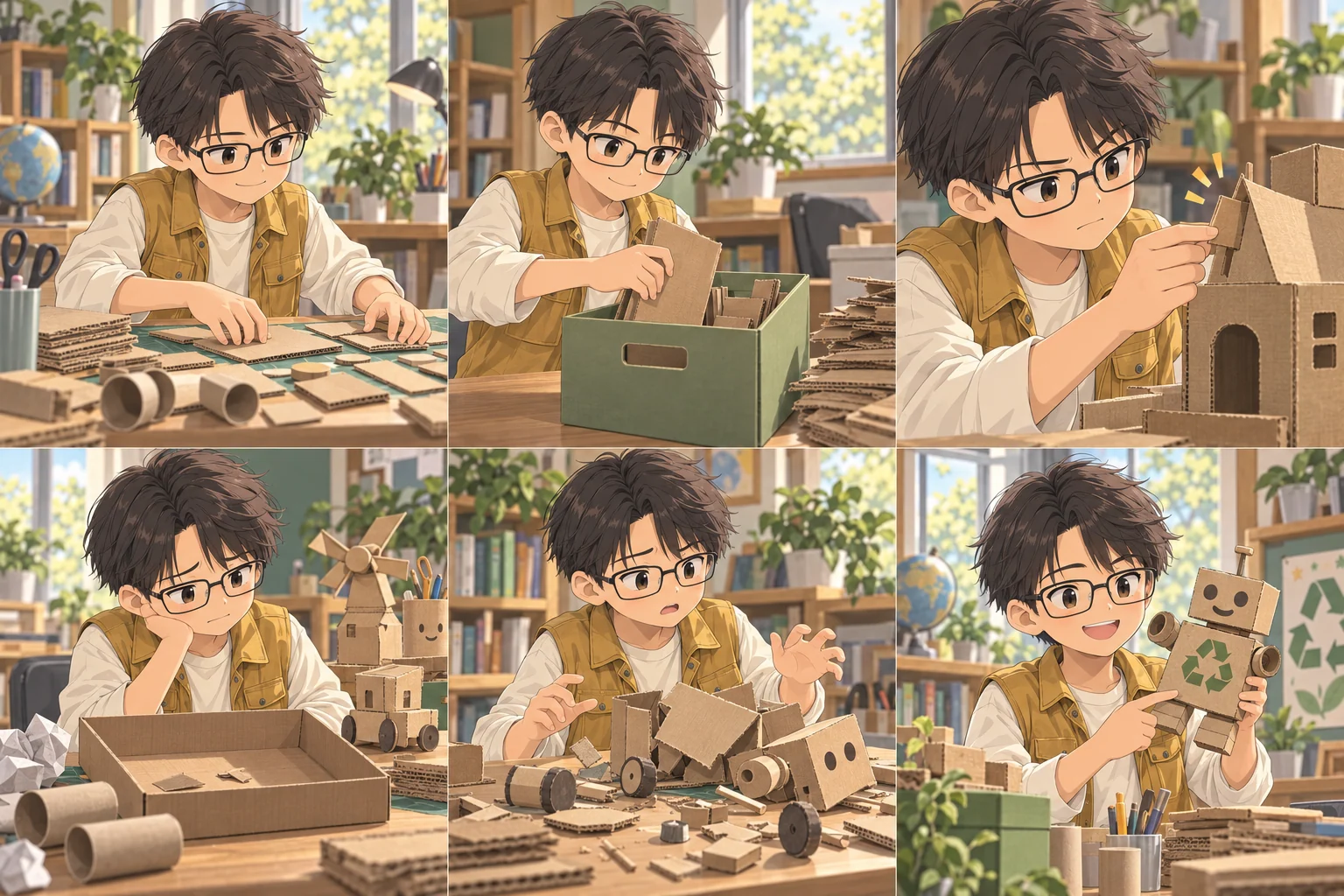
Duy looked at the piece of cardboard sticking out from the side of the paper model.
stick out
A little piece of cardboard sticks out from the side.
Read the example again
A little piece of cardboard sticks out from the side.
The tab was sticking out of the model.
Read the example again
The tab was sticking out of the model.
View meaning & usage
Protruding / protruding from the surface
stick outstick out of somethingstick out from something
The meaning in the lesson is the protruding position of an object; do not have to continue selecting in “stick with”. The past “stuck”.
Haven't studied yet
Duy looked at the empty craft paper tray after making many items.
give out
Our supply of craft paper gave out before we finished.
Read the example again
Our supply of craft paper gave out before we finished.
The glue may give out if we use too much.
Read the example again
The glue may give out if we use too much.
View meaning & usage
Supplies are running out / are no longer enough
a supply gives out
Supply is the subject and gradually runs out. Different from "give out papers" which means giving out papers to many people; past tense “gave”.
Haven't studied yet
Duy looked at the cover model broken into separate parts on the table.
fall apart
The model fell apart because the glue was weak.
Read the example again
The model fell apart because the glue was weak.
Be careful with the old box. It might fall apart.
Read the example again
Be careful with the old box. It might fall apart.
View meaning & usage
Burst / break into many parts
something falls apart
Close meaning "come apart", learned before; often suggests that the object is no longer stable or continuous. Past tense “fell”.
Haven't studied yet
The examples were written for this course. Usage was checked against Matt Errey’s book, pages 77, 100, 122, 54, 43. A2–B1 is the course’s intended level.
Recall it · Use it
One step forward every day
Practice completed!
Your browser could not save your play history. Results from this session may be lost when you close the page.
Sentences using suggestions are counted as needing more practice. Review schedule based on each phrase's meaning.
Drag a wire from the dot beside a phrase to the dot beside its matching picture. You can also tap a phrase, then a picture. Drag again to change a pair before checking.
Read the picture descriptions for more context. Similar expressions are accepted when they fit the particular scene.
Phrases
Actions in the pictures
Picture description
Duy displays pieces of old cardboard orderly on the table to make models.
The picture could not load. Try loading it again before matching.
Picture description
Duy kept some good cardboard in the box for next time.
The picture could not load. Try loading it again before matching.
Picture description
Duy looked at the piece of cardboard sticking out from the side of the paper model.
The picture could not load. Try loading it again before matching.
Picture description
Duy looked at the empty craft paper tray after making many items.
The picture could not load. Try loading it again before matching.
Picture description
Duy looked at the cover model broken into separate parts on the table.
The picture could not load. Try loading it again before matching.
Choose a phrase to begin.
Your browser could not save your play history. Results from this session may be lost when you close the page.
A conversation in context
Read the conversation and find the expressions you have learned.
Mai
Let us lay out the materials before we start.
Read the example again
Let us lay out the materials before we start.
Alex
I will put aside the pieces we need for the roof.
Read the example again
I will put aside the pieces we need for the roof.
Mai
Check that nothing sticks out where someone could catch a hand.
Read the example again
Check that nothing sticks out where someone could catch a hand.
Compare the uses
lay out / put aside
“Lay out” arranges parts so they can be seen; “put aside” reserves something for another purpose or time. Position and purpose distinguish the actions.
Practice and check your answers
Try answering before revealing the suggested answer. This practice is not scored.
The answers below are models. Other answers can also work if they preserve the facts, meaning and structure requested in the task.
A situation to apply what you have learned
A maker arranges recycled pieces across a bench and saves two hinges for a different model.
Describe arranging the pieces for inspection.
Show the answer and explanation
She lays out the pieces on the bench.
Arranging the pieces across the bench for inspection is “lays out”; “lays” agrees with “she”.
Replace “the hinges” with “them”: Put the hinges aside.
Show the answer and explanation
Put them aside.
“Them” replaces the two hinges being reserved, so use “put them aside”, not “put aside them”.
Explain why the saved pieces should not be discarded.
Show the answer and explanation
Put those hinges aside because we will need them for another model.
“Because we will need them” explains reserving the hinges for another model instead of discarding them.
The usage comparisons are checked against the Cambridge Dictionary entries linked beside the compared expressions. The additional conversations and exercises are written for this course.
Progress is saved on the device. Sign in with Google to save with the same account and continue on another device.