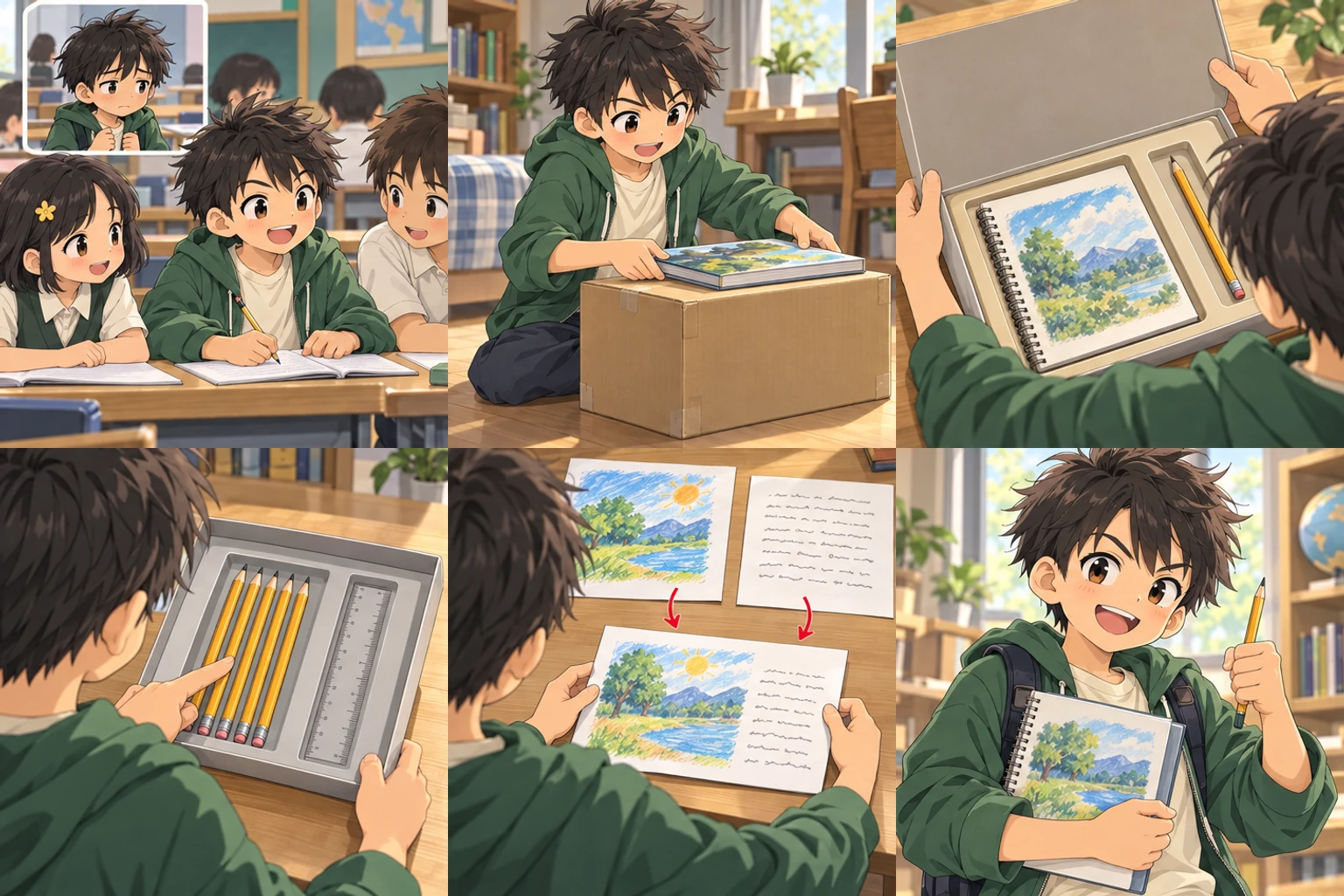
Bảo combines a drawing with a short story to make an illustrated story page.
combine with
We can combine our drawings with short stories.
Read the example again
We can combine our drawings with short stories.
She combined music with movement in her activity.
Read the example again
She combined music with movement in her activity.
View meaning & usage
Join one thing with another
combine something with something
Put the first item between “combine” and “with”, followed by the second item. The two parts are used together.
Haven't studied yet
The examples were written for this course. Usage was checked against Matt Errey’s book, pages 115, 6, 27, 27, 23. A2–B1 is the course’s intended level.
Recall it · Use it
One step forward every day
Practice completed!
Your browser could not save your play history. Results from this session may be lost when you close the page.
Sentences using suggestions are counted as needing more practice. Review schedule based on each phrase's meaning.
Drag a wire from the dot beside a phrase to the dot beside its matching picture. You can also tap a phrase, then a picture. Drag again to change a pair before checking.
Read the picture descriptions for more context. Similar expressions are accepted when they fit the particular scene.
Phrases
Actions in the pictures
Picture description
Bảo now works comfortably with two friends in his new class; a small earlier inset shows him looking shy.
The picture could not load. Try loading it again before matching.
Picture description
Bảo places a light book on an upside-down sturdy box that serves as a small table.
The picture could not load. Try loading it again before matching.
Picture description
Bảo opens a sketchbook set with a pencil supplied in the same packaging tray.
The picture could not load. Try loading it again before matching.
Picture description
Bảo points to a kit consisting only of pencils and a ruler, laid out as two clear groups.
The picture could not load. Try loading it again before matching.
Picture description
Bảo combines a drawing with a short story to make an illustrated story page.
The picture could not load. Try loading it again before matching.
Choose a phrase to begin.
Your browser could not save your play history. Results from this session may be lost when you close the page.
A conversation in context
Read the conversation and find the expressions you have learned.
Mai
Does this kit come with a storage bag?
Read the example again
Does this kit come with a storage bag?
Alex
Yes. The kit itself consists of five tools.
Read the example again
Yes. The kit itself consists of five tools.
Mai
Two of them can combine with the stand to make a small holder.
Read the example again
Two of them can combine with the stand to make a small holder.
Compare the uses
come with / consist of
“Come with” describes what is supplied alongside something; “consist of” describes its components. An included accessory need not be part of the main item itself.
Practice and check your answers
Try answering before revealing the suggested answer. This practice is not scored.
The answers below are models. Other answers can also work if they preserve the facts, meaning and structure requested in the task.
A situation to apply what you have learned
A drawing set contains four pencils. A separate case is supplied with it, but the case is not one of the pencils.
State what the drawing set consists of.
Show the answer and explanation
The set consists of four pencils.
The four pencils are the set’s components, so use “consists of”; the separate case is additional.
Complete: The set comes ___ a separate case.
Show the answer and explanation
with
“Comes with a separate case” identifies an included accessory; “with” does not make it one of the pencils.
Explain the difference to a customer.
Show the answer and explanation
The set consists of four pencils and comes with a case.
The clauses distinguish the pencils from the accompanying case, avoiding counting it as a fifth pencil.
The usage comparisons are checked against the Cambridge Dictionary entries linked beside the compared expressions. The additional conversations and exercises are written for this course.
Progress is saved on the device. Sign in with Google to save with the same account and continue on another device.