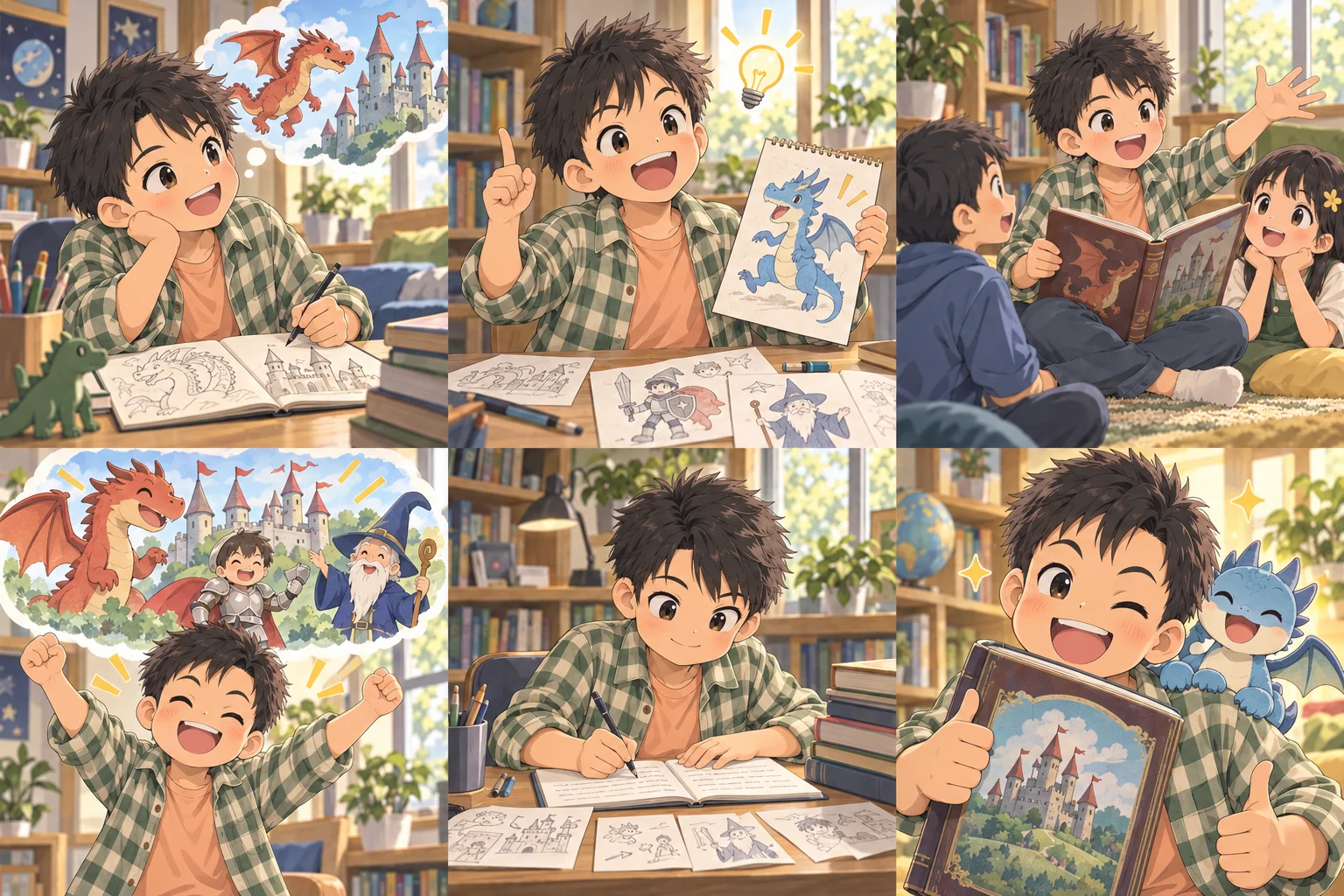
Phúc continued telling the story while his friends were listening.
go on
Please go on. We want to hear what happened next.
Read the example again
Please go on. We want to hear what happened next.
He went on telling the story after a short pause.
Read the example again
He went on telling the story after a short pause.
View meaning & usage
Continue talking/telling
go ongo on doing something
Used when continuing an unfinished task or story; With actions, the -ing form is often used.
Haven't studied yet
Phúc ends the story with pictures of happy characters.
end with
Our story ends with a happy surprise.
Read the example again
Our story ends with a happy surprise.
We ended the show with a song.
Read the example again
We ended the show with a song.
View meaning & usage
End with one thing
end with somethingend something with something
After “with” is what appears at the end.
Haven't studied yet
Phúc writes a complete story from picture notes.
write up
After planning, we will write up our story.
Read the example again
After planning, we will write up our story.
I wrote my notes up into a short report.
Read the example again
I wrote my notes up into a short report.
View meaning & usage
Write a full version
write up somethingwrite something up
You develop notes or information into a complete piece of writing; different from quick writing in "write down".
Haven't studied yet
The examples were written for this course. Usage was checked against Matt Errey’s book, pages 86, 131, 56, 40, 140. A2–B1 is the course’s intended level.
Recall it · Use it
One step forward every day
Practice completed!
Your browser could not save your play history. Results from this session may be lost when you close the page.
Sentences using suggestions are counted as needing more practice. Review schedule based on each phrase's meaning.
Drag a wire from the dot beside a phrase to the dot beside its matching picture. You can also tap a phrase, then a picture. Drag again to change a pair before checking.
Read the picture descriptions for more context. Similar expressions are accepted when they fit the particular scene.
Phrases
Actions in the pictures
Picture description
Phúc came up with a story with dragons and castles.
The picture could not load. Try loading it again before matching.
Picture description
Phúc came up with an idea for a new character for the story.
The picture could not load. Try loading it again before matching.
Picture description
Phúc continued telling the story while his friends were listening.
The picture could not load. Try loading it again before matching.
Picture description
Phúc ends the story with pictures of happy characters.
The picture could not load. Try loading it again before matching.
Picture description
Phúc writes a complete story from picture notes.
The picture could not load. Try loading it again before matching.
Choose a phrase to begin.
Your browser could not save your play history. Results from this session may be lost when you close the page.
A conversation in context
Read the conversation and find the expressions you have learned.
Mai
Let us make up a story about a lost kite.
Read the example again
Let us make up a story about a lost kite.
Alex
I can think up a surprising ending.
Read the example again
I can think up a surprising ending.
Mai
Great. Write it up when we have agreed on the main events.
Read the example again
Great. Write it up when we have agreed on the main events.
Compare the uses
make up / think up
“Make up” and “think up” can both concern invention. Here “make up” concerns a story, while “think up” stresses devising an idea. Their uses can overlap.
Practice and check your answers
Try answering before revealing the suggested answer. This practice is not scored.
The answers below are models. Other answers can also work if they preserve the facts, meaning and structure requested in the task.
A situation to apply what you have learned
A writing group invents a mystery and then looks for a surprising explanation of the missing key.
Describe inventing the story.
Show the answer and explanation
They are making up a mystery story.
The group invents the mystery, so “making up” describes fiction rather than reporting a real event.
Replace “a new ending” with “it”: Think up a new ending.
Show the answer and explanation
Think it up.
“It” replaces the new ending being invented, so use “think it up” with the pronoun in the middle.
Write a request for a complete written version.
Show the answer and explanation
Please write up the story once we agree on the ending.
“Write up” requests a complete written version after agreeing on the ending, beyond simply inventing ideas.
The usage comparisons are checked against the Cambridge Dictionary entries linked beside the compared expressions. The additional conversations and exercises are written for this course.
Progress is saved on the device. Sign in with Google to save with the same account and continue on another device.