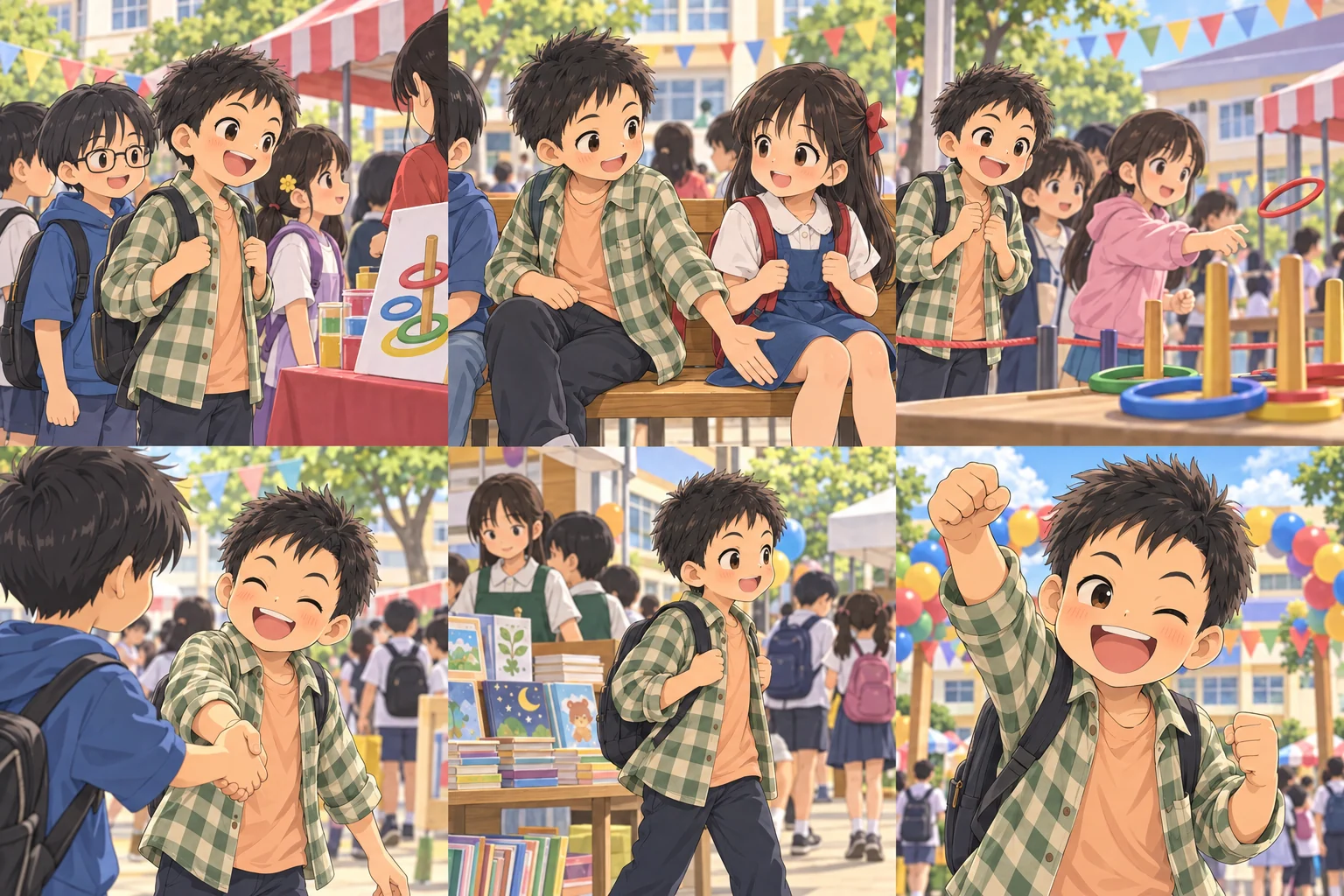
Phúc stood watching his friends play ring toss, but did not participate in this round.
look on
I looked on while my friends played the first round.
Read the example again
I looked on while my friends played the first round.
Some parents looked on as the children played.
Read the example again
Some parents looked on as the children played.
View meaning & usage
Watching without participating
look onlook on while / as something happens
Observe an activity without participating directly; different from looking at an object in “look at”.
Haven't studied yet
Phúc reached out to shake hands with a friend.
reach out
I reached out to shake my friend’s hand.
Read the example again
I reached out to shake my friend’s hand.
She reached out for the card on the table.
Read the example again
She reached out for the card on the table.
View meaning & usage
Extend/stretch out your hand
reach outreach out for somethingreach out to do something
In the lesson, it is the movement of the hand. The phrase also means contact or help in other contexts.
Haven't studied yet
Phúc walked past the bookstore to another activity.
pass by
We passed by the book stall on our way to the game.
Read the example again
We passed by the book stall on our way to the game.
I pass by the school gate every morning.
Read the example again
I pass by the school gate every morning.
View meaning & usage
Passing by a place
pass bypass by a place / someone
You pass near a place or person; not sure to drop in as in “drop by”.
Haven't studied yet
The examples were written for this course. Usage was checked against Matt Errey’s book, pages 103, 88, 82, 106, 94. A2–B1 is the course’s intended level.
Recall it · Use it
One step forward every day
Practice completed!
Your browser could not save your play history. Results from this session may be lost when you close the page.
Sentences using suggestions are counted as needing more practice. Review schedule based on each phrase's meaning.
Drag a wire from the dot beside a phrase to the dot beside its matching picture. You can also tap a phrase, then a picture. Drag again to change a pair before checking.
Read the picture descriptions for more context. Similar expressions are accepted when they fit the particular scene.
Phrases
Actions in the pictures
Picture description
Phúc lined up with his friends at an activity booth at school.
The picture could not load. Try loading it again before matching.
Picture description
Phúc moves aside on the chair so you can sit.
The picture could not load. Try loading it again before matching.
Picture description
Phúc stood watching his friends play ring toss, but did not participate in this round.
The picture could not load. Try loading it again before matching.
Picture description
Phúc reached out to shake hands with a friend.
The picture could not load. Try loading it again before matching.
Picture description
Phúc walked past the bookstore to another activity.
The picture could not load. Try loading it again before matching.
Choose a phrase to begin.
Your browser could not save your play history. Results from this session may be lost when you close the page.
A conversation in context
Read the conversation and find the expressions you have learned.
Mai
Please queue up for the next game.
Read the example again
Please queue up for the next game.
Alex
Could you move over a little so I can see the sign?
Read the example again
Could you move over a little so I can see the sign?
Mai
Of course. You can look on until your turn comes.
Read the example again
Of course. You can look on until your turn comes.
Compare the uses
queue up / move over
“Queue up” means wait in a line; “move over” means shift sideways to make room. Moving sideways does not itself give away a place in a queue.
Practice and check your answers
Try answering before revealing the suggested answer. This practice is not scored.
The answers below are models. Other answers can also work if they preserve the facts, meaning and structure requested in the task.
A situation to apply what you have learned
Visitors wait in a line for a planetarium. One seated visitor needs to shift sideways for a friend.
Describe what the waiting visitors do.
Show the answer and explanation
They queue up outside the planetarium.
The visitors form a line outside the planetarium: “queue up”; this differs from the seated visitor’s task.
Complete: Could you move ___ so I can sit beside you?
Show the answer and explanation
over
“Move over” asks for a sideways shift to make seating space, rather than leaving the visit.
Tell a younger visitor how to watch before joining.
Show the answer and explanation
You can look on until your turn comes.
“Look on until your turn comes” allows watching others before taking part.
The usage comparisons are checked against the Cambridge Dictionary entries linked beside the compared expressions. The additional conversations and exercises are written for this course.
Progress is saved on the device. Sign in with Google to save with the same account and continue on another device.