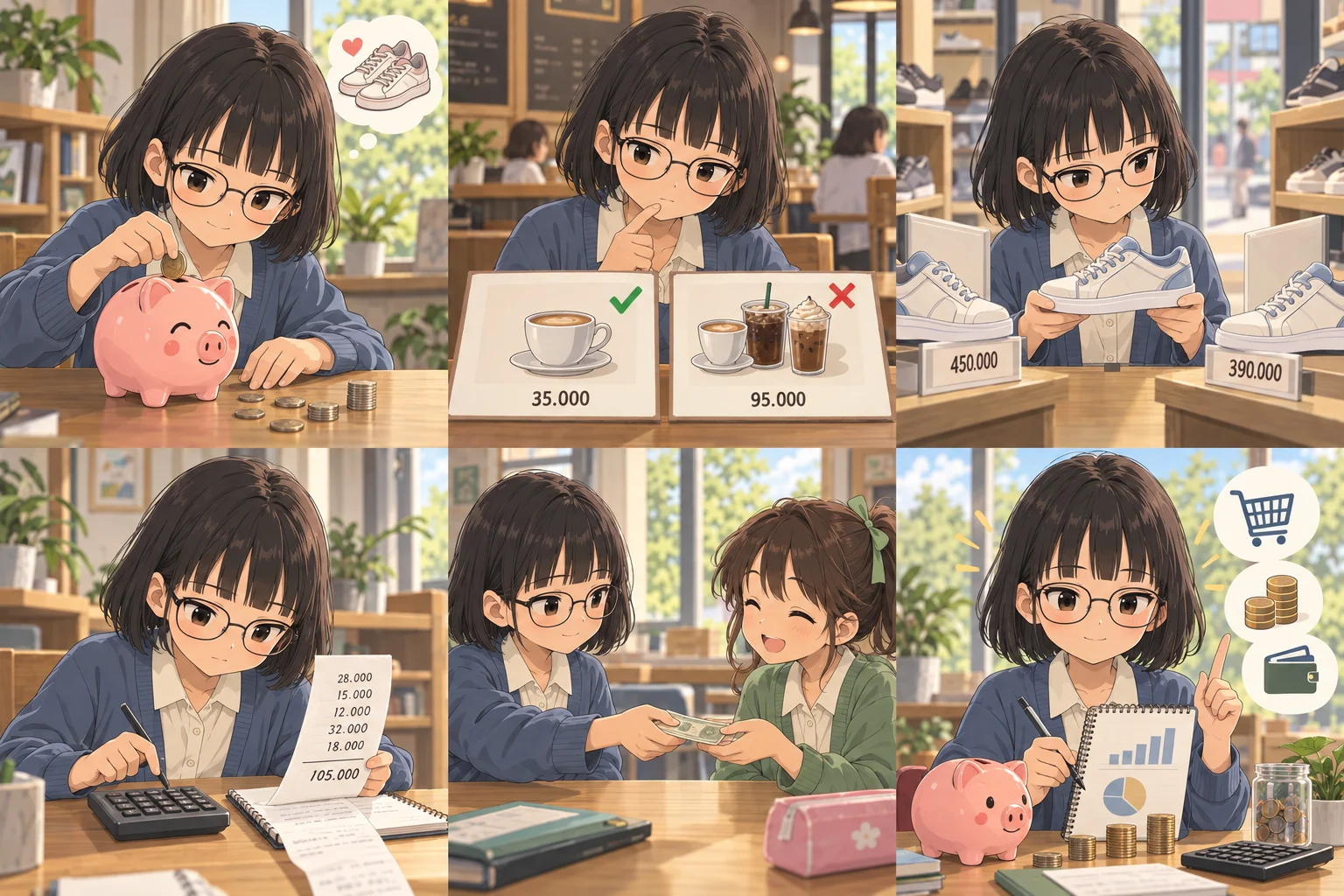
Linh looked at the same type of shoes in two stores before choosing to buy.
shop around
Shop around before you buy a new phone.
Read the example again
Shop around before you buy a new phone.
I shopped around and found a cheaper ticket.
Read the example again
I shopped around and found a cheaper ticket.
View meaning & usage
Compare prices in many places
shop aroundshop around for something
It's not just shopping; The purpose is usually to compare prices or conditions.
Haven't studied yet
Linh added up the items on the bill using a calculator to find the total amount.
add up to
These three bills add up to fifty dollars.
Read the example again
These three bills add up to fifty dollars.
Our weekly expenses add up to more than we expected.
Read the example again
Our weekly expenses add up to more than we expected.
View meaning & usage
Add together to make a total
amounts add up to a total
After "to" is the total number. Different from “it does not add up” which means it is not reasonable.
Haven't studied yet
Linh returned the money she borrowed to her friend.
give back
Please give back the money you borrowed.
Read the example again
Please give back the money you borrowed.
I will give your wallet back when we meet.
Read the example again
I will give your wallet back when we meet.
View meaning & usage
Return what was received/borrowed
give back somethinggive something backgive it back to someone
Can be used with money or objects. Pronoun in the middle: “give it back”.
Haven't studied yet
The examples were written for this course. Usage was checked against Matt Errey’s book, pages 112, 31, 116, 6, 53. A2–B1 is the course’s intended level.
Recall it · Use it
One step forward every day
Practice completed!
Your browser could not save your play history. Results from this session may be lost when you close the page.
Sentences using suggestions are counted as needing more practice. Review schedule based on each phrase's meaning.
Drag a wire from the dot beside a phrase to the dot beside its matching picture. You can also tap a phrase, then a picture. Drag again to change a pair before checking.
Read the picture descriptions for more context. Similar expressions are accepted when they fit the particular scene.
Phrases
Actions in the pictures
Picture description
Linh put a few more coins in her piggy bank to save for an item.
The picture could not load. Try loading it again before matching.
Picture description
Linh chose to buy just one cup of coffee instead of multiple cups to reduce costs.
The picture could not load. Try loading it again before matching.
Picture description
Linh looked at the same type of shoes in two stores before choosing to buy.
The picture could not load. Try loading it again before matching.
Picture description
Linh added up the items on the bill using a calculator to find the total amount.
The picture could not load. Try loading it again before matching.
Picture description
Linh returned the money she borrowed to her friend.
The picture could not load. Try loading it again before matching.
Choose a phrase to begin.
Your browser could not save your play history. Results from this session may be lost when you close the page.
A conversation in context
Read the conversation and find the expressions you have learned.
Mai
I am saving up for a bicycle.
Read the example again
I am saving up for a bicycle.
Alex
You could cut back on takeaway lunches and shop around for a good price.
Read the example again
You could cut back on takeaway lunches and shop around for a good price.
Mai
Good idea. Small costs add up to quite a lot each month.
Read the example again
Good idea. Small costs add up to quite a lot each month.
Compare the uses
save up / cut back on
“Save up” concerns accumulating money for a goal; “cut back on” concerns reducing spending or use. Reducing spending may help you save, but the expressions describe different actions.
Practice and check your answers
Try answering before revealing the suggested answer. This practice is not scored.
The answers below are models. Other answers can also work if they preserve the facts, meaning and structure requested in the task.
A situation to apply what you have learned
A student keeps coins for a telescope and reduces bus trips by walking. Three prices need comparing before purchase.
Which expression describes collecting the money gradually?
Show the answer and explanation
She is saving up for a telescope.
Putting coins aside gradually for a telescope is “saving up for”; “for” introduces the purchase goal.
Complete: She cuts back ___ bus travel.
Show the answer and explanation
on
“Cut back on bus travel” means reduce bus journeys; keep “on” before the activity being reduced.
Advise her to compare prices first.
Show the answer and explanation
Shop around before spending the money you have saved up.
“Shop around” means compare sellers before spending the savings, rather than accept the first price.
The usage comparisons are checked against the Cambridge Dictionary entries linked beside the compared expressions. The additional conversations and exercises are written for this course.
Progress is saved on the device. Sign in with Google to save with the same account and continue on another device.