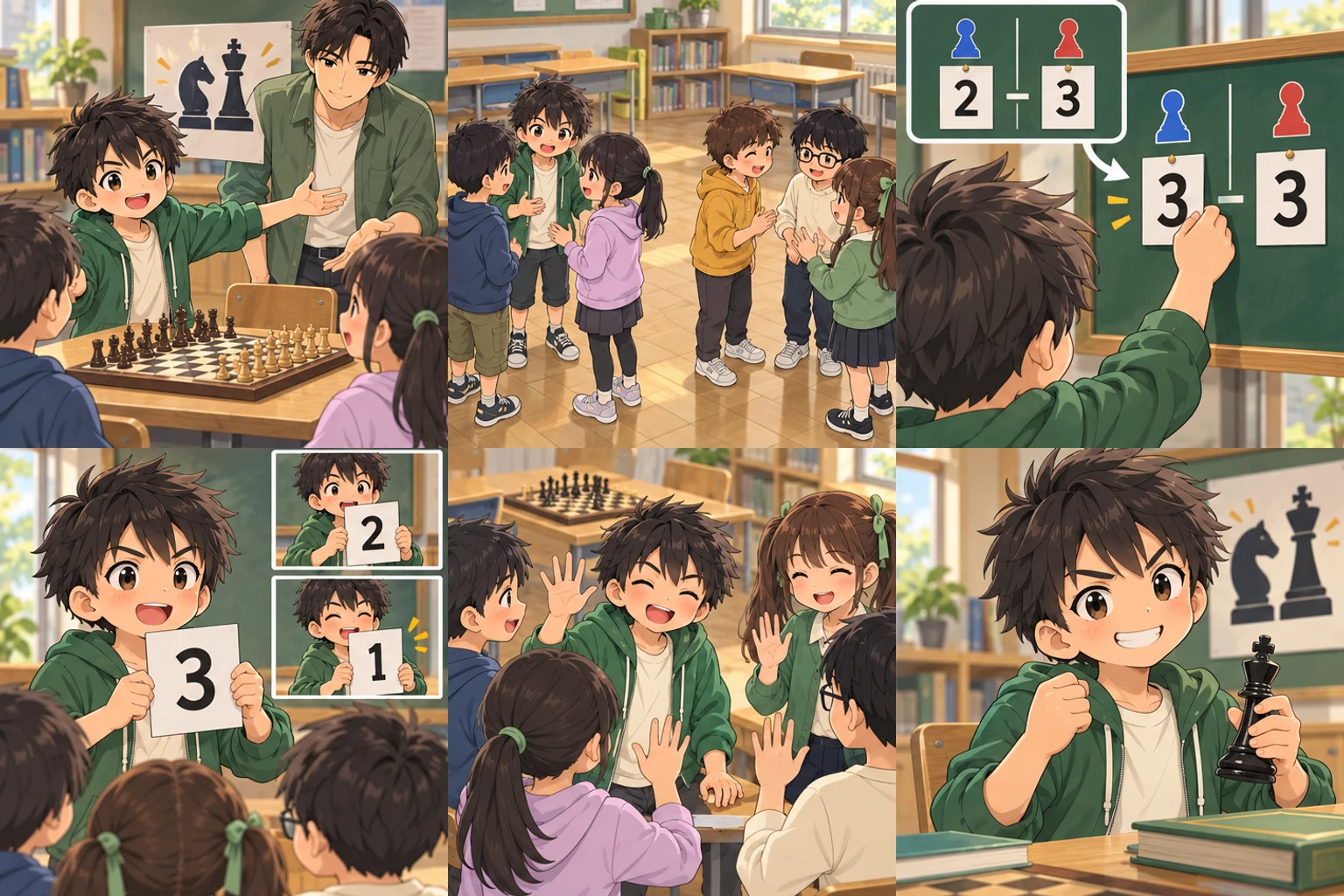
Bảo holds number cards before the group; three small sequential insets show 3, 2, 1 before the game begins.
count down
We counted down from five before starting the game.
Read the example again
We counted down from five before starting the game.
Everyone counted the last ten seconds down.
Read the example again
Everyone counted the last ten seconds down.
View meaning & usage
Count backwards towards a starting point
count downcount down from a numbercount something down
The numbers decrease towards a starting point, rather than increasing.
Haven't studied yet
Bảo and his classmates begin the club session with a greeting circle before moving to the chess table.
begin with
Our club meetings begin with a quick welcome.
Read the example again
Our club meetings begin with a quick welcome.
Let us begin with an easy question.
Read the example again
Let us begin with an easy question.
View meaning & usage
Have something as the first part
begin with somethingbegin something with something
The first part of the activity follows “with”. The past form of “begin” is “began”.
Haven't studied yet
The examples were written for this course. Usage was checked against Matt Errey’s book, pages 121, 120, 41, 29, 11. A2–B1 is the course’s intended level.
Recall it · Use it
One step forward every day
Practice completed!
Your browser could not save your play history. Results from this session may be lost when you close the page.
Sentences using suggestions are counted as needing more practice. Review schedule based on each phrase's meaning.
Drag a wire from the dot beside a phrase to the dot beside its matching picture. You can also tap a phrase, then a picture. Drag again to change a pair before checking.
Read the picture descriptions for more context. Similar expressions are accepted when they fit the particular scene.
Phrases
Actions in the pictures
Picture description
Bảo and his teacher establish a chess club, setting out a chessboard and welcoming students to its first session.
The picture could not load. Try loading it again before matching.
Picture description
Bảo and five classmates divide into two separate groups of three.
The picture could not load. Try loading it again before matching.
Picture description
Bảo adds a score card so the two teams’ scores change from 2–3 to 3–3.
The picture could not load. Try loading it again before matching.
Picture description
Bảo holds number cards before the group; three small sequential insets show 3, 2, 1 before the game begins.
The picture could not load. Try loading it again before matching.
Picture description
Bảo and his classmates begin the club session with a greeting circle before moving to the chess table.
The picture could not load. Try loading it again before matching.
Choose a phrase to begin.
Your browser could not save your play history. Results from this session may be lost when you close the page.
A conversation in context
Read the conversation and find the expressions you have learned.
Mai
Let us split up into two teams.
Read the example again
Let us split up into two teams.
Alex
One team has more people. We need to even them up.
Read the example again
One team has more people. We need to even them up.
Mai
Then we can count down and begin with the first challenge.
Read the example again
Then we can count down and begin with the first challenge.
Compare the uses
split up / even up
“Split up” can divide a group into smaller groups; “even up” makes numbers more balanced. Dividing the group does not guarantee equal teams.
Practice and check your answers
Try answering before revealing the suggested answer. This practice is not scored.
The answers below are models. Other answers can also work if they preserve the facts, meaning and structure requested in the task.
A situation to apply what you have learned
A workshop divides into two groups, but one has four more participants. The leader wants equal team sizes.
Describe the division.
Show the answer and explanation
The workshop splits up into two groups.
The workshop “splits up into two groups”; division alone does not ensure equal team sizes.
Replace “the teams” with “them”: Even the teams up.
Show the answer and explanation
Even them up.
“Them” replaces the teams needing equal numbers, so use “even them up”, not “even up them”.
Give the next instruction before starting.
Show the answer and explanation
Even up the teams before we count down to the first task.
Balance the teams before the countdown; moving two people from the team with four extra members makes the sizes equal.
The usage comparisons are checked against the Cambridge Dictionary entries linked beside the compared expressions. The additional conversations and exercises are written for this course.
Progress is saved on the device. Sign in with Google to save with the same account and continue on another device.