The examples were written for this course. Usage was checked against Matt Errey’s book, pages 13, 45, 35, 19, 134. A2–B1 is the course’s intended level.
Recall it · Use it
One step forward every day
Practice completed!
Your browser could not save your play history. Results from this session may be lost when you close the page.
Sentences using suggestions are counted as needing more practice. Review schedule based on each phrase's meaning.
Drag a wire from the dot beside a phrase to the dot beside its matching picture. You can also tap a phrase, then a picture. Drag again to change a pair before checking.
Read the picture descriptions for more context. Similar expressions are accepted when they fit the particular scene.
Phrases
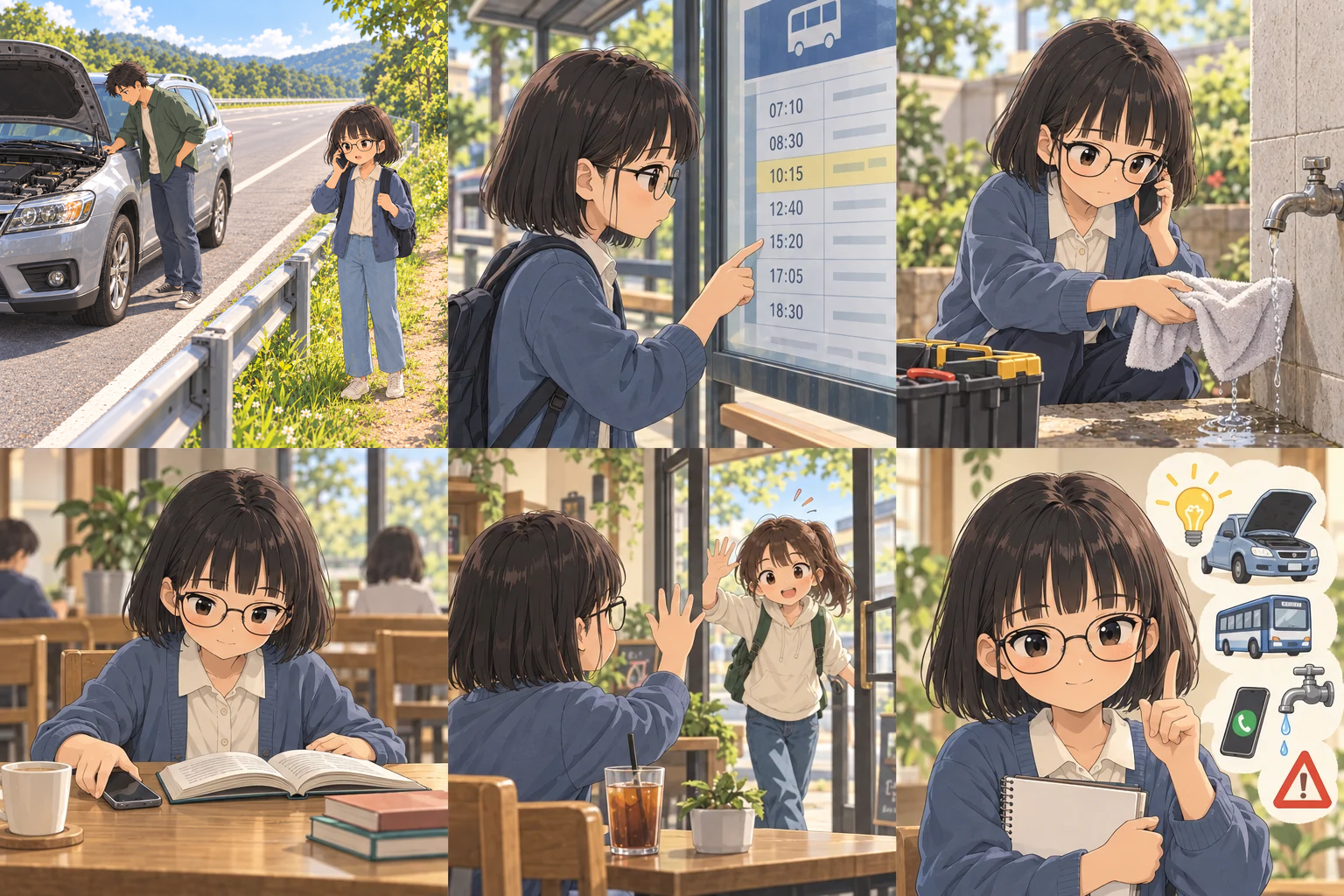
Actions in the pictures
Picture description
The car has stopped on a wide shoulder with its hood open; Minh checks the car while Linh calls for help from the outer side of the guardrail.
The picture could not load. Try loading it again before matching.
Picture description
Linh read the information board at the station and found the bus's departure time.
The picture could not load. Try loading it again before matching.
Picture description
Linh used a towel to catch water from the leaking faucet and called a repairman.
The picture could not load. Try loading it again before matching.
Picture description
After a call, Linh put down the phone and continued reading.
The picture could not load. Try loading it again before matching.
Picture description
A friend arrived late at the cafe; Linh at the desk waved.
The picture could not load. Try loading it again before matching.
Choose a phrase to begin.
Your browser could not save your play history. Results from this session may be lost when you close the page.
A conversation in context
Read the conversation and find the expressions you have learned.
Mai
Our car has broken down outside the village.
Read the example again
Our car has broken down outside the village.
Alex
I will find out whether the garage is open.
Read the example again
I will find out whether the garage is open.
Mai
Thanks. We can deal with the bookings while we wait for the mechanic to turn up.
Read the example again
Thanks. We can deal with the bookings while we wait for the mechanic to turn up.
Compare the uses
break down / turn up
Here “break down” describes a machine stopping, while “turn up” describes a person arriving. Neither sense needs a direct object immediately after the expression.
Practice and check your answers
Try answering before revealing the suggested answer. This practice is not scored.
The answers below are models. Other answers can also work if they preserve the facts, meaning and structure requested in the task.
A situation to apply what you have learned
A freezer stops working before a school sale. Volunteers continue arranging tables while a repairer is on the way.
Describe the machine problem.
Show the answer and explanation
The freezer has broken down.
The freezer has stopped working, so it “has broken down”; this describes machine failure rather than someone arriving.
Give the past form: The repairer turns up at noon.
Show the answer and explanation
The repairer turned up at noon.
“Turn” takes regular “-ed” to become “turned”; keep “up” and the noon arrival time.
Write a practical message using carry on.
Show the answer and explanation
Carry on arranging the tables while we wait for the repairer.
The volunteers can continue arranging tables while waiting; “carry on arranging” uses the “-ing” form.
The usage comparisons are checked against the Cambridge Dictionary entries linked beside the compared expressions. The additional conversations and exercises are written for this course.
Progress is saved on the device. Sign in with Google to save with the same account and continue on another device.