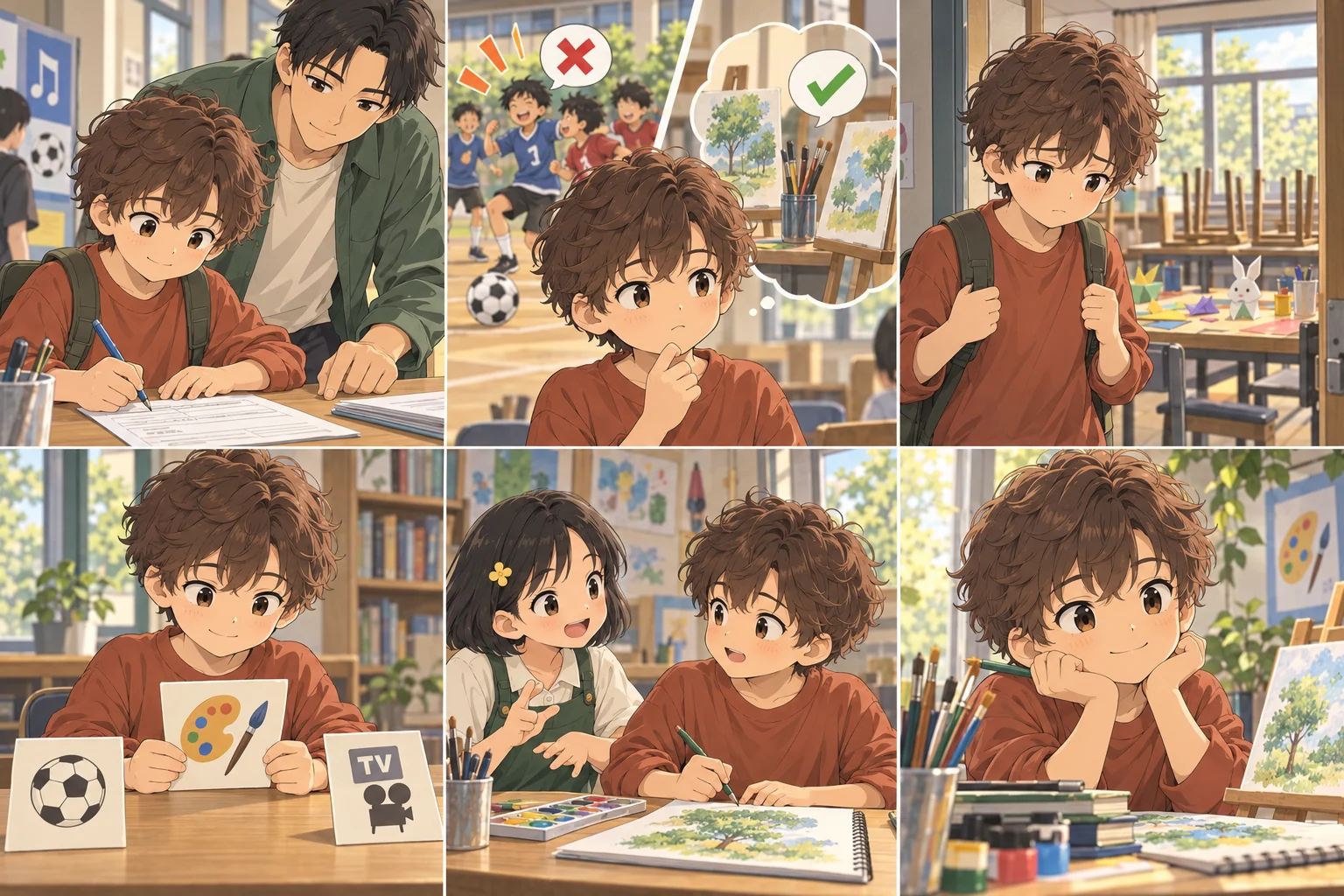
Khoa finally chose the art club after comparing three picture cards.
settle on
After trying three clubs, I settled on the art club.
Read the example again
After trying three clubs, I settled on the art club.
We have settled on a name for our club.
Read the example again
We have settled on a name for our club.
View meaning & usage
Finally choose after consideration
settle on someone / something
Emphasize coming to the final choice after consideration; Close to the meaning of “decide on”, not the emotional stability in “settle down”.
Haven't studied yet
Khoa was explained by his friend and agreed to try the art club.
talk into
My friend talked me into trying the art club.
Read the example again
My friend talked me into trying the art club.
I talked my brother into joining our drawing game.
Read the example again
I talked my brother into joining our drawing game.
View meaning & usage
Convince someone to agree to do something
talk someone into somethingtalk someone into doing something
The person being persuaded stands between “talk” and “into”. After “into” use a noun or -ing form.
Haven't studied yet
The examples were written for this course. Usage was checked against Matt Errey’s book, pages 45, 92, 87, 115, 130. A2–B1 is the course’s intended level.
Recall it · Use it
One step forward every day
Practice completed!
Your browser could not save your play history. Results from this session may be lost when you close the page.
Sentences using suggestions are counted as needing more practice. Review schedule based on each phrase's meaning.
Drag a wire from the dot beside a phrase to the dot beside its matching picture. You can also tap a phrase, then a picture. Drag again to change a pair before checking.
Read the picture descriptions for more context. Similar expressions are accepted when they fit the particular scene.
Phrases
Actions in the pictures
Picture description
Khoa filling out club registration form, with Minh next to him.
The picture could not load. Try loading it again before matching.
Picture description
Khoa actively chooses not to play noisy games and chooses to be quieter.
The picture could not load. Try loading it again before matching.
Picture description
Khoa arrives after the craft session has ended and feels disappointed about missing the opportunity.
The picture could not load. Try loading it again before matching.
Picture description
Khoa finally chose the art club after comparing three picture cards.
The picture could not load. Try loading it again before matching.
Picture description
Khoa was explained by his friend and agreed to try the art club.
The picture could not load. Try loading it again before matching.
Choose a phrase to begin.
Your browser could not save your play history. Results from this session may be lost when you close the page.
A conversation in context
Read the conversation and find the expressions you have learned.
Mai
Can I opt out of the overnight trip?
Read the example again
Can I opt out of the overnight trip?
Alex
Yes. You will not miss out on the daytime activities.
Read the example again
Yes. You will not miss out on the daytime activities.
Mai
Thanks. I have settled on the art club instead.
Read the example again
Thanks. I have settled on the art club instead.
Compare the uses
opt out / miss out
“Opt out” means choose not to participate; “miss out” means lose an enjoyable or useful opportunity. Not participating may be a choice rather than a lack of opportunity.
Practice and check your answers
Try answering before revealing the suggested answer. This practice is not scored.
The answers below are models. Other answers can also work if they preserve the facts, meaning and structure requested in the task.
A situation to apply what you have learned
A club offers optional camping and a daytime workshop. A member refuses camping but wants the workshop place.
Describe the camping decision.
Show the answer and explanation
She opts out of the camping trip.
Camping is optional, so “opts out of” expresses a decision not to participate.
Complete: I do not want to miss ___ on the workshop.
Show the answer and explanation
out
“Miss out on the workshop” means lose the chance to attend; keep “out on” before the activity.
Write a clear preference using settle on.
Show the answer and explanation
I have settled on the daytime workshop instead of camping.
“Settled on” confirms the daytime workshop instead of camping, rather than declining all club activities.
The usage comparisons are checked against the Cambridge Dictionary entries linked beside the compared expressions. The additional conversations and exercises are written for this course.
Progress is saved on the device. Sign in with Google to save with the same account and continue on another device.