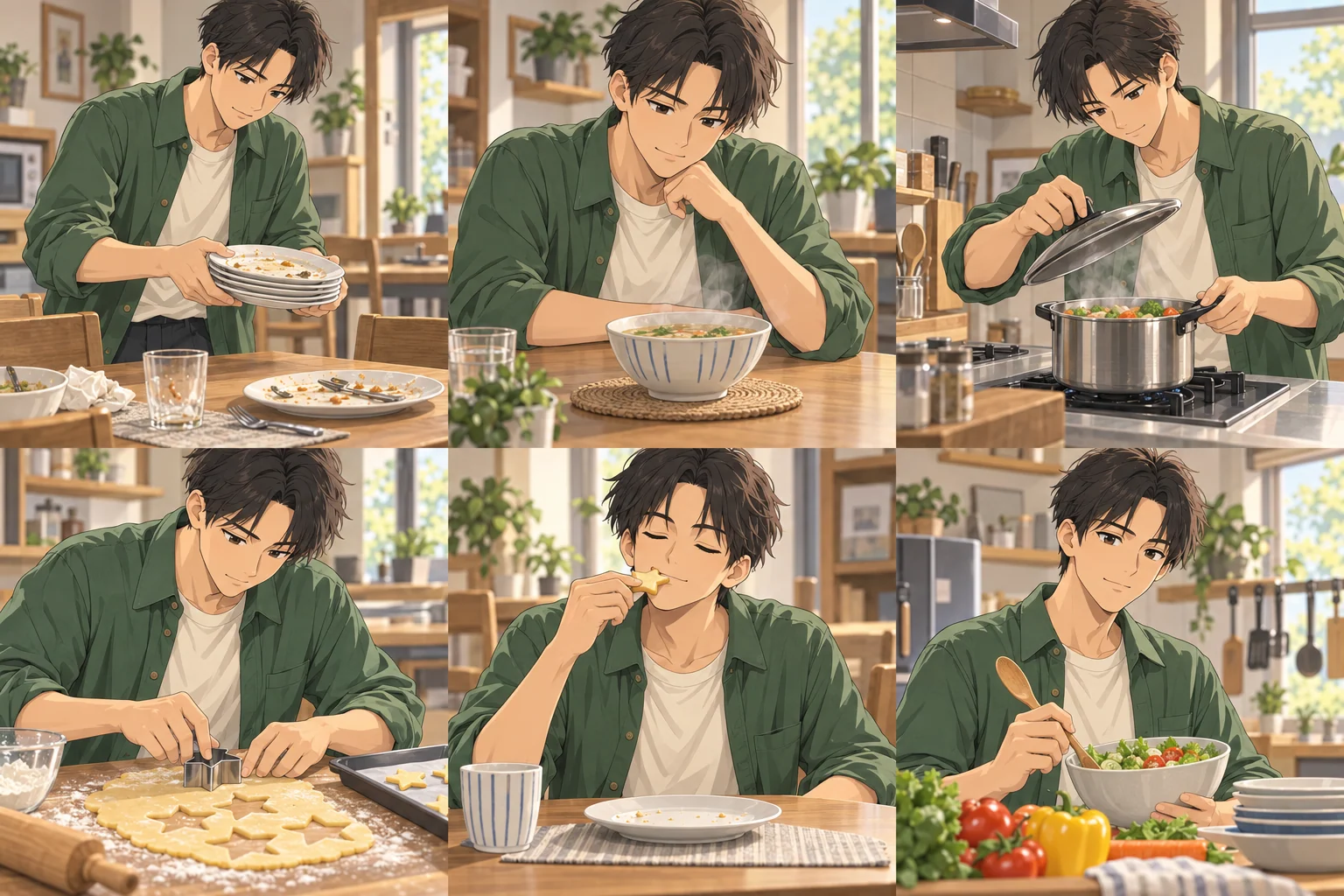
Minh used a mold to cut star shapes from cake dough.
cut out
Cut out a star from the dough for each biscuit.
Read the example again
Cut out a star from the dough for each biscuit.
We cut the shapes out and put them on the tray.
Read the example again
We cut the shapes out and put them on the tray.
View meaning & usage
Cut a shape out of the material
cut out somethingcut something outcut a shape out of something
You cut to separate a shape from a large piece of paper or dough. Not all meanings of “cut out” mean cutting material.
Haven't studied yet
Minh ate the last piece of cake left on the plate.
finish off
There is one slice left. Who wants to finish it off?
Read the example again
There is one slice left. Who wants to finish it off?
We finished off the salad before dessert.
Read the example again
We finished off the salad before dessert.
View meaning & usage
Eat the rest
finish off somethingfinish something off
With food, it means eating the last remaining portion. Phrases are also used for completing jobs.
Haven't studied yet
The examples were written for this course. Usage was checked against Matt Errey’s book, pages 127, 28, 137, 31, 45. A2–B1 is the course’s intended level.
Recall it · Use it
One step forward every day
Practice completed!
Your browser could not save your play history. Results from this session may be lost when you close the page.
Sentences using suggestions are counted as needing more practice. Review schedule based on each phrase's meaning.
Drag a wire from the dot beside a phrase to the dot beside its matching picture. You can also tap a phrase, then a picture. Drag again to change a pair before checking.
Read the picture descriptions for more context. Similar expressions are accepted when they fit the particular scene.
Phrases
Actions in the pictures
Picture description
Minh took the dirty plates off the dining table.
The picture could not load. Try loading it again before matching.
Picture description
Minh placed the bowl of hot soup on the table and waited for it to cool down.
The picture could not load. Try loading it again before matching.
Picture description
Minh warmed cold food in a pot.
The picture could not load. Try loading it again before matching.
Picture description
Minh used a mold to cut star shapes from cake dough.
The picture could not load. Try loading it again before matching.
Picture description
Minh ate the last piece of cake left on the plate.
The picture could not load. Try loading it again before matching.
Choose a phrase to begin.
Your browser could not save your play history. Results from this session may be lost when you close the page.
A conversation in context
Read the conversation and find the expressions you have learned.
Mai
This soup needs to cool down before we serve it.
Read the example again
This soup needs to cool down before we serve it.
Alex
Then I will warm up the bread while we wait.
Read the example again
Then I will warm up the bread while we wait.
Mai
Thanks. We can finish off the salad first.
Read the example again
Thanks. We can finish off the salad first.
Compare the uses
cool down / warm up
“Cool down” reduces temperature; “warm up” increases it. Both can describe food changing temperature or someone causing that change.
Practice and check your answers
Try answering before revealing the suggested answer. This practice is not scored.
The answers below are models. Other answers can also work if they preserve the facts, meaning and structure requested in the task.
A situation to apply what you have learned
A bowl of porridge is too hot, but bread from the fridge is cold. Guests arrive in ten minutes.
Give an instruction about the porridge.
Show the answer and explanation
Let the porridge cool down before serving it.
The porridge is too hot, so let it cool down before serving rather than heat it further.
Correct: Warm up it for the guests.
Show the answer and explanation
Warm it up for the guests.
“It” replaces the food to be warmed and goes between “warm” and “up”: “warm it up”.
Describe both temperature changes in one instruction.
Show the answer and explanation
Let the porridge cool down while you warm up the bread.
The porridge needs cooling and the bread needs warming; “while” links the two simultaneous tasks.
The usage comparisons are checked against the Cambridge Dictionary entries linked beside the compared expressions. The additional conversations and exercises are written for this course.
Progress is saved on the device. Sign in with Google to save with the same account and continue on another device.