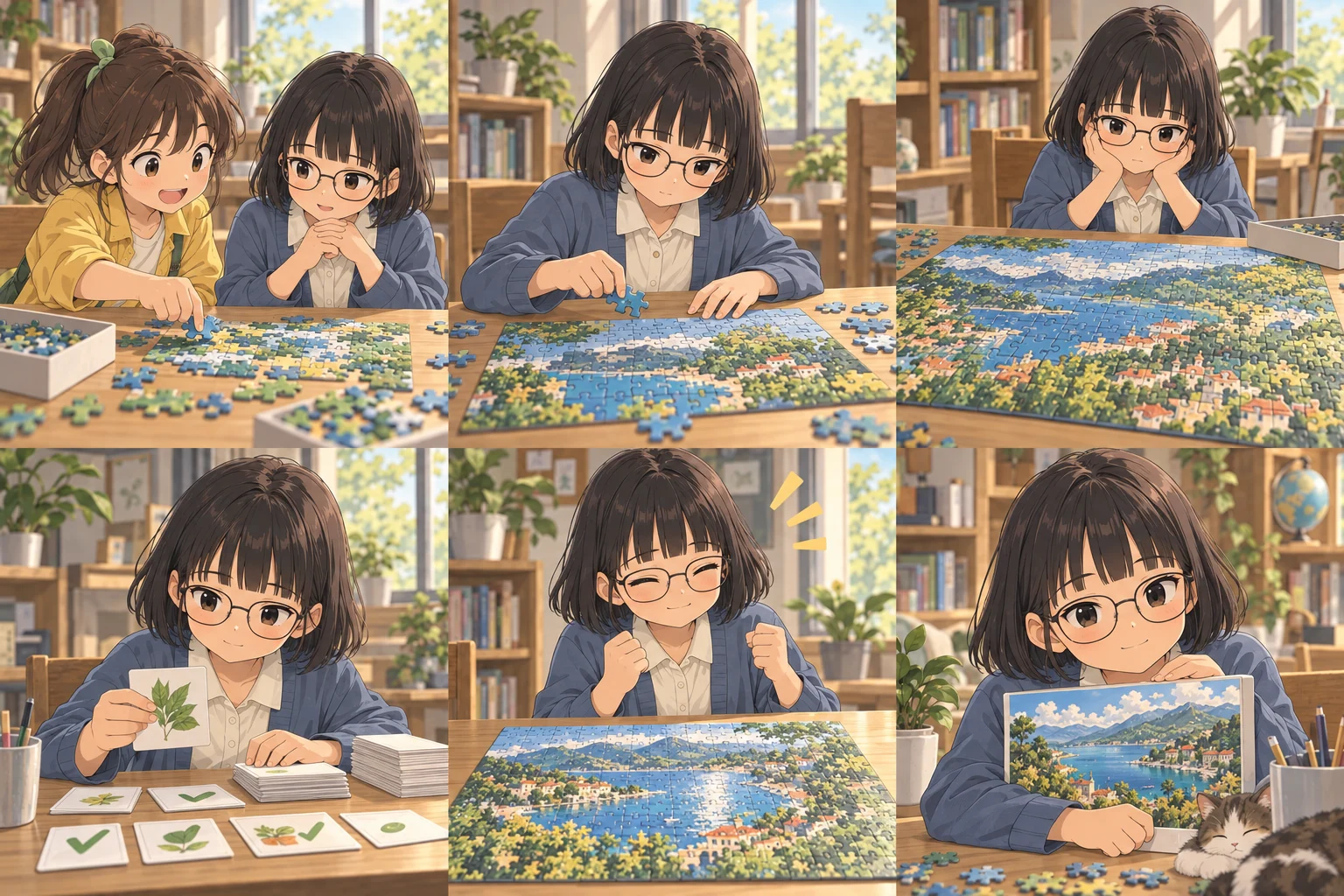
Linh looked at the large jigsaw puzzle that took up most of the table.
take up
This puzzle takes up most of the table.
Read the example again
This puzzle takes up most of the table.
The game took up the whole afternoon.
Read the example again
The game took up the whole afternoon.
View meaning & usage
Taking up space / taking up time
take up space / timetake something up
The meaning here is to use an amount of space or time; different from starting a new hobby.
Haven't studied yet
Linh completed the puzzle cards one by one in a small pile.
get through
We got through all five puzzles before lunch.
Read the example again
We got through all five puzzles before lunch.
I can get through these questions with your help.
Read the example again
I can get through these questions with your help.
View meaning & usage
Complete a certain amount of work
get through something
In this lesson, it's about completing a task, not connecting a call. Past tense “got”.
Haven't studied yet
Linh was happy when she solved the game after much practice.
pay off
Our practice paid off, and we solved the puzzle.
Read the example again
Our practice paid off, and we solved the puzzle.
Keep practising. Your hard work will pay off.
Read the example again
Keep practising. Your hard work will pay off.
View meaning & usage
Brings good results after effort
effort / practice pays off
The meaning here is about results; “pay off a loan” is to pay off the loan in full. Past tense “paid”.
Haven't studied yet
The examples were written for this course. Usage was checked against Matt Errey’s book, pages 20, 52, 129, 52, 95. A2–B1 is the course’s intended level.
Recall it · Use it
One step forward every day
Practice completed!
Your browser could not save your play history. Results from this session may be lost when you close the page.
Sentences using suggestions are counted as needing more practice. Review schedule based on each phrase's meaning.
Drag a wire from the dot beside a phrase to the dot beside its matching picture. You can also tap a phrase, then a picture. Drag again to change a pair before checking.
Read the picture descriptions for more context. Similar expressions are accepted when they fit the particular scene.
Phrases
Actions in the pictures
Picture description
Linh understands the rules of the game after a friend demonstrates them.
The picture could not load. Try loading it again before matching.
Picture description
Linh continued to put the puzzle pieces together after pausing to talk.
The picture could not load. Try loading it again before matching.
Picture description
Linh looked at the large jigsaw puzzle that took up most of the table.
The picture could not load. Try loading it again before matching.
Picture description
Linh completed the puzzle cards one by one in a small pile.
The picture could not load. Try loading it again before matching.
Picture description
Linh was happy when she solved the game after much practice.
The picture could not load. Try loading it again before matching.
Choose a phrase to begin.
Your browser could not save your play history. Results from this session may be lost when you close the page.
A conversation in context
Read the conversation and find the expressions you have learned.
Mai
I am starting to catch on to the rules.
Read the example again
I am starting to catch on to the rules.
Alex
Good. We can get on with the puzzle now.
Read the example again
Good. We can get on with the puzzle now.
Mai
Our practice should pay off when we reach the harder levels.
Read the example again
Our practice should pay off when we reach the harder levels.
Compare the uses
catch on / get on with
“Catch on” means begin to understand; “get on with” a task means start or continue it. Understanding rules and performing the task are different steps.
Practice and check your answers
Try answering before revealing the suggested answer. This practice is not scored.
The answers below are models. Other answers can also work if they preserve the facts, meaning and structure requested in the task.
A situation to apply what you have learned
A child finally understands a board-game rule. Now the group must continue a challenge that takes a long time.
Describe the moment of understanding.
Show the answer and explanation
The child has caught on to the rule.
“Has caught on to the rule” shows that the child has understood it, rather than merely heard it.
Complete: Let us get on ___ the challenge.
Show the answer and explanation
with
“Get on with the challenge” means continue it; keep “with” before the task.
Warn the group about the time needed.
Show the answer and explanation
This challenge may take up the rest of the afternoon.
“Take up the rest of the afternoon” warns that the challenge may occupy all the remaining afternoon.
The usage comparisons are checked against the Cambridge Dictionary entries linked beside the compared expressions. The additional conversations and exercises are written for this course.
Progress is saved on the device. Sign in with Google to save with the same account and continue on another device.