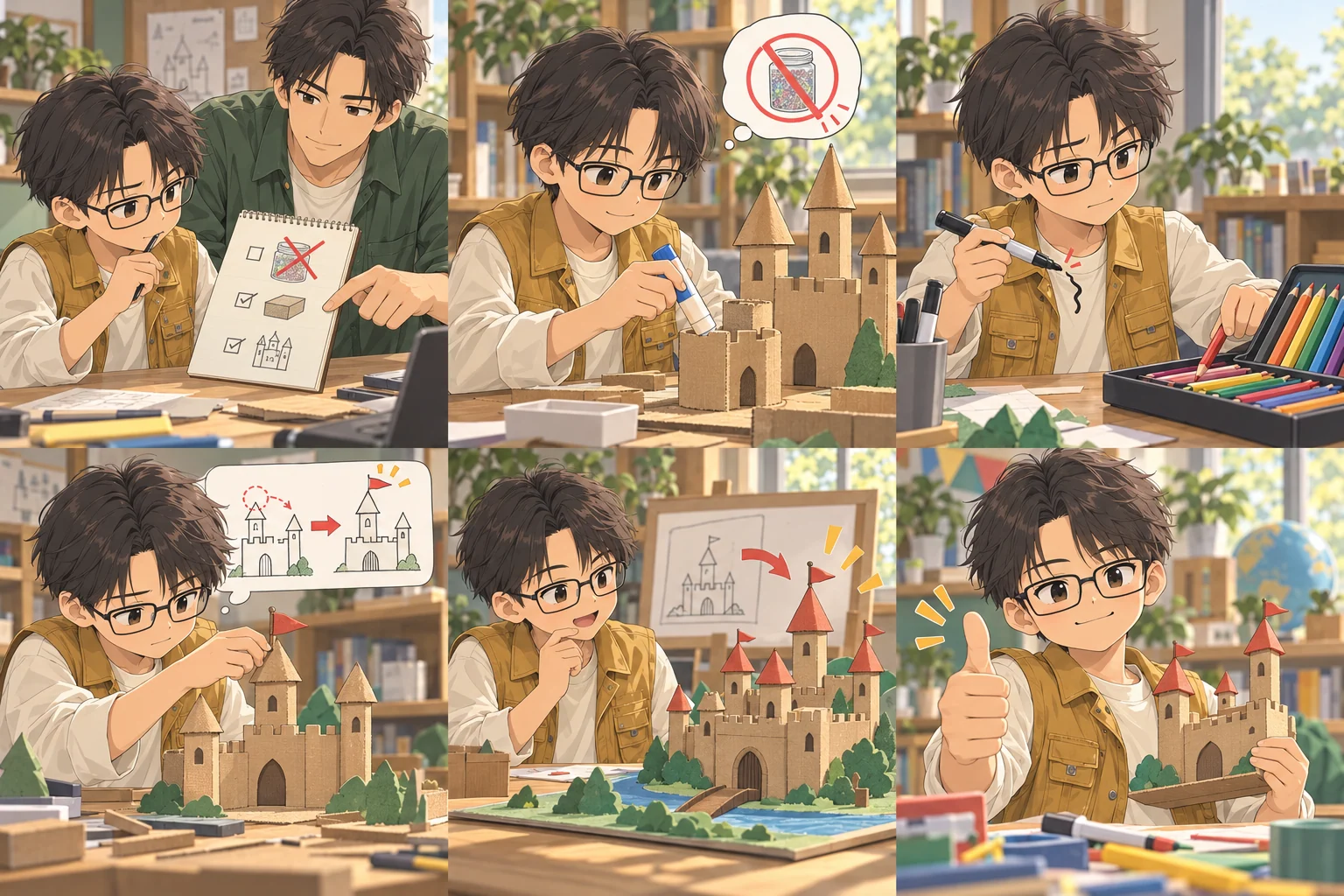
Duy uses a spare set of colored pencils when the markers don't work.
fall back on
If the markers stop working, we can fall back on our pencils.
Read the example again
If the markers stop working, we can fall back on our pencils.
We fell back on our picture cards when the video did not work.
Read the example again
We fell back on our picture cards when the video did not work.
View meaning & usage
Use backup plans when needed
fall back on something
You use what is available as an alternative when the first method fails. Past tense “fell”; no phrase separation.
Haven't studied yet
Duy did an extra job to make up for the task he forgot earlier.
make up for
I did an extra task to make up for the one I forgot.
Read the example again
I did an extra task to make up for the one I forgot.
We made up for lost time by working together.
Read the example again
We made up for lost time by working together.
View meaning & usage
Compensate for an omission/missed thing
make up for something
Do something else to offset the impact of a deficiency. Different from making peace in "make up"; past tense “made”.
Haven't studied yet
Duy looked at the completed paper castle larger than the original sketch.
end up
We planned a small tower but ended up building a castle.
Read the example again
We planned a small tower but ended up building a castle.
I ended up working with a new friend on the project.
Read the example again
I ended up working with a new friend on the project.
View meaning & usage
Finally fall into/do a thing
end up doing somethingend up in / at a place
The final result is often different from the original intention. After “end up” you can use -ing; don't say "end up to do".
Haven't studied yet
The examples were written for this course. Usage was checked against Matt Errey’s book, pages 36, 57, 43, 86, 40. A2–B1 is the course’s intended level.
Recall it · Use it
One step forward every day
Practice completed!
Your browser could not save your play history. Results from this session may be lost when you close the page.
Sentences using suggestions are counted as needing more practice. Review schedule based on each phrase's meaning.
Drag a wire from the dot beside a phrase to the dot beside its matching picture. You can also tap a phrase, then a picture. Drag again to change a pair before checking.
Read the picture descriptions for more context. Similar expressions are accepted when they fit the particular scene.
Phrases
Actions in the pictures
Picture description
Duy and Minh removed an unnecessary rule from the modeling plan.
The picture could not load. Try loading it again before matching.
Picture description
Duy did not use glitter as a model because it was not available.
The picture could not load. Try loading it again before matching.
Picture description
Duy uses a spare set of colored pencils when the markers don't work.
The picture could not load. Try loading it again before matching.
Picture description
Duy did an extra job to make up for the task he forgot earlier.
The picture could not load. Try loading it again before matching.
Picture description
Duy looked at the completed paper castle larger than the original sketch.
The picture could not load. Try loading it again before matching.
Choose a phrase to begin.
Your browser could not save your play history. Results from this session may be lost when you close the page.
A conversation in context
Read the conversation and find the expressions you have learned.
Mai
Could we do away with this unnecessary approval step?
Read the example again
Could we do away with this unnecessary approval step?
Alex
Yes, but we cannot go without the safety check.
Read the example again
Yes, but we cannot go without the safety check.
Mai
Then let us fall back on the simpler plan we used last time.
Read the example again
Then let us fall back on the simpler plan we used last time.
Compare the uses
do away with / go without
“Do away with” means abolish or remove; “go without” means manage despite not having something. Removing a rule differs from temporarily lacking an item.
Practice and check your answers
Try answering before revealing the suggested answer. This practice is not scored.
The answers below are models. Other answers can also work if they preserve the facts, meaning and structure requested in the task.
A situation to apply what you have learned
A project removes a redundant sign-off step but still needs a safety review. The printer is temporarily unavailable.
Describe removing the redundant step.
Show the answer and explanation
We can do away with the extra sign-off step.
The redundant sign-off step is removed entirely with “do away with”; the safety review remains necessary.
Complete: We will go ___ printed copies today.
Show the answer and explanation
without
“Go without printed copies today” means manage without paper copies today, rather than cancel the project.
Name a fallback plan using fall back on.
Show the answer and explanation
We can fall back on the digital checklist for today.
The digital checklist is the fallback to “fall back on” while the printer is temporarily unavailable.
The usage comparisons are checked against the Cambridge Dictionary entries linked beside the compared expressions. The additional conversations and exercises are written for this course.
Progress is saved on the device. Sign in with Google to save with the same account and continue on another device.