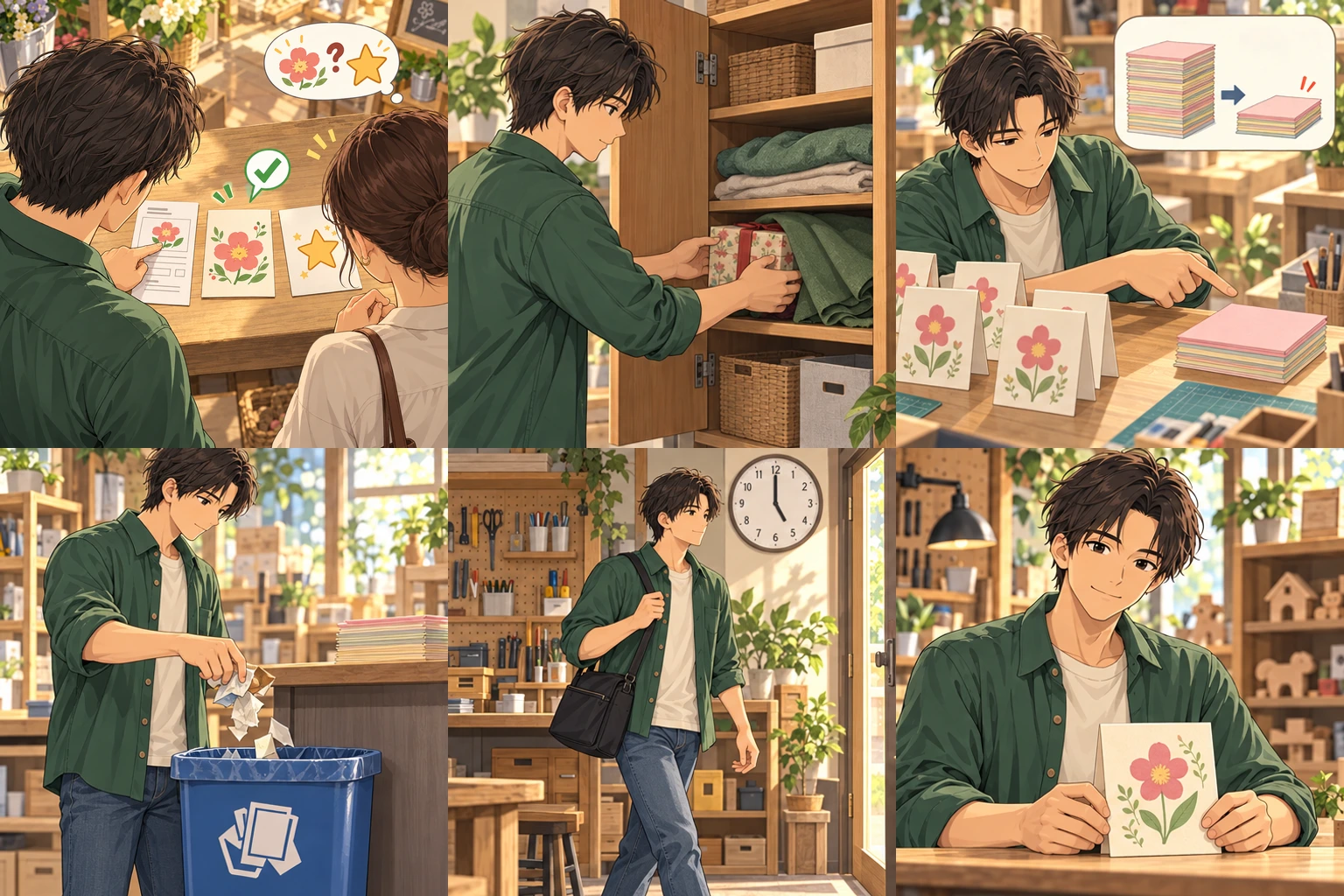
Minh puts damaged paper packaging into the workshop’s paper collection bin.
dispose of
He disposed of the damaged packaging properly.
Read the example again
He disposed of the damaged packaging properly.
Please dispose of the waste in the correct bin.
Read the example again
Please dispose of the waste in the correct bin.
View meaning & usage
Get rid of unwanted material
dispose of somethingdispose of it
Fairly formal. Keep “of”: not “dispose it”. Sort waste according to local rules.
Haven't studied yet
Minh finishes work and leaves his tidy workbench at five o’clock.
knock off
He knocked off at five and went home.
Read the example again
He knocked off at five and went home.
What time do you usually knock off?
Read the example again
What time do you usually knock off?
View meaning & usage
Finish work for the day
knock offknock off at a time
An informal way to say finish work. This sense takes no object and does not mean knocking something over.
Haven't studied yet
The examples were written for this course. Usage was checked against Matt Errey’s book, pages 123, 63, 78, 36, 73. A2–B1 is the course’s intended level.
Recall it · Use it
One step forward every day
Practice completed!
Your browser could not save your play history. Results from this session may be lost when you close the page.
Sentences using suggestions are counted as needing more practice. Review schedule based on each phrase's meaning.
Drag a wire from the dot beside a phrase to the dot beside its matching picture. You can also tap a phrase, then a picture. Drag again to change a pair before checking.
Read the picture descriptions for more context. Similar expressions are accepted when they fit the particular scene.
Phrases
Actions in the pictures
Picture description
Minh and a customer compare the order with the cards and resolve a flower-versus-star mix-up.
The picture could not load. Try loading it again before matching.
Picture description
Minh hides a wrapped gift behind folded fabric in a cupboard.
The picture could not load. Try loading it again before matching.
Picture description
Minh points to unused paper remaining beside the finished cards.
The picture could not load. Try loading it again before matching.
Picture description
Minh puts damaged paper packaging into the workshop’s paper collection bin.
The picture could not load. Try loading it again before matching.
Picture description
Minh finishes work and leaves his tidy workbench at five o’clock.
The picture could not load. Try loading it again before matching.
Choose a phrase to begin.
Your browser could not save your play history. Results from this session may be lost when you close the page.
A conversation in context
Read the conversation and find the expressions you have learned.
Mai
We should straighten out the mistake before we knock off.
Read the example again
We should straighten out the mistake before we knock off.
Alex
Agreed. Is there any paper left over for a corrected label?
Read the example again
Agreed. Is there any paper left over for a corrected label?
Mai
Yes. I hid a spare pack away in the cupboard.
Read the example again
Yes. I hid a spare pack away in the cupboard.
Compare the uses
straighten out / left over
Here “straighten out” resolves a problem or misunderstanding; “left over” describes what remains. Do not treat “left over” in these patterns as a verb meaning leave a place.
Practice and check your answers
Try answering before revealing the suggested answer. This practice is not scored.
The answers below are models. Other answers can also work if they preserve the facts, meaning and structure requested in the task.
A situation to apply what you have learned
A workshop resolves confusion about a parcel. Some ribbon remains after all packages are finished.
Describe resolving the confusion.
Show the answer and explanation
They straighten out the misunderstanding about the parcel.
“Straighten out the misunderstanding” resolves confusion about the parcel rather than straightens a physical object.
Complete: There is some ribbon left ___.
Show the answer and explanation
over
“Ribbon left over” is material remaining after packing; “over” does not mean physically above.
Suggest a sensible use for the remaining material.
Show the answer and explanation
We can hide the spare ribbon away for the next workshop.
“Hide… away for the next workshop” puts the spare ribbon away for later use, rather than uses it all now.
The usage comparisons are checked against the Cambridge Dictionary entries linked beside the compared expressions. The additional conversations and exercises are written for this course.
Progress is saved on the device. Sign in with Google to save with the same account and continue on another device.