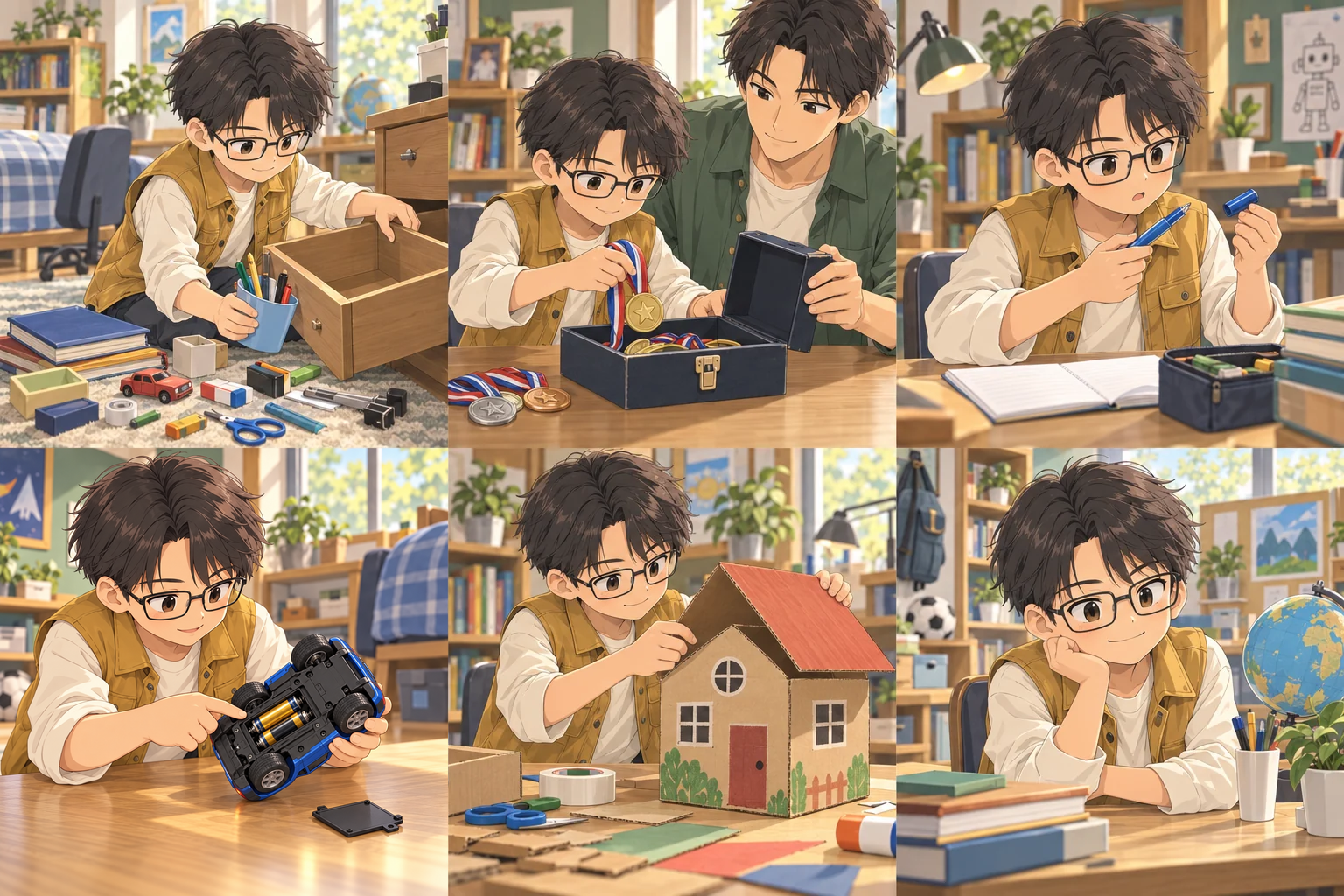
Duy looked at the pen cap that had slipped off and held the loose cap in his hand.
come off
The cap came off my pen in the bag.
Read the example again
The cap came off my pen in the bag.
This wheel may come off if it is not attached properly.
Read the example again
This wheel may come off if it is not attached properly.
View meaning & usage
Loose / slip from the mounting position
something comes offcome off something
Partly removed from attachment. Different from the whole thing breaking into many parts in "come apart"; past tense “came”.
Haven't studied yet
Duy points to three batteries in the open compartment on the toy car’s underside; the battery cover rests on the table.
run on
This toy car runs on batteries.
Read the example again
This toy car runs on batteries.
Some buses run on electricity.
Read the example again
Some buses run on electricity.
View meaning & usage
Operates thanks to an energy source
run on batteries / electricity / fuel
After “on” is the source of energy; not running on a surface in this sense.
Haven't studied yet
Duy turned an old cardboard box into a small toy house.
make into
We made the old box into a little toy house.
Read the example again
We made the old box into a little toy house.
You can make this paper into a simple bird.
Read the example again
You can make this paper into a simple bird.
View meaning & usage
Turn existing materials/things into something else
make something into something
The original object stands between “make” and “into”; the created thing comes after “into”. Past tense “made”.
Haven't studied yet
The examples were written for this course. Usage was checked against Matt Errey’s book, pages 22, 80, 25, 109, 86. A2–B1 is the course’s intended level.
Recall it · Use it
One step forward every day
Practice completed!
Your browser could not save your play history. Results from this session may be lost when you close the page.
Sentences using suggestions are counted as needing more practice. Review schedule based on each phrase's meaning.
Drag a wire from the dot beside a phrase to the dot beside its matching picture. You can also tap a phrase, then a picture. Drag again to change a pair before checking.
Read the picture descriptions for more context. Similar expressions are accepted when they fit the particular scene.
Phrases
Actions in the pictures
Picture description
Duy took all the things out of the drawer before rearranging them.
The picture could not load. Try loading it again before matching.
Picture description
Duy and Minh put the medal in a locked commemorative box.
The picture could not load. Try loading it again before matching.
Picture description
Duy looked at the pen cap that had slipped off and held the loose cap in his hand.
The picture could not load. Try loading it again before matching.
Picture description
Duy points to three batteries in the open compartment on the toy car’s underside; the battery cover rests on the table.
The picture could not load. Try loading it again before matching.
Picture description
Duy turned an old cardboard box into a small toy house.
The picture could not load. Try loading it again before matching.
Choose a phrase to begin.
Your browser could not save your play history. Results from this session may be lost when you close the page.
A conversation in context
Read the conversation and find the expressions you have learned.
Mai
Let us clear out this cupboard before we move the desk.
Read the example again
Let us clear out this cupboard before we move the desk.
Alex
I will lock away the documents we need to keep.
Read the example again
I will lock away the documents we need to keep.
Mai
We can make the empty corner into a reading space.
Read the example again
We can make the empty corner into a reading space.
Compare the uses
clear out / lock away
“Clear out” removes things from a space; “lock away” puts something in locked storage. Removing an item from a room need not mean discarding it.
Practice and check your answers
Try answering before revealing the suggested answer. This practice is not scored.
The answers below are models. Other answers can also work if they preserve the facts, meaning and structure requested in the task.
A situation to apply what you have learned
An organiser empties a cupboard. Private papers must be kept, and the empty space will become a reading corner.
Describe making room in the cupboard.
Show the answer and explanation
She clears out the cupboard.
“Clear out the cupboard” removes its contents to make space without requiring everything to be discarded.
Correct: Lock away them before the visitors arrive.
Show the answer and explanation
Lock them away before the visitors arrive.
“Them” refers to private papers to secure, so use “lock them away”, not “lock away them”.
Write the plan for the new space.
Show the answer and explanation
We can make the empty corner into a reading area.
“Make the corner into a reading area” gives the cleared space a new purpose.
The usage comparisons are checked against the Cambridge Dictionary entries linked beside the compared expressions. The additional conversations and exercises are written for this course.
Progress is saved on the device. Sign in with Google to save with the same account and continue on another device.