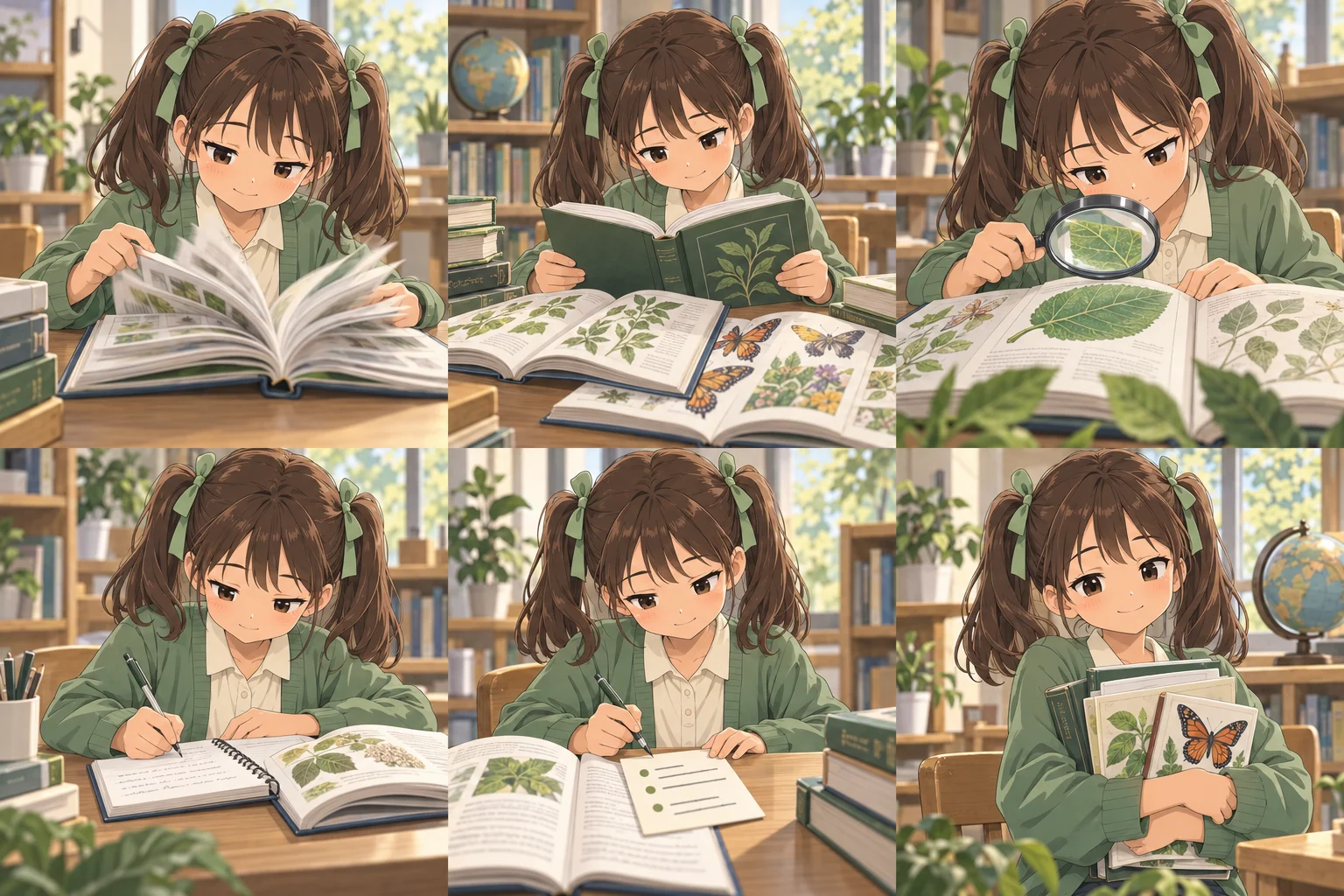
Nhi reads several illustrated books about plants and butterflies to learn more about the same topic.
read up on
I read up on butterflies before our visit to the garden.
Read the example again
I read up on butterflies before our visit to the garden.
We should read up on local wildlife before we go camping.
Read the example again
We should read up on local wildlife before we go camping.
View meaning & usage
Learn about a topic by reading
read up on something
Reading to gain more knowledge, often to prepare for something. Keep “up on” before the topic. “Read” in the past is still written like that but reads /red/.
Nhi writes a few short notes in a notebook beside an open book.
note down
Note down the title so you can find the book later.
Read the example again
Note down the title so you can find the book later.
That is a useful fact. I will note it down.
Read the example again
That is a useful fact. I will note it down.
View meaning & usage
Record information in writing so you can remember it
note down somethingnote something downnote it down
Close to the meaning “write down”; Often used when briefly writing down information that needs to be remembered. Middle pronoun: “note it down”, do not use “note down it”.
The examples were written for this course. Usage was checked against Matt Errey’s book, pages 46, 106, 46, 90, 124. A2–B1 is the course’s intended level.
Recall it · Use it
One step forward every day
Practice completed!
Your browser could not save your play history. Results from this session may be lost when you close the page.
Sentences using suggestions are counted as needing more practice. Review schedule based on each phrase's meaning.
Drag a wire from the dot beside a phrase to the dot beside its matching picture. You can also tap a phrase, then a picture. Drag again to change a pair before checking.
Read the picture descriptions for more context. Similar expressions are accepted when they fit the particular scene.
Phrases
Actions in the pictures
Picture description
Nhi quickly flicks through a book, with the edges of the pages visibly turning.
The picture could not load. Try loading it again before matching.
Picture description
Nhi reads several illustrated books about plants and butterflies to learn more about the same topic.
The picture could not load. Try loading it again before matching.
Picture description
Nhi focuses on a leaf picture under a magnifying glass while the surrounding pictures are less prominent.
The picture could not load. Try loading it again before matching.
Picture description
Nhi writes a few short notes in a notebook beside an open book.
The picture could not load. Try loading it again before matching.
Picture description
Nhi reduces a page of information to a small card with three main points, shown as short lines beside the original page.
The picture could not load. Try loading it again before matching.
Choose a phrase to begin.
Your browser could not save your play history. Results from this session may be lost when you close the page.
A conversation in context
Read the conversation and find the expressions you have learned.
Mai
I will flick through this brochure to see what is in it.
Read the example again
I will flick through this brochure to see what is in it.
Alex
We should read up on local birds before our trip.
Read the example again
We should read up on local birds before our trip.
Mai
Let us focus on the birds we might actually see.
Read the example again
Let us focus on the birds we might actually see.
Alex
I will note down their names and the best places to look.
Read the example again
I will note down their names and the best places to look.
Mai
At the end, we can sum up what we have learned.
Read the example again
At the end, we can sum up what we have learned.
Compare the uses
Browsing and reading for information
“Flick through” stresses looking quickly through pages; “read up on” means read to learn about a topic. You can do one after the other, but browsing alone does not mean you have studied the subject.
Recording and summarising
“Note down” means record information to remember it; “sum up” means state the important points briefly. With pronouns, say “note it down” and “sum it up”. Keep the object after “on” in “focus on it”.
Practice and check your answers
Try answering before revealing the suggested answer. This practice is not scored.
The answers below are models. Other answers can also work if they preserve the facts, meaning and structure requested in the task.
A situation to apply what you have learned
A visitor plans a birdwatching trip. She scans a leaflet first, researches the birds, and later explains only the main points.
Describe the quick first look.
Show the answer and explanation
She flicks through the leaflet.
The first look only scans the leaflet’s pages, so “flicks through” fits rather than detailed bird research.
Replace “the main points” with “them”: Sum up the main points.
Show the answer and explanation
Sum them up.
“Them” replaces the main points, so say “sum them up”, not “sum up them”.
Write a preparation plan using read up on.
Show the answer and explanation
I will read up on the local birds before our visit.
“Read up on the local birds” plans reading to learn about the birds before the visit.
The usage comparisons are checked against the Cambridge Dictionary entries linked beside the compared expressions. The additional conversations and exercises are written for this course.
Progress is saved on the device. Sign in with Google to save with the same account and continue on another device.