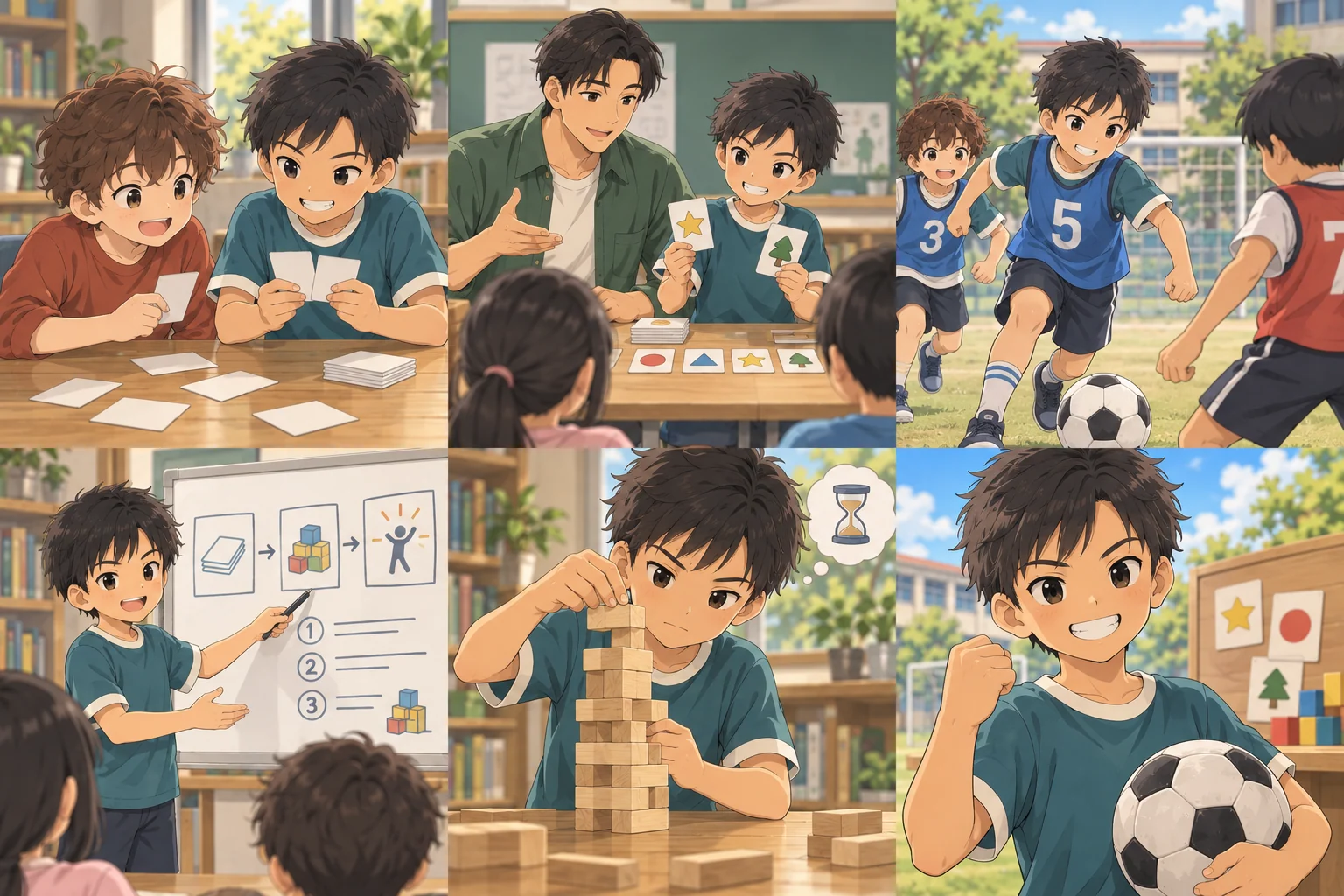
Nam and Minh introduce a simple game for beginners.
aim at
This game is aimed at beginners.
Read the example again
This game is aimed at beginners.
Our activity aims at helping everyone practise speaking.
Read the example again
Our activity aims at helping everyone practise speaking.
View meaning & usage
Target an audience/goal
be aimed at someoneaim at somethingaim at doing something
In the lesson is the object or goal of the activity; You don't have to point an object in any direction.
Haven't studied yet
Nam played a friendly match with another team at school.
take on
Our team takes on another class tomorrow.
Read the example again
Our team takes on another class tomorrow.
We took them on in a friendly game.
Read the example again
We took them on in a friendly game.
View meaning & usage
Compete/confront an opponent
take on someone / somethingtake someone on
The meaning in the lesson is confrontation in competition. The phrase also means accepting a job or receiving a person in another context; past tense “took”.
Nam explains how the group will make a new game with a picture plan.
go about
How should we go about making a new game?
Read the example again
How should we go about making a new game?
We went about the task one step at a time.
Read the example again
We went about the task one step at a time.
View meaning & usage
How to do something
go about somethinggo about doing something
Talking about how to shake hands and get things done; don't have to go around an area. Past tense “went”.
Haven't studied yet
Nam builds a tower of blocks and realizes that the game requires patience.
call for
This game calls for patience and teamwork.
Read the example again
This game calls for patience and teamwork.
A tricky task calls for careful thinking.
Read the example again
A tricky task calls for careful thinking.
View meaning & usage
Demanding / needing something
something calls for something
The article is about needing or demanding something, not calling. The phrase also means calling depending on the situation.
Haven't studied yet
The examples were written for this course. Usage was checked against Matt Errey’s book, pages 121, 6, 128, 54, 19. A2–B1 is the course’s intended level.
Recall it · Use it
One step forward every day
Practice completed!
Your browser could not save your play history. Results from this session may be lost when you close the page.
Sentences using suggestions are counted as needing more practice. Review schedule based on each phrase's meaning.
Drag a wire from the dot beside a phrase to the dot beside its matching picture. You can also tap a phrase, then a picture. Drag again to change a pair before checking.
Read the picture descriptions for more context. Similar expressions are accepted when they fit the particular scene.
Phrases
Actions in the pictures
Picture description
Nam remembers when the group made the game with just the two of them and a few paper cards.
The picture could not load. Try loading it again before matching.
Picture description
Nam and Minh introduce a simple game for beginners.
The picture could not load. Try loading it again before matching.
Picture description
Nam played a friendly match with another team at school.
The picture could not load. Try loading it again before matching.
Picture description
Nam explains how the group will make a new game with a picture plan.
The picture could not load. Try loading it again before matching.
Picture description
Nam builds a tower of blocks and realizes that the game requires patience.
The picture could not load. Try loading it again before matching.
Choose a phrase to begin.
Your browser could not save your play history. Results from this session may be lost when you close the page.
A conversation in context
Read the conversation and find the expressions you have learned.
Mai
Our chess club started out with borrowed boards.
Read the example again
Our chess club started out with borrowed boards.
Alex
Now we are going to take on a larger club in a friendly match.
Read the example again
Now we are going to take on a larger club in a friendly match.
Mai
How should we go about preparing for it?
Read the example again
How should we go about preparing for it?
Compare the uses
start out / take on
“Start out” describes initial circumstances; “take on” here means compete against an opponent. The opposing person or team follows “take on”.
Practice and check your answers
Try answering before revealing the suggested answer. This practice is not scored.
The answers below are models. Other answers can also work if they preserve the facts, meaning and structure requested in the task.
A situation to apply what you have learned
A tiny chess club begins with borrowed boards. Its members are preparing for a friendly match against a larger club.
Describe the small beginning.
Show the answer and explanation
The club started out with borrowed boards.
“Started out with borrowed boards” describes the chess club’s beginnings, rather than its forthcoming match.
Complete: We will take ___ the larger club in a friendly match.
Show the answer and explanation
on
“Take on the larger club” means compete against it, rather than accept responsibility for organising an event.
Ask how to prepare for the match using go about.
Show the answer and explanation
How should we go about preparing for the match?
“Go about preparing” asks how to approach match preparation; “about” takes the “-ing” form, not “prepare”.
The usage comparisons are checked against the Cambridge Dictionary entries linked beside the compared expressions. The additional conversations and exercises are written for this course.
Progress is saved on the device. Sign in with Google to save with the same account and continue on another device.