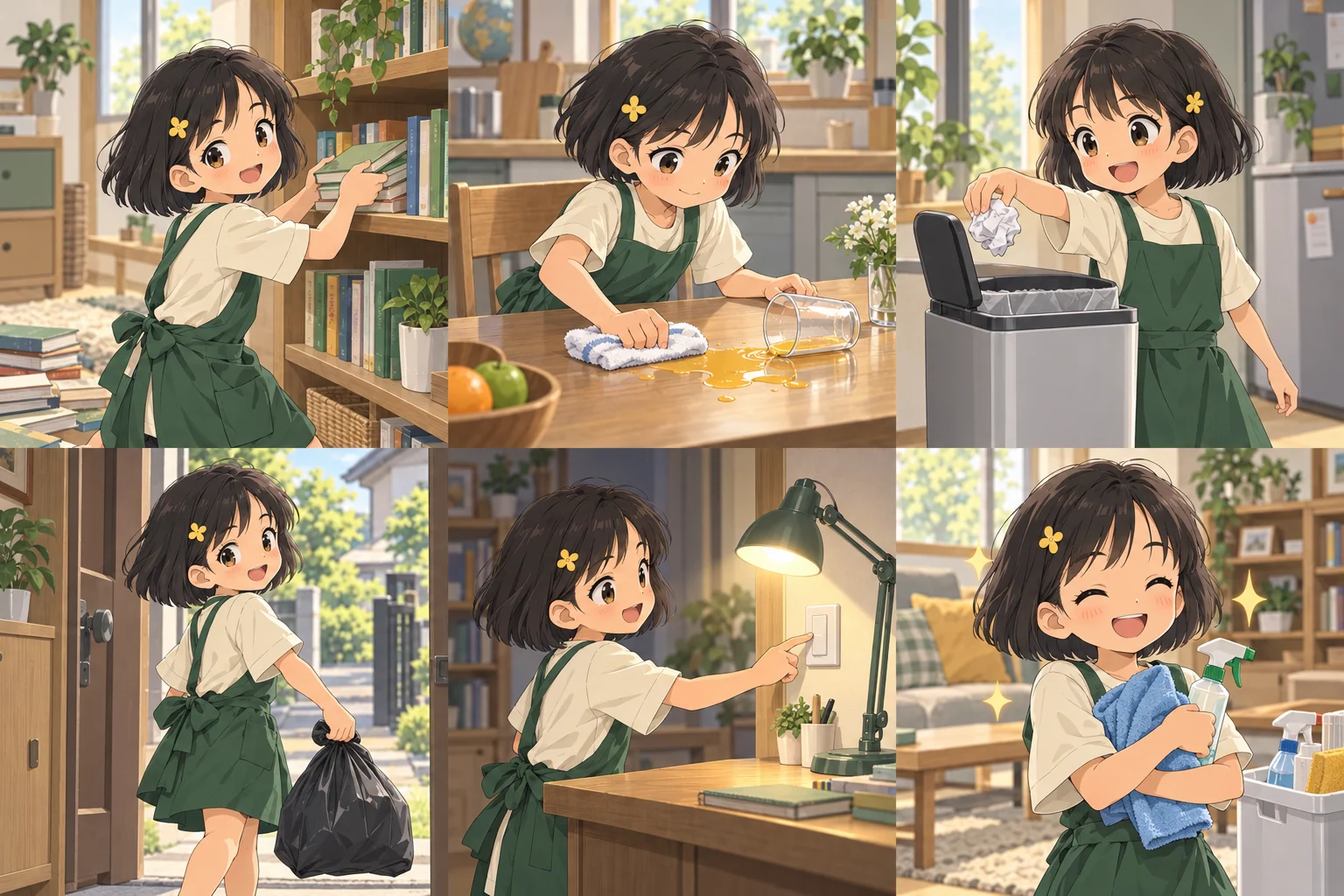
An carried a sealed garbage bag through the door and out.
take out
Can you take out the rubbish before dinner?
Read the example again
Can you take out the rubbish before dinner?
Take the empty bottles out of the cupboard.
Read the example again
Take the empty bottles out of the cupboard.
View meaning & usage
Bring / take out
take out somethingtake something outtake it out of a place
The meaning in the lesson is to take or bring something out of the place where it is contained.
Haven't studied yet
An pressed the switch; the desk lamp turned on.
turn on
It is dark. Please turn on the lamp.
Read the example again
It is dark. Please turn on the lamp.
The fan is off. Can you turn it on?
Read the example again
The fan is off. Can you turn it on?
View meaning & usage
Turn on the device/light
turn on somethingturn something onturn it on
Antonym of “turn off”. With pronouns: “turn it on”.
Haven't studied yet
The examples were written for this course. Usage was checked against Matt Errey’s book, pages 131, 22, 131, 129, 134. A2–B1 is the course’s intended level.
Recall it · Use it
One step forward every day
Practice completed!
Your browser could not save your play history. Results from this session may be lost when you close the page.
Sentences using suggestions are counted as needing more practice. Review schedule based on each phrase's meaning.
Drag a wire from the dot beside a phrase to the dot beside its matching picture. You can also tap a phrase, then a picture. Drag again to change a pair before checking.
Read the picture descriptions for more context. Similar expressions are accepted when they fit the particular scene.
Phrases
Actions in the pictures
Picture description
An arranged the books lying haphazardly on the shelf.
The picture could not load. Try loading it again before matching.
Picture description
An used a towel to wipe up the juice she had just spilled on the table.
The picture could not load. Try loading it again before matching.
Picture description
An put a crumpled piece of paper in the trash.
The picture could not load. Try loading it again before matching.
Picture description
An carried a sealed garbage bag through the door and out.
The picture could not load. Try loading it again before matching.
Picture description
An pressed the switch; the desk lamp turned on.
The picture could not load. Try loading it again before matching.
Choose a phrase to begin.
Your browser could not save your play history. Results from this session may be lost when you close the page.
A conversation in context
Read the conversation and find the expressions you have learned.
Mai
Let us tidy up before our guests arrive.
Read the example again
Let us tidy up before our guests arrive.
Alex
I will put the books on the shelf. Can you clean up the spilled juice?
Read the example again
I will put the books on the shelf. Can you clean up the spilled juice?
Mai
Yes. Keep the bottles we can reuse; do not throw them away.
Read the example again
Yes. Keep the bottles we can reuse; do not throw them away.
Compare the uses
tidy up / clean up
“Tidy up” focuses on putting things in order; “clean up” focuses on removing dirt or dealing with a mess. An orderly room may still need cleaning.
Practice and check your answers
Try answering before revealing the suggested answer. This practice is not scored.
The answers below are models. Other answers can also work if they preserve the facts, meaning and structure requested in the task.
A situation to apply what you have learned
After a craft session, chairs are scattered and glue covers one table. Useful paper remains on the floor.
Which job concerns arranging the chairs?
Show the answer and explanation
Tidy up the chairs.
The scattered chairs need arranging: “tidy up”; removing glue is the cleaning task.
Correct: Do not throw away it; we can reuse it.
Show the answer and explanation
Do not throw it away; we can reuse it.
“It” refers to reusable paper, so use “throw it away”; “do not” tells the reader to keep it.
Give two different instructions for the room.
Show the answer and explanation
Tidy up the chairs and clean up the glue on the table.
“Tidy up” arranges the chairs, while “clean up” removes the glue: two instructions for different kinds of mess.
The usage comparisons are checked against the Cambridge Dictionary entries linked beside the compared expressions. The additional conversations and exercises are written for this course.
Progress is saved on the device. Sign in with Google to save with the same account and continue on another device.