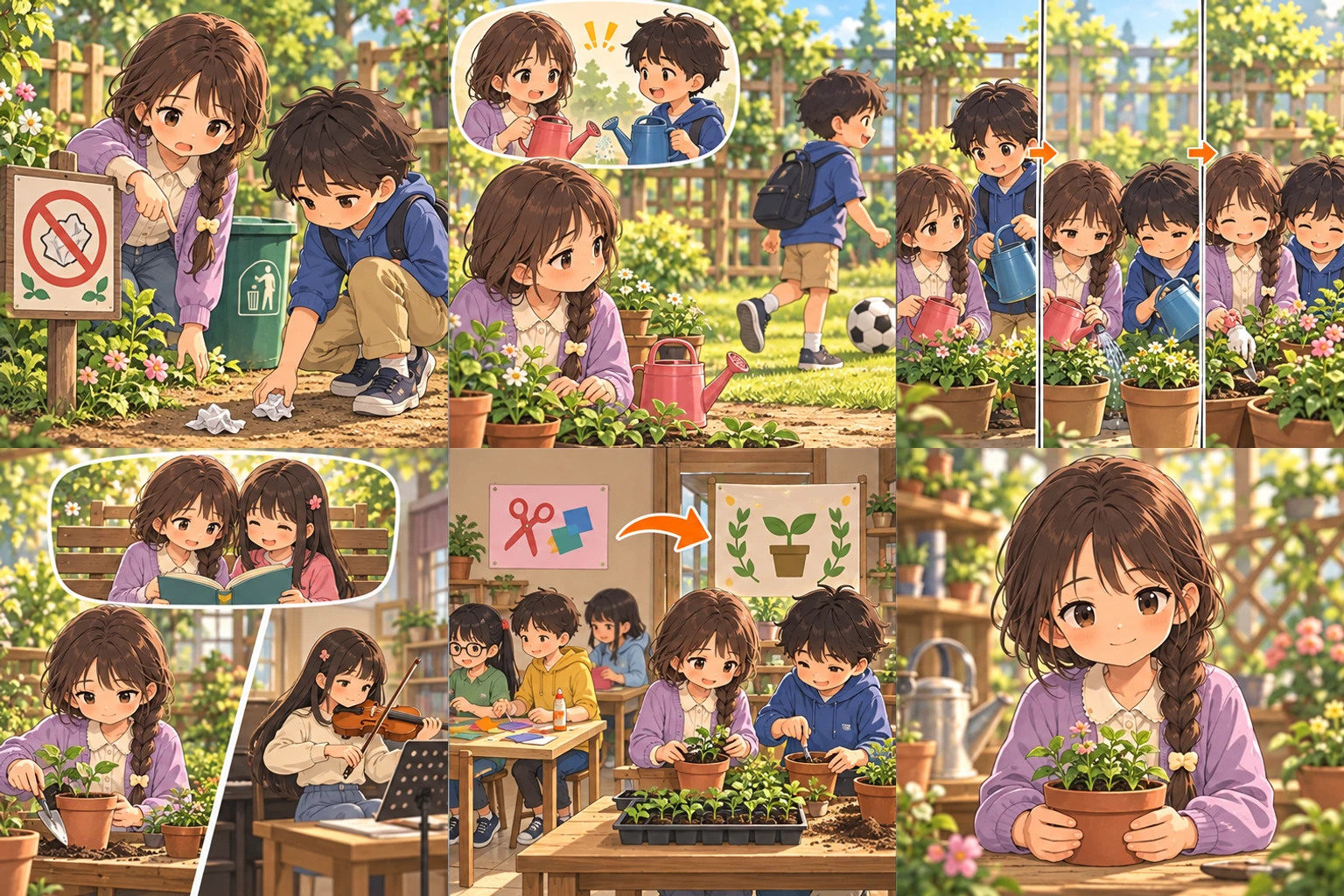
The friend reliably returns to help with the plants over three sessions, gradually winning back Mây’s trust.
win back
Her friend worked hard to win back her trust.
Read the example again
Her friend worked hard to win back her trust.
Keeping our promises can help us win trust back.
Read the example again
Keeping our promises can help us win trust back.
View meaning & usage
Regain something through effort
win back somethingwin something back
“Back” indicates something was previously held and lost. With a pronoun: “win it back”.
Haven't studied yet
Mây and a friend become less close as they spend time on different interests.
grow apart
They grew apart after joining different clubs.
Read the example again
They grew apart after joining different clubs.
Old friends sometimes grow apart as their interests change.
Read the example again
Old friends sometimes grow apart as their interests change.
View meaning & usage
Become less close over time
grow apartgrow apart from someone
Emphasises gradual change in a relationship, not necessarily an argument. The past is “grew”.
Haven't studied yet
Mây and a friend leave a general craft group and form their own gardening club.
break away
A few members broke away to form a new club.
Read the example again
A few members broke away to form a new club.
They broke away from the larger group.
Read the example again
They broke away from the larger group.
View meaning & usage
Leave a group to act independently
break awaybreak away from a group
Emphasises leaving a group or organisation to become independent. Use “from” before the former group.
Haven't studied yet
The examples were written for this course. Usage was checked against Matt Errey’s book, pages 54, 55, 139, 57, 13. A2–B1 is the course’s intended level.
Recall it · Use it
One step forward every day
Practice completed!
Your browser could not save your play history. Results from this session may be lost when you close the page.
Sentences using suggestions are counted as needing more practice. Review schedule based on each phrase's meaning.
Drag a wire from the dot beside a phrase to the dot beside its matching picture. You can also tap a phrase, then a picture. Drag again to change a pair before checking.
Read the picture descriptions for more context. Similar expressions are accepted when they fit the particular scene.
Phrases
Actions in the pictures
Picture description
Mây points out that leaving paper litter on the ground conflicts with the clean-garden rule.
The picture could not load. Try loading it again before matching.
Picture description
Mây is disappointed when a friend who promised to help with the plants goes off to play instead.
The picture could not load. Try loading it again before matching.
Picture description
The friend reliably returns to help with the plants over three sessions, gradually winning back Mây’s trust.
The picture could not load. Try loading it again before matching.
Picture description
Mây and a friend become less close as they spend time on different interests.
The picture could not load. Try loading it again before matching.
Picture description
Mây and a friend leave a general craft group and form their own gardening club.
The picture could not load. Try loading it again before matching.
Choose a phrase to begin.
Your browser could not save your play history. Results from this session may be lost when you close the page.
A conversation in context
Read the conversation and find the expressions you have learned.
Mai
I do not want to go back on my promise to help.
Read the example again
I do not want to go back on my promise to help.
Alex
Then suggest a plan that does not go against your other commitments.
Read the example again
Then suggest a plan that does not go against your other commitments.
Mai
I hope that will help me win back their trust.
Read the example again
I hope that will help me win back their trust.
Compare the uses
go against / go back on
“Go against” conflicts with something such as principles or wishes; “go back on” breaks a promise. Disagreeing with an idea does not necessarily break a promise.
Practice and check your answers
Try answering before revealing the suggested answer. This practice is not scored.
The answers below are models. Other answers can also work if they preserve the facts, meaning and structure requested in the task.
A situation to apply what you have learned
A helper promised to attend an event. Cancelling would break that promise, but another plan would conflict with her principles.
Describe breaking the promise.
Show the answer and explanation
She would be going back on her promise.
“Would be going back on her promise” describes what cancelling would mean, without claiming cancellation has occurred.
Complete: That alternative goes ___ my principles.
Show the answer and explanation
against
“Goes against my principles” conflicts with those principles; “against” introduces the standard being violated.
Write a message seeking a workable solution.
Show the answer and explanation
I want to keep my promise without going against my principles.
The message preserves both the wish to keep the promise and the principles, without claiming a solution is already found.
The usage comparisons are checked against the Cambridge Dictionary entries linked beside the compared expressions. The additional conversations and exercises are written for this course.
Progress is saved on the device. Sign in with Google to save with the same account and continue on another device.