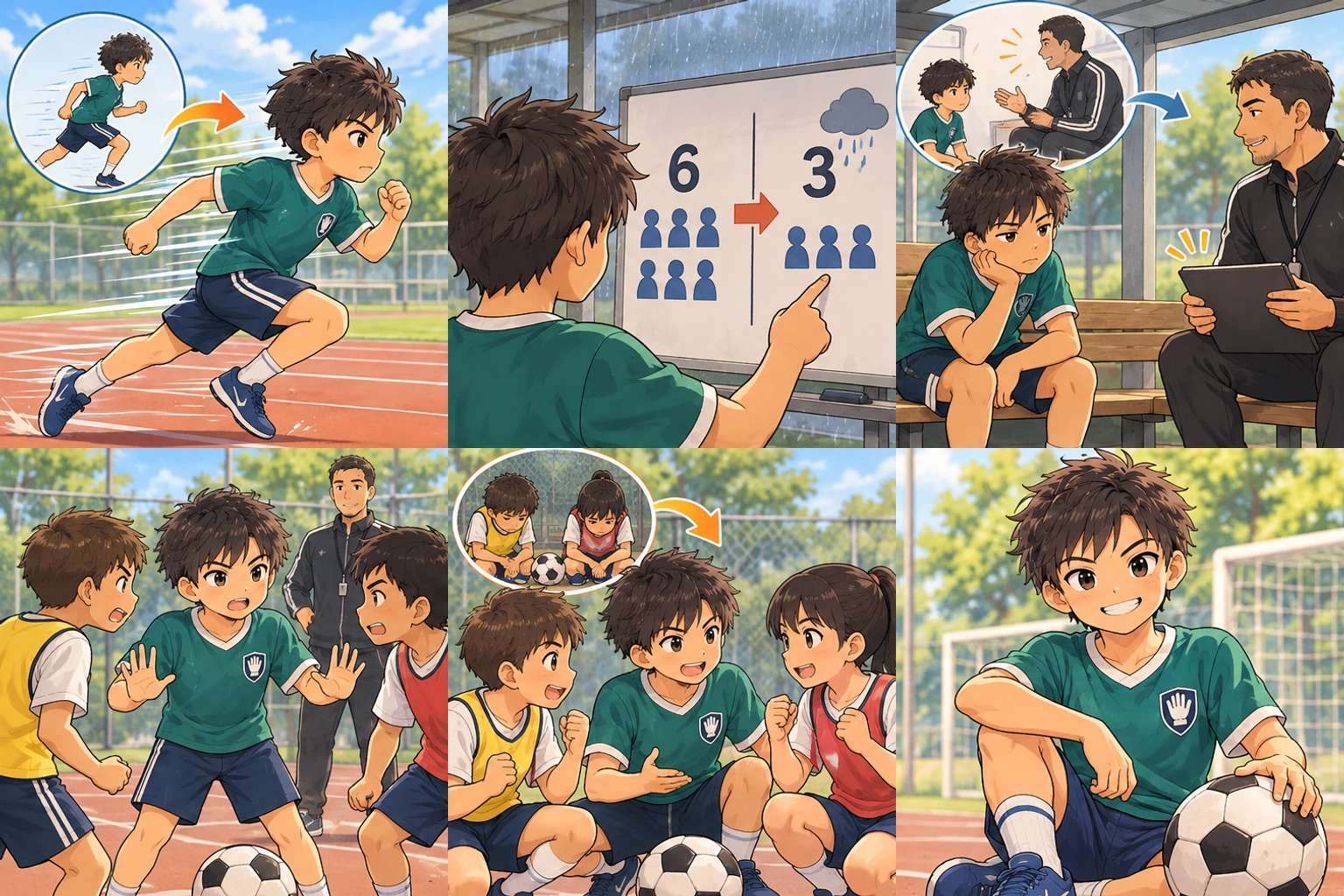
Nam stays through a long team talk until it finishes, despite looking bored.
sit out
He sat out the long team meeting.
Read the example again
He sat out the long team meeting.
We decided to sit the whole speech out.
Read the example again
We decided to sit the whole speech out.
View meaning & usage
Stay until an unpleasant event ends
sit something outsit out something
Here it means enduring something to the end. It can also mean not participating in a round; that is not the sense shown here.
Haven't studied yet
Nam calmly intervenes between two teammates arguing over a ball.
step in
He stepped in when his teammates began to argue.
Read the example again
He stepped in when his teammates began to argue.
The coach stepped in to settle the dispute.
Read the example again
The coach stepped in to settle the dispute.
View meaning & usage
Intervene to help resolve a situation
step instep in to do something
Enter a situation to help or prevent a problem, rather than simply walking into a room.
Haven't studied yet
Nam encourages two teammates, changing their mood from discouraged to eager to practise.
fire up
He fired his teammates up with an encouraging speech.
Read the example again
He fired his teammates up with an encouraging speech.
The coach knows how to fire up the team.
Read the example again
The coach knows how to fire up the team.
View meaning & usage
Make someone enthusiastic and motivated
fire someone upfire up the team
Figurative motivation, with no real flames. With a pronoun: “fire them up”.
Haven't studied yet
The examples were written for this course. Usage was checked against Matt Errey’s book, pages 120, 43, 118, 122, 45. A2–B1 is the course’s intended level.
Recall it · Use it
One step forward every day
Practice completed!
Your browser could not save your play history. Results from this session may be lost when you close the page.
Sentences using suggestions are counted as needing more practice. Review schedule based on each phrase's meaning.
Drag a wire from the dot beside a phrase to the dot beside its matching picture. You can also tap a phrase, then a picture. Drag again to change a pair before checking.
Read the picture descriptions for more context. Similar expressions are accepted when they fit the particular scene.
Phrases
Actions in the pictures
Picture description
Nam accelerates from left to right along an empty running lane.
The picture could not load. Try loading it again before matching.
Picture description
Nam sees practice attendance fall from six to three during rainy weather.
The picture could not load. Try loading it again before matching.
Picture description
Nam stays through a long team talk until it finishes, despite looking bored.
The picture could not load. Try loading it again before matching.
Picture description
Nam calmly intervenes between two teammates arguing over a ball.
The picture could not load. Try loading it again before matching.
Picture description
Nam encourages two teammates, changing their mood from discouraged to eager to practise.
The picture could not load. Try loading it again before matching.
Choose a phrase to begin.
Your browser could not save your play history. Results from this session may be lost when you close the page.
A conversation in context
Read the conversation and find the expressions you have learned.
Mai
Can we speed up the passing drill?
Read the example again
Can we speed up the passing drill?
Alex
A little, but our accuracy is falling off.
Read the example again
A little, but our accuracy is falling off.
Mai
Then let us rest before we fire the team up for another round.
Read the example again
Then let us rest before we fire the team up for another round.
Compare the uses
speed up / fall off
“Speed up” means become faster; here “fall off” means decrease in amount or level. Check the subject rather than assuming a literal fall from a surface.
Practice and check your answers
Try answering before revealing the suggested answer. This practice is not scored.
The answers below are models. Other answers can also work if they preserve the facts, meaning and structure requested in the task.
A situation to apply what you have learned
A relay team starts running faster, but the accuracy of its handovers decreases. After the drill, the team must stay until a long briefing ends.
Describe the faster movement.
Show the answer and explanation
The team speeds up during the drill.
The team runs faster with “speeds up”; increased speed does not establish better handover accuracy.
Complete: Our accuracy is beginning to fall ___.
Show the answer and explanation
off
“Accuracy… fall off” describes declining accuracy; “off” is not a runner physically falling.
Write a patient response about the briefing using sit out.
Show the answer and explanation
We will sit out the whole briefing before going home.
“Sit out the whole briefing” means remain until the long briefing ends; in this taught sense the team does not skip it or sit out a match.
The usage comparisons are checked against the Cambridge Dictionary entries linked beside the compared expressions. The additional conversations and exercises are written for this course.
Progress is saved on the device. Sign in with Google to save with the same account and continue on another device.