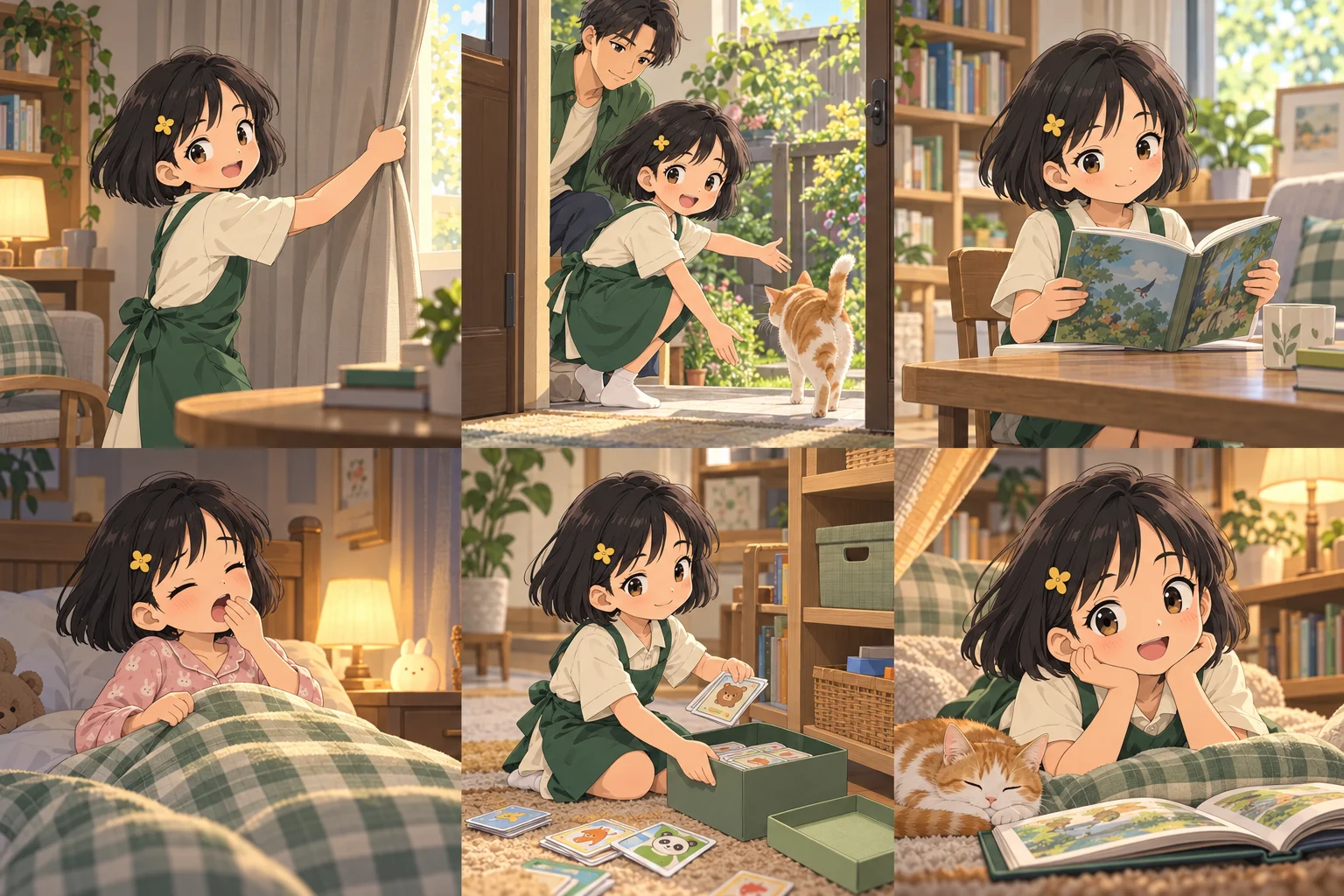
An sits upright on a chair and reads a book at a low table.
sit up
I sat up straight so I could see the page clearly.
Read the example again
I sat up straight so I could see the page clearly.
She asked us to sit up and listen.
Read the example again
She asked us to sit up and listen.
View meaning & usage
Sit in a more upright position
sit upsit up straight
This emphasises sitting more upright, unlike “sit down”, which means moving from standing to sitting. The past form is “sat”.
Haven't studied yet
An wears pyjamas, yawns gently and pulls up the blanket as she gets ready for bed in soft light.
turn in
I am tired, so I will turn in early tonight.
Read the example again
I am tired, so I will turn in early tonight.
We turned in after finishing our story.
Read the example again
We turned in after finishing our story.
View meaning & usage
Go to bed (informal)
turn inturn in early / late
An informal way to say go to bed, rather than hand in work in another sense of “turn in”. There is no object in this use.
Haven't studied yet
An packs game cards into their box and stores the box on a low shelf.
pack away
Pack the game away before dinner.
Read the example again
Pack the game away before dinner.
We packed away the art materials after class.
Read the example again
We packed away the art materials after class.
View meaning & usage
Pack and store things after use
pack away somethingpack something away
Similar to “put away”, often emphasising packing a set of materials or equipment after use. With a pronoun, say “pack them away”.
Haven't studied yet
The examples were written for this course. Usage was checked against Matt Errey’s book, pages 117, 78, 118, 133, 94. A2–B1 is the course’s intended level.
Recall it · Use it
One step forward every day
Practice completed!
Your browser could not save your play history. Results from this session may be lost when you close the page.
Sentences using suggestions are counted as needing more practice. Review schedule based on each phrase's meaning.
Drag a wire from the dot beside a phrase to the dot beside its matching picture. You can also tap a phrase, then a picture. Drag again to change a pair before checking.
Read the picture descriptions for more context. Similar expressions are accepted when they fit the particular scene.
Phrases
Actions in the pictures
Picture description
An closes the curtains to keep bright sunlight out of her reading corner.
The picture could not load. Try loading it again before matching.
Picture description
An opens the door for a cat to enter a safely enclosed yard, with an adult nearby.
The picture could not load. Try loading it again before matching.
Picture description
An sits upright on a chair and reads a book at a low table.
The picture could not load. Try loading it again before matching.
Picture description
An wears pyjamas, yawns gently and pulls up the blanket as she gets ready for bed in soft light.
The picture could not load. Try loading it again before matching.
Picture description
An packs game cards into their box and stores the box on a low shelf.
The picture could not load. Try loading it again before matching.
Choose a phrase to begin.
Your browser could not save your play history. Results from this session may be lost when you close the page.
A conversation in context
Read the conversation and find the expressions you have learned.
Mai
Close the curtains to shut out the sunlight.
Read the example again
Close the curtains to shut out the sunlight.
Alex
I will let the cat out into the enclosed garden first.
Read the example again
I will let the cat out into the enclosed garden first.
Mai
Then let us pack away the equipment and turn in early.
Read the example again
Then let us pack away the equipment and turn in early.
Compare the uses
shut out / let out
Here “shut out” keeps outside light from entering; “let out” allows the cat to leave. Keep the object and direction of each action clear.
Practice and check your answers
Try answering before revealing the suggested answer. This practice is not scored.
The answers below are models. Other answers can also work if they preserve the facts, meaning and structure requested in the task.
A situation to apply what you have learned
A studio’s curtains keep bright sunlight outside. A cat waits by a door to an enclosed garden while the occupants pack up for the evening.
Describe the curtains’ purpose.
Show the answer and explanation
The curtains shut out the sunlight.
The curtains keep sunlight from entering: “shut out the sunlight”; the aim is darkness.
Replace “the cat” with “it”: Let the cat out.
Show the answer and explanation
Let it out.
“It” replaces the cat being allowed into the enclosed garden; “let it out” keeps the pronoun between “let” and “out”.
Write an evening plan using turn in.
Show the answer and explanation
We will pack away the equipment and turn in early.
“Pack away” stores the equipment before “turn in early”, which here means go to bed early, not submit work.
The usage comparisons are checked against the Cambridge Dictionary entries linked beside the compared expressions. The additional conversations and exercises are written for this course.
Progress is saved on the device. Sign in with Google to save with the same account and continue on another device.