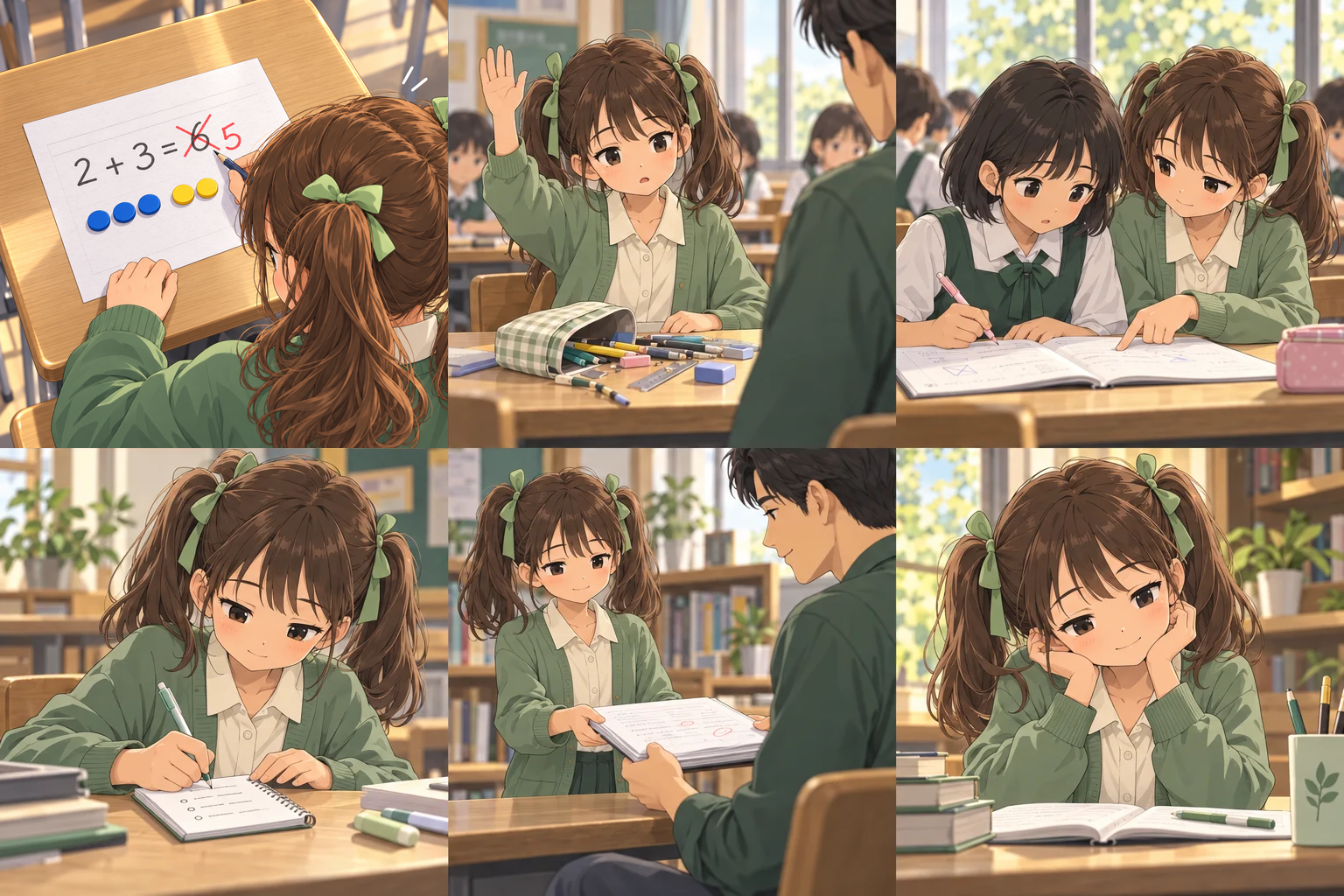
Nhi checks how a friend is getting on with an exercise and is ready to help.
check on
I will check on your progress after the break.
Read the example again
I will check on your progress after the break.
The teacher checked on us during the activity.
Read the example again
The teacher checked on us during the activity.
View meaning & usage
Check that someone or something is all right
check on someone / something
The focus is on checking well-being or progress, rather than examining every error as in “check over”. Do not separate the phrase.
Haven't studied yet
Nhi quickly notes a reminder in a small notebook after her teacher’s feedback.
jot down
Jot down the new date before you forget it.
Read the example again
Jot down the new date before you forget it.
I jotted her number down on a small card.
Read the example again
I jotted her number down on a small card.
View meaning & usage
Write a short note quickly
jot down somethingjot something down
Similar to “note down”, with an emphasis on a short, quick note. The past form is “jotted down”.
Haven't studied yet
Nhi brings her revised work to the teacher to follow up on feedback from the previous session.
follow up
I will follow up our lesson with some extra practice.
Read the example again
I will follow up our lesson with some extra practice.
We followed up the first discussion with another short meeting.
Read the example again
We followed up the first discussion with another short meeting.
View meaning & usage
Take further action after an earlier step
follow up somethingfollow something upfollow something up with something
This means taking further action on something already started. Add “with” to name the next action; it does not simply mean walking behind someone.
Haven't studied yet
The examples were written for this course. Usage was checked against Matt Errey’s book, pages 118, 92, 21, 69, 46. A2–B1 is the course’s intended level.
Recall it · Use it
One step forward every day
Practice completed!
Your browser could not save your play history. Results from this session may be lost when you close the page.
Sentences using suggestions are counted as needing more practice. Review schedule based on each phrase's meaning.
Drag a wire from the dot beside a phrase to the dot beside its matching picture. You can also tap a phrase, then a picture. Drag again to change a pair before checking.
Read the picture descriptions for more context. Similar expressions are accepted when they fit the particular scene.
Phrases
Actions in the pictures
Picture description
Nhi notices an arithmetic slip in her exercise; the 6 is crossed out and corrected to 5, with five counters to check the answer.
The picture could not load. Try loading it again before matching.
Picture description
Nhi raises her hand to admit spilling the pencil box in front of her teacher, looking honest.
The picture could not load. Try loading it again before matching.
Picture description
Nhi checks how a friend is getting on with an exercise and is ready to help.
The picture could not load. Try loading it again before matching.
Picture description
Nhi quickly notes a reminder in a small notebook after her teacher’s feedback.
The picture could not load. Try loading it again before matching.
Picture description
Nhi brings her revised work to the teacher to follow up on feedback from the previous session.
The picture could not load. Try loading it again before matching.
Choose a phrase to begin.
Your browser could not save your play history. Results from this session may be lost when you close the page.
A conversation in context
Read the conversation and find the expressions you have learned.
Mai
I slipped up when I copied the date.
Read the example again
I slipped up when I copied the date.
Alex
Thank you for owning up. Let us check on the booking.
Read the example again
Thank you for owning up. Let us check on the booking.
Mai
I will jot down the correct date and follow up tomorrow.
Read the example again
I will jot down the correct date and follow up tomorrow.
Compare the uses
slip up / own up
“Slip up” means make a mistake; “own up” means admit wrongdoing. An admission can help address the mistake without undoing it.
Practice and check your answers
Try answering before revealing the suggested answer. This practice is not scored.
The answers below are models. Other answers can also work if they preserve the facts, meaning and structure requested in the task.
A situation to apply what you have learned
An assistant accidentally prints the wrong date. He decides to admit it and check the corrected booking later.
Describe the mistake.
Show the answer and explanation
He slipped up when he printed the date.
The assistant accidentally printed the wrong date, so he “slipped up”; admitting it is the later “own up”.
Complete: I should own ___ to the mistake.
Show the answer and explanation
up
“Own up to the mistake” keeps “up to” before the admitted error; “up” cannot be omitted.
Write his follow-up promise.
Show the answer and explanation
I will follow up tomorrow to confirm the corrected booking.
“Follow up tomorrow to confirm…” promises to check the corrected booking tomorrow, beyond admitting today’s error.
The usage comparisons are checked against the Cambridge Dictionary entries linked beside the compared expressions. The additional conversations and exercises are written for this course.
Progress is saved on the device. Sign in with Google to save with the same account and continue on another device.