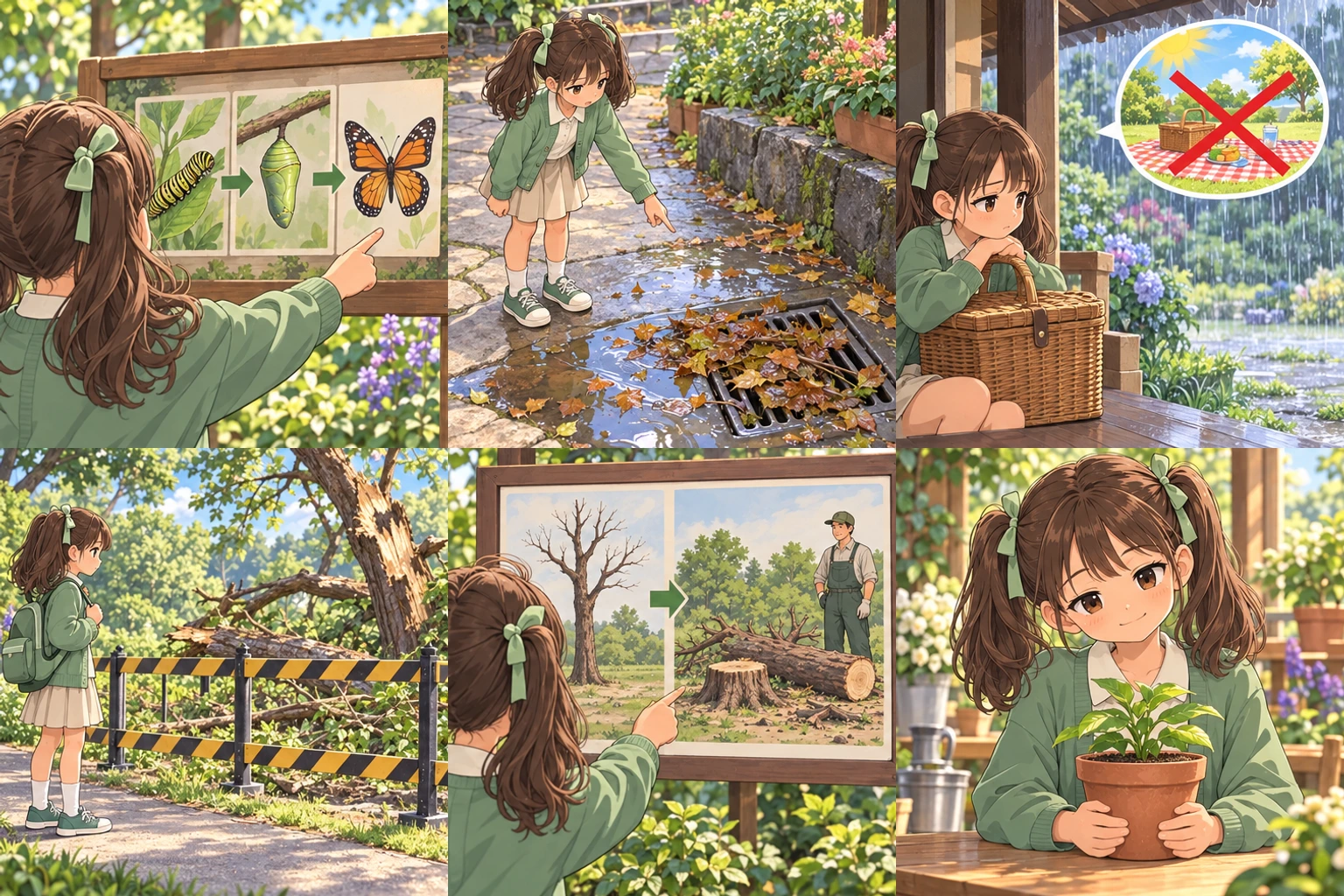
Nhi shelters beside a closed picnic basket while heavy rain cancels the planned picnic.
wash out
Heavy rain washed out our garden picnic.
Read the example again
Heavy rain washed out our garden picnic.
The match was washed out on Saturday.
Read the example again
The match was washed out on Saturday.
View meaning & usage
Cause an outdoor event to be cancelled by rain
wash out an eventan event is washed out
This sense is rain spoiling an outdoor event, not washing an object clean.
Haven't studied yet
Nhi stops outside a barrier and keeps her distance from a storm-damaged tree.
stay away
She stayed away from the damaged tree.
Read the example again
She stayed away from the damaged tree.
Please stay away from the wet path.
Read the example again
Please stay away from the wet path.
View meaning & usage
Keep away from a person or place
stay awaystay away from something
Use “from” before the place or thing to avoid. Do not split the expression with an object.
Haven't studied yet
Nhi views a before-and-after display showing a dead tree cut down, leaving a stump and a felled trunk.
chop down
The gardener chopped down the dead tree.
Read the example again
The gardener chopped down the dead tree.
They had to chop the damaged tree down.
Read the example again
They had to chop the damaged tree down.
View meaning & usage
Cut a tree down
chop down a treechop a tree down
Means cutting a tree so that it falls; “chop up” means cutting it into small pieces.
Haven't studied yet
The examples were written for this course. Usage was checked against Matt Errey’s book, pages 20, 23, 138, 122, 22. A2–B1 is the course’s intended level.
Recall it · Use it
One step forward every day
Practice completed!
Your browser could not save your play history. Results from this session may be lost when you close the page.
Sentences using suggestions are counted as needing more practice. Review schedule based on each phrase's meaning.
Drag a wire from the dot beside a phrase to the dot beside its matching picture. You can also tap a phrase, then a picture. Drag again to change a pair before checking.
Read the picture descriptions for more context. Similar expressions are accepted when they fit the particular scene.
Phrases
Actions in the pictures
Picture description
Nhi observes a life-cycle board showing caterpillar, chrysalis and butterfly in that order.
The picture could not load. Try loading it again before matching.
Picture description
Nhi stands on a dry path and sees wet leaves blocking a drain, with water pooling around it.
The picture could not load. Try loading it again before matching.
Picture description
Nhi shelters beside a closed picnic basket while heavy rain cancels the planned picnic.
The picture could not load. Try loading it again before matching.
Picture description
Nhi stops outside a barrier and keeps her distance from a storm-damaged tree.
The picture could not load. Try loading it again before matching.
Picture description
Nhi views a before-and-after display showing a dead tree cut down, leaving a stump and a felled trunk.
The picture could not load. Try loading it again before matching.
Choose a phrase to begin.
Your browser could not save your play history. Results from this session may be lost when you close the page.
A conversation in context
Read the conversation and find the expressions you have learned.
Mai
This caterpillar will change into a butterfly.
Read the example again
This caterpillar will change into a butterfly.
Alex
Let us move the wet leaves before they clog up the drain.
Read the example again
Let us move the wet leaves before they clog up the drain.
Mai
We should stay away from that damaged tree while we work.
Read the example again
We should stay away from that damaged tree while we work.
Compare the uses
change into / clog up
Here “change into” means transform into another form; “clog up” means block a passage. A natural transformation differs from material obstructing a flow.
Practice and check your answers
Try answering before revealing the suggested answer. This practice is not scored.
The answers below are models. Other answers can also work if they preserve the facts, meaning and structure requested in the task.
A situation to apply what you have learned
A caterpillar becomes a butterfly. Elsewhere, leaves block a garden drain and heavy rain ruins a picnic.
Describe the animal’s transformation.
Show the answer and explanation
The caterpillar changes into a butterfly.
The caterpillar becomes a butterfly with “changes into”; “into” introduces the resulting form.
Complete: Wet leaves have clogged ___ the drain.
Show the answer and explanation
up
“Clogged up the drain” means wet leaves blocked drainage; “up” completes the expression without upward movement.
Report the effect of rain using wash out.
Show the answer and explanation
The heavy rain washed out our garden picnic.
“Washed out our picnic” means heavy rain ruined the outing, without claiming people or objects were swept away.
The usage comparisons are checked against the Cambridge Dictionary entries linked beside the compared expressions. The additional conversations and exercises are written for this course.
Progress is saved on the device. Sign in with Google to save with the same account and continue on another device.