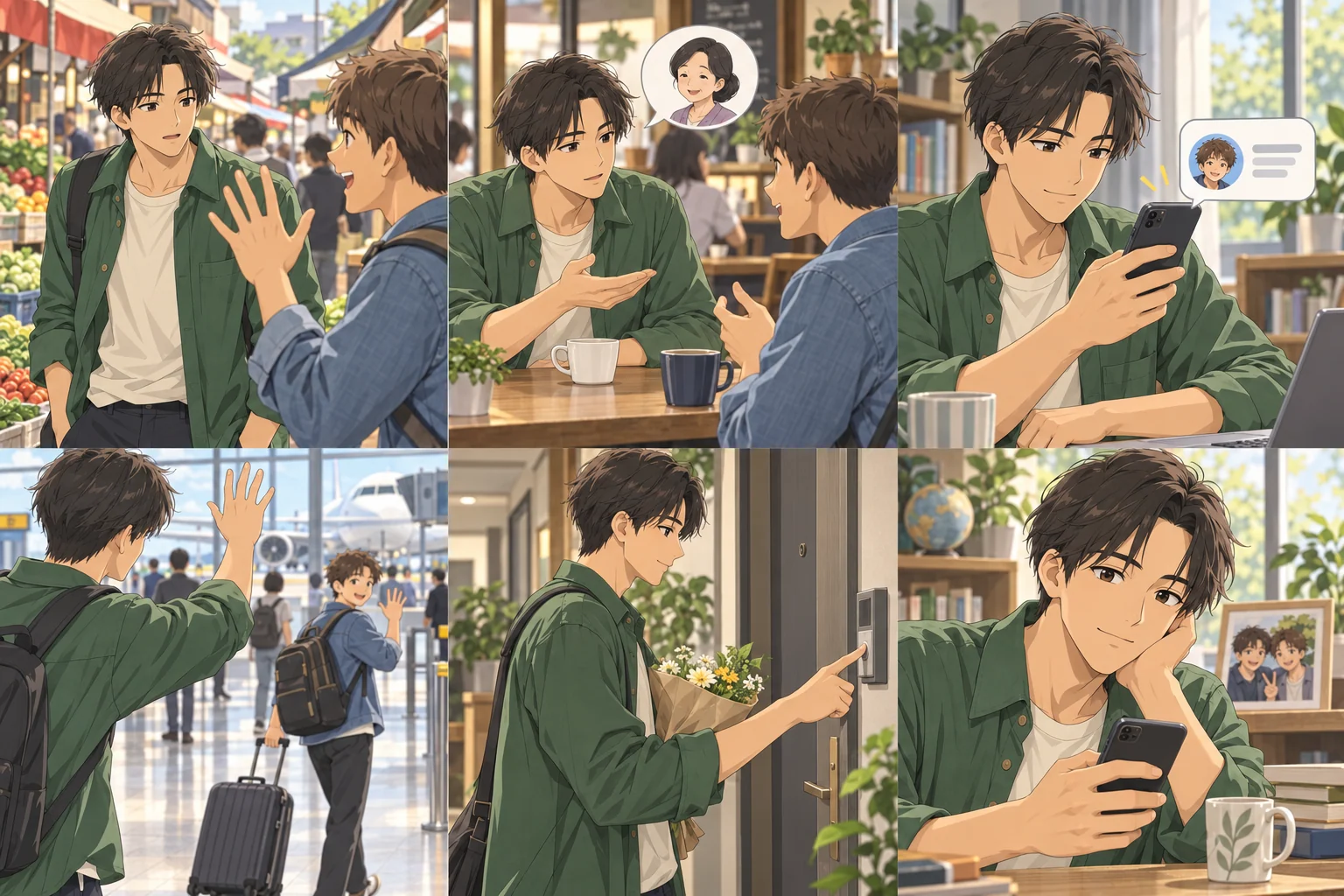
Minh received a text message from a friend he had not contacted for a long time.
hear from
I have not heard from Nam for a few weeks.
Read the example again
I have not heard from Nam for a few weeks.
It was lovely to hear from you again.
Read the example again
It was lovely to hear from you again.
View meaning & usage
Received news from someone
hear from someone
It can be receiving messages, letters or calls, not necessarily just hearing voices.
Haven't studied yet
Minh waved his hand to see off his friend carrying a suitcase at the airport.
see off
We went to the airport to see him off.
Read the example again
We went to the airport to see him off.
Can you come to the station and see me off?
Read the example again
Can you come to the station and see me off?
View meaning & usage
Send someone off on their way
see someone offsee off someone
You arrive at the departure point to say goodbye to the person who is leaving. Middle pronoun: “see him off”.
Haven't studied yet
Minh visited a friend at the apartment door.
call on
We called on an old friend while we were in Hue.
Read the example again
We called on an old friend while we were in Hue.
I will call on my uncle this weekend.
Read the example again
I will call on my uncle this weekend.
View meaning & usage
Visiting someone
call on someone
Here is a direct visit; don't have to call anyone.
Haven't studied yet
The examples were written for this course. Usage was checked against Matt Errey’s book, pages 16, 7, 62, 112, 19. A2–B1 is the course’s intended level.
Recall it · Use it
One step forward every day
Practice completed!
Your browser could not save your play history. Results from this session may be lost when you close the page.
Sentences using suggestions are counted as needing more practice. Review schedule based on each phrase's meaning.
Drag a wire from the dot beside a phrase to the dot beside its matching picture. You can also tap a phrase, then a picture. Drag again to change a pair before checking.
Read the picture descriptions for more context. Similar expressions are accepted when they fit the particular scene.
Phrases
Actions in the pictures
Picture description
Minh suddenly met his old friend at a market.
The picture could not load. Try loading it again before matching.
Picture description
Minh asks you about a relative who is not present.
The picture could not load. Try loading it again before matching.
Picture description
Minh received a text message from a friend he had not contacted for a long time.
The picture could not load. Try loading it again before matching.
Picture description
Minh waved his hand to see off his friend carrying a suitcase at the airport.
The picture could not load. Try loading it again before matching.
Picture description
Minh visited a friend at the apartment door.
The picture could not load. Try loading it again before matching.
Choose a phrase to begin.
Your browser could not save your play history. Results from this session may be lost when you close the page.
A conversation in context
Read the conversation and find the expressions you have learned.
Mai
I bumped into our old neighbour yesterday.
Read the example again
I bumped into our old neighbour yesterday.
Alex
Did she ask after your parents?
Read the example again
Did she ask after your parents?
Mai
Yes. I said I had heard from them that morning.
Read the example again
Yes. I said I had heard from them that morning.
Compare the uses
bump into / ask after
“Bump into” describes meeting unexpectedly; “ask after” means enquire about someone, often through another person. You need not meet the person you ask after.
Practice and check your answers
Try answering before revealing the suggested answer. This practice is not scored.
The answers below are models. Other answers can also work if they preserve the facts, meaning and structure requested in the task.
A situation to apply what you have learned
You unexpectedly meet a former teammate. She wants news of your brother, who is not present.
Describe the meeting using bump into.
Show the answer and explanation
I bumped into my former teammate.
The teammate meeting was unplanned, so use “bumped into”, with past-tense “bumped”.
Complete: She asked ___ my brother.
Show the answer and explanation
after
“Asked after my brother” asks about the absent brother’s well-being; “after” is required.
Write a message telling your brother about it.
Show the answer and explanation
I bumped into my former teammate, and she asked after you.
In the message to the brother, “you” is the person asked about; “bumped into” still describes the actual meeting.
The usage comparisons are checked against the Cambridge Dictionary entries linked beside the compared expressions. The additional conversations and exercises are written for this course.
Progress is saved on the device. Sign in with Google to save with the same account and continue on another device.