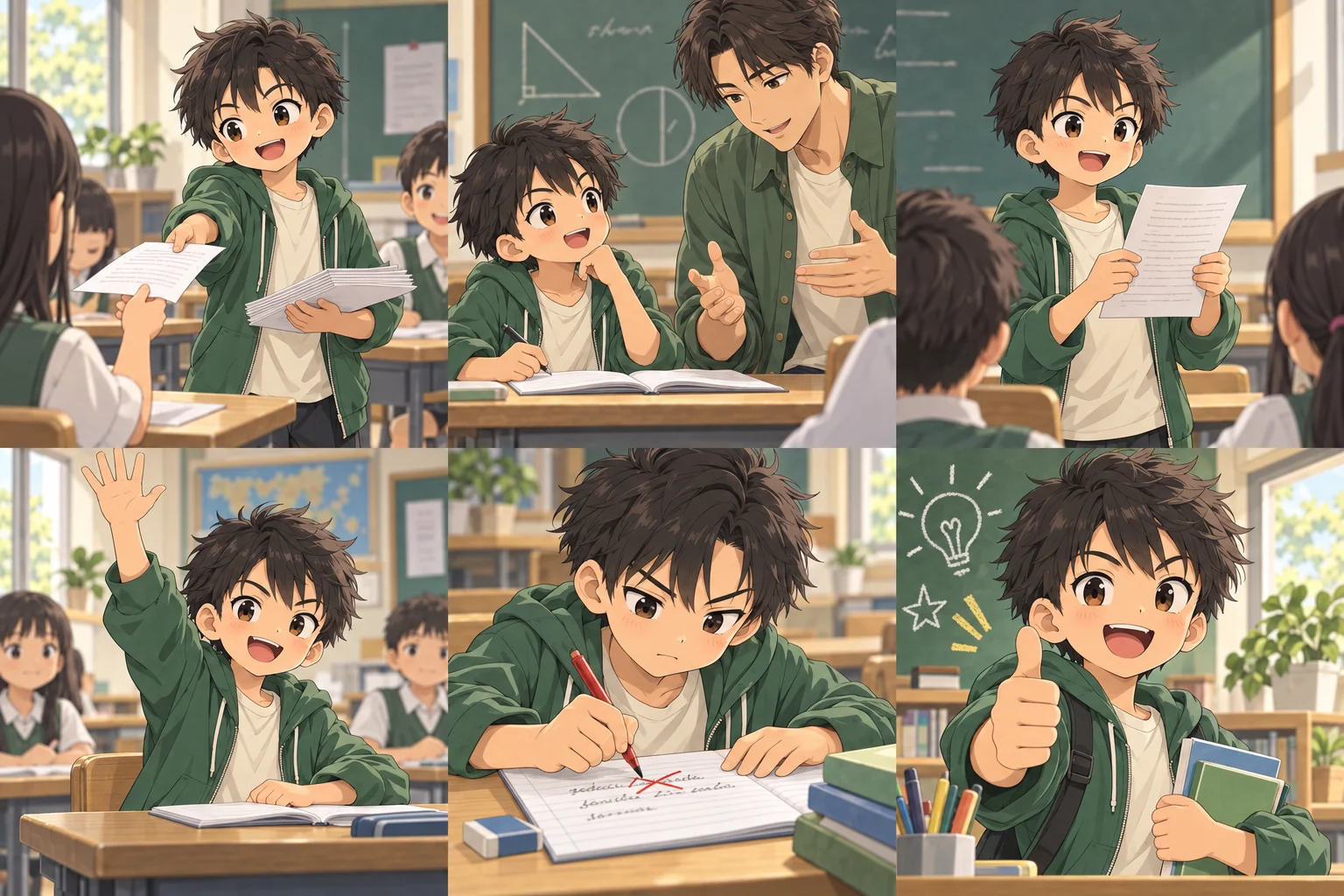
Bảo crossed out a misspelled word in his notebook.
cross out
Cross out the wrong word and write the correct one.
Read the example again
Cross out the wrong word and write the correct one.
I crossed my old answer out with a pencil.
Read the example again
I crossed my old answer out with a pencil.
View meaning & usage
Cross out the written word
cross out somethingcross something out
You draw a line through a word to indicate that the word is no longer in use.
Haven't studied yet
The examples were written for this course. Usage was checked against Matt Errey’s book, pages 54, 128, 106, 119, 30. A2–B1 is the course’s intended level.
Recall it · Use it
One step forward every day
Practice completed!
Your browser could not save your play history. Results from this session may be lost when you close the page.
Sentences using suggestions are counted as needing more practice. Review schedule based on each phrase's meaning.
Drag a wire from the dot beside a phrase to the dot beside its matching picture. You can also tap a phrase, then a picture. Drag again to change a pair before checking.
Read the picture descriptions for more context. Similar expressions are accepted when they fit the particular scene.
Phrases
Actions in the pictures
Picture description
Bảo distributed each worksheet to his classmates.
The picture could not load. Try loading it again before matching.
Picture description
Bảo listened attentively to Minh's explanation and gradually understood the lesson.
The picture could not load. Try loading it again before matching.
Picture description
Bảo held the paper and read it in front of his friends.
The picture could not load. Try loading it again before matching.
Picture description
Bảo raised his hand and boldly stated his opinion.
The picture could not load. Try loading it again before matching.
Picture description
Bảo crossed out a misspelled word in his notebook.
The picture could not load. Try loading it again before matching.
Choose a phrase to begin.
Your browser could not save your play history. Results from this session may be lost when you close the page.
A conversation in context
Read the conversation and find the expressions you have learned.
Mai
Please read out the instructions before we begin.
Read the example again
Please read out the instructions before we begin.
Alex
I need a moment to take them in.
Read the example again
I need a moment to take them in.
Mai
Ask questions, and speak out if something seems unfair.
Read the example again
Ask questions, and speak out if something seems unfair.
Compare the uses
read out / speak out
“Read out” means say written words aloud; “speak out” means express a view openly. Expressing an opinion need not involve reading an existing text.
Practice and check your answers
Try answering before revealing the suggested answer. This practice is not scored.
The answers below are models. Other answers can also work if they preserve the facts, meaning and structure requested in the task.
A situation to apply what you have learned
A class has written instructions and a rule one pupil thinks is unfair. The class must hear both.
How can the instructions be shared aloud?
Show the answer and explanation
Read out the instructions to the class.
The instructions are written; “read out” makes their content audible to the class.
Replace “the wrong word” with “it”: Cross out the wrong word.
Show the answer and explanation
Cross it out.
Replacing “the wrong word” with “it” changes “cross out the wrong word” to “cross it out”.
Invite an opinion without asking for more reading.
Show the answer and explanation
Speak out if you think the rule is unfair.
“Speak out” invites an opinion about the unfair rule, rather than more reading of the instructions.
The usage comparisons are checked against the Cambridge Dictionary entries linked beside the compared expressions. The additional conversations and exercises are written for this course.
Progress is saved on the device. Sign in with Google to save with the same account and continue on another device.