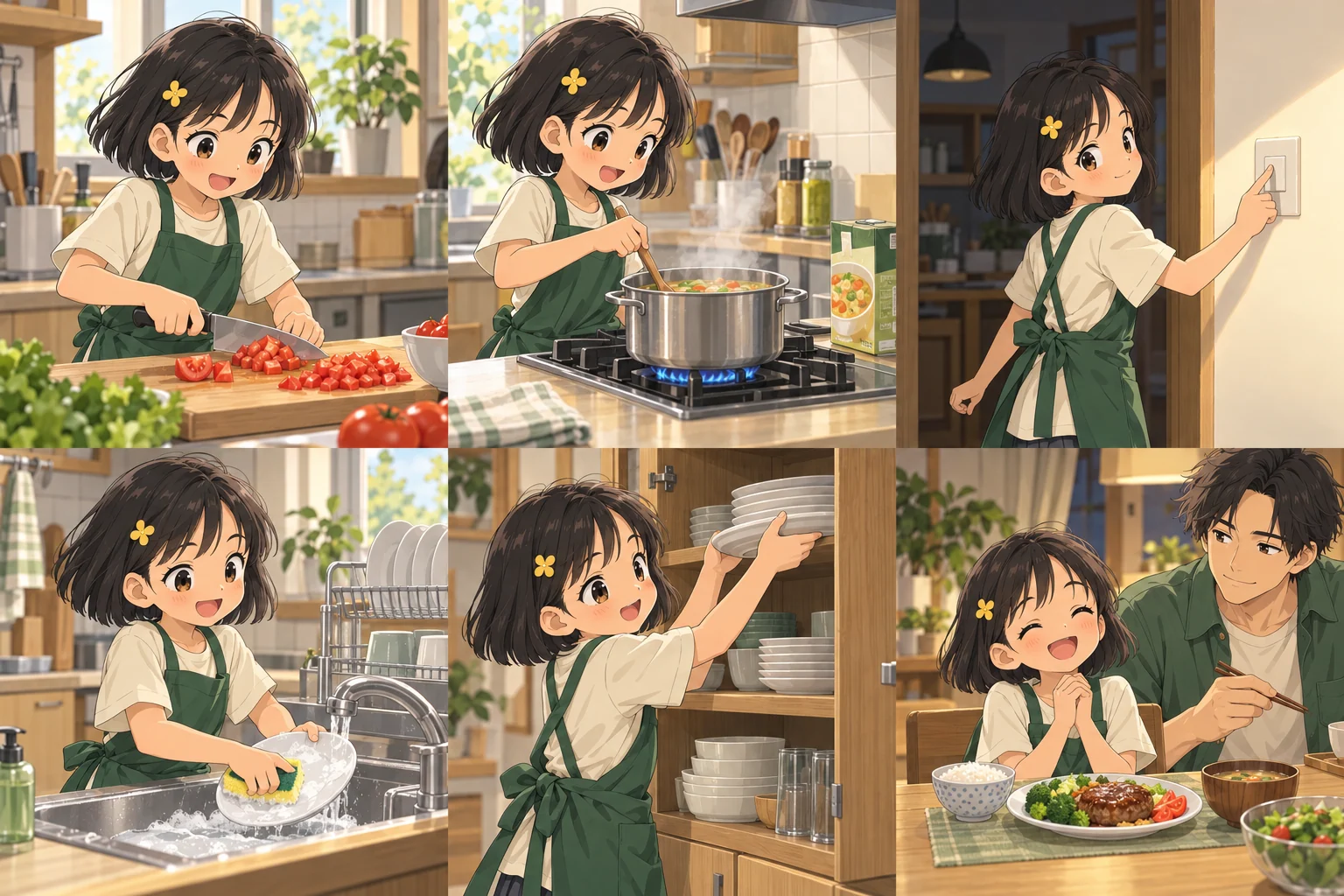
Dinner is finished. Why does An press the switch before leaving the kitchen?
turn off
Please turn off the kitchen light when you leave.
Read the example again
Please turn off the kitchen light when you leave.
The oven is still on. I'll turn it off.
Read the example again
The oven is still on. I'll turn it off.
View meaning & usage
Switch off a device or light
turn off + somethingturn + something + offturn it off
Antonym in device context: “turn on”. The pronoun “it” comes between the verb and “off”.
Haven't studied yet
After dinner, what needs to be done to the plates?
wash up
You cooked dinner, so I'll wash up.
Read the example again
You cooked dinner, so I'll wash up.
We can wash up the plates after dessert.
Read the example again
We can wash up the plates after dessert.
View meaning & usage
Wash the dishes (British English)
wash upwash up + the disheswash the dishes up
The meaning of “washing dishes” is common in British English. American English often say “do the dishes”; “wash up” can refer to washing hands/face.
Haven't studied yet
The plates are clean and dry. Where does An put them?
put away
The plates are dry. Please put them away.
Read the example again
The plates are dry. Please put them away.
Let's put away the bowls before we sit down.
Read the example again
Let's put away the bowls before we sit down.
View meaning & usage
Put something back where it belongs
put away + somethingput + something + awayput it / them away
In this lesson, "put away" means to put things in their place, not to throw them away. With “them”, use “put them away”.
Haven't studied yet
The examples were written for this course. Usage was checked against Matt Errey’s book, pages 22, 63, 134, 138, 101. A2–B1 is the course’s intended level.
Recall it · Use it
One step forward every day
Practice completed!
Your browser could not save your play history. Results from this session may be lost when you close the page.
Sentences using suggestions are counted as needing more practice. Review schedule based on each phrase's meaning.
Drag a wire from the dot beside a phrase to the dot beside its matching picture. You can also tap a phrase, then a picture. Drag again to change a pair before checking.
Read the picture descriptions for more context. Similar expressions are accepted when they fit the particular scene.
Phrases
Actions in the pictures
Picture description
An chops tomatoes on a cutting board, with small pieces of tomato beside her.
The picture could not load. Try loading it again before matching.
Picture description
An stirs a steaming pot of soup on the stove, beside a container of leftover soup.
The picture could not load. Try loading it again before matching.
Picture description
An pressed the light switch when leaving the kitchen.
The picture could not load. Try loading it again before matching.
Picture description
An uses a sponge to wash dishes at the sink; Clean plates are stacked on shelves.
The picture could not load. Try loading it again before matching.
Picture description
An puts clean dishes in a cabinet with neat stacks of dishes.
The picture could not load. Try loading it again before matching.
Choose a phrase to begin.
Your browser could not save your play history. Results from this session may be lost when you close the page.
A conversation in context
Read the conversation and find the expressions you have learned.
Mai
Could you chop up the carrots for our salad?
Read the example again
Could you chop up the carrots for our salad?
Alex
Yes. Shall I heat up the soup as well?
Read the example again
Yes. Shall I heat up the soup as well?
Mai
Please do, then turn off the cooker and put the bowls away.
Read the example again
Please do, then turn off the cooker and put the bowls away.
Compare the uses
chop up / heat up
“Chop up” makes ingredients into smaller pieces; “heat up” makes food hotter. Name the item clearly when asking for both tasks.
Practice and check your answers
Try answering before revealing the suggested answer. This practice is not scored.
The answers below are models. Other answers can also work if they preserve the facts, meaning and structure requested in the task.
A situation to apply what you have learned
Your cousin is packing a picnic. The fruit pieces are too large and yesterday’s rice is cold.
Give one instruction about the fruit.
Show the answer and explanation
Chop up the fruit before packing it.
The fruit pieces are too large, so use “chop up” to make them smaller before packing.
Replace “the rice” with “it”: Heat up the rice.
Show the answer and explanation
Heat it up.
“It” refers to the cold rice and goes between “heat” and “up”: “heat it up”.
Tell your cousin what to do with the unused plates.
Show the answer and explanation
Put the unused plates away in the cupboard.
The unused plates go into the cupboard; “put away” means store them, not throw them away.
The usage comparisons are checked against the Cambridge Dictionary entries linked beside the compared expressions. The additional conversations and exercises are written for this course.
Progress is saved on the device. Sign in with Google to save with the same account and continue on another device.