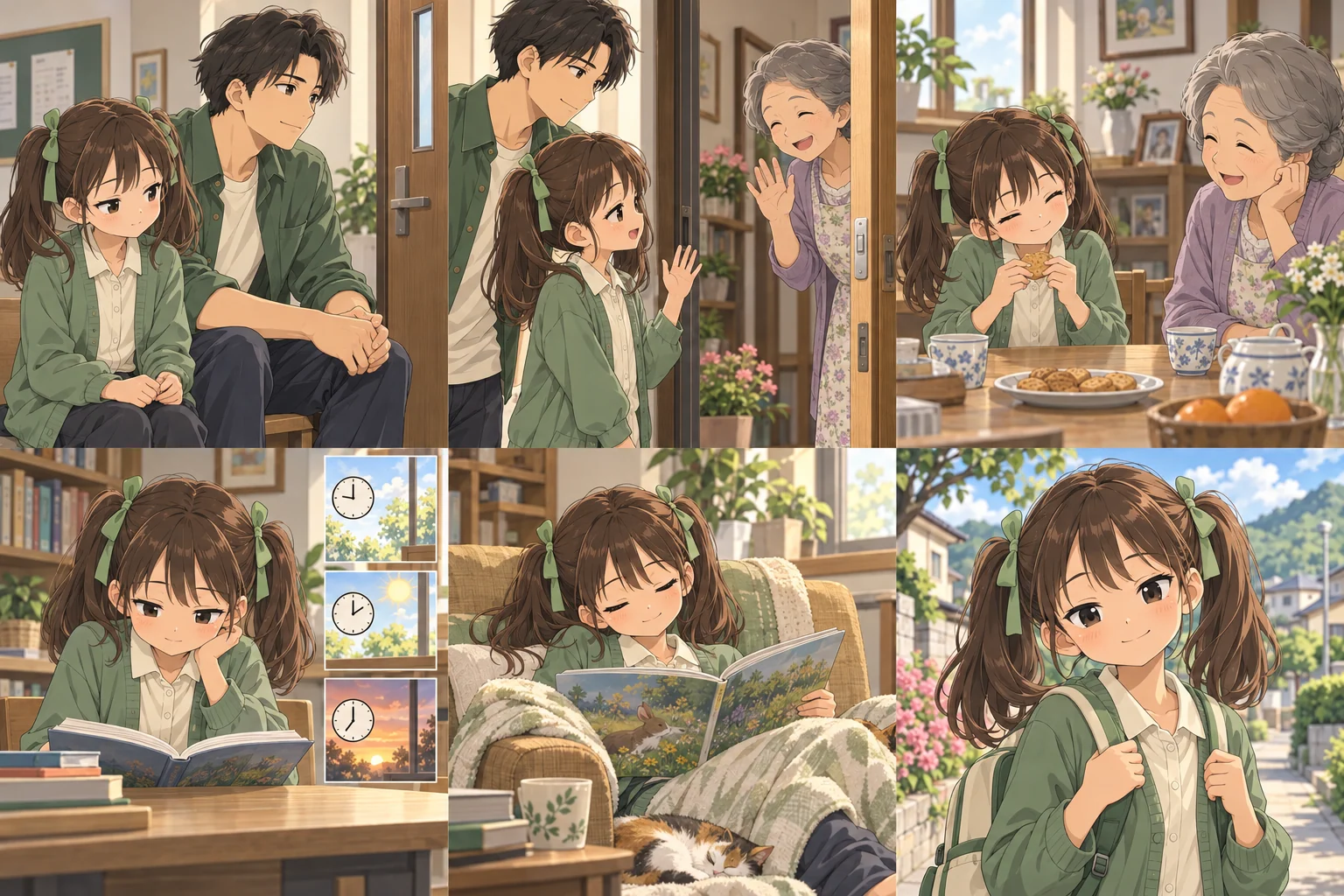
Nhi stayed at her grandmother's house for a while because the visit was fun.
stay on
We stayed on at Grandma’s house for another hour.
Read the example again
We stayed on at Grandma’s house for another hour.
Can we stay on a little longer?
Read the example again
Can we stay on a little longer?
View meaning & usage
Stayed longer than expected
stay onstay on for a period
Emphasis on prolonging stay instead of leaving as planned; You don't have to stay up late to "stay up".
Haven't studied yet
Nhi reads a book while the time changes from morning to afternoon.
go by
The afternoon went by quickly while I was reading.
Read the example again
The afternoon went by quickly while I was reading.
As the weeks go by, our plants get bigger.
Read the example again
As the weeks go by, our plants get bigger.
View meaning & usage
Time passes
time / days / weeks go by
The subject is time. The phrase can also refer to a passing place, but that is not the meaning in this lesson. Past tense “went”.
Haven't studied yet
Nhi relaxing on a chair with a picture book after a busy week.
chill out
After a busy week, I want to chill out at home.
Read the example again
After a busy week, I want to chill out at home.
We chilled out with music and a picture book.
Read the example again
We chilled out with music and a picture book.
View meaning & usage
Relax/rest comfortably
chill out
An informal way to relax, not to chill food.
Haven't studied yet
The examples were written for this course. Usage was checked against Matt Errey’s book, pages 61, 98, 122, 55, 22. A2–B1 is the course’s intended level.
Recall it · Use it
One step forward every day
Practice completed!
Your browser could not save your play history. Results from this session may be lost when you close the page.
Sentences using suggestions are counted as needing more practice. Review schedule based on each phrase's meaning.
Drag a wire from the dot beside a phrase to the dot beside its matching picture. You can also tap a phrase, then a picture. Drag again to change a pair before checking.
Read the picture descriptions for more context. Similar expressions are accepted when they fit the particular scene.
Phrases
Actions in the pictures
Picture description
Nhi and Minh waited near the living room door before opening the door.
The picture could not load. Try loading it again before matching.
Picture description
Nhi and Minh stopped by a neighbor's house to say hello for a moment.
The picture could not load. Try loading it again before matching.
Picture description
Nhi stayed at her grandmother's house for a while because the visit was fun.
The picture could not load. Try loading it again before matching.
Picture description
Nhi reads a book while the time changes from morning to afternoon.
The picture could not load. Try loading it again before matching.
Picture description
Nhi relaxing on a chair with a picture book after a busy week.
The picture could not load. Try loading it again before matching.
Choose a phrase to begin.
Your browser could not save your play history. Results from this session may be lost when you close the page.
A conversation in context
Read the conversation and find the expressions you have learned.
Mai
We are hanging around near the library this afternoon.
Read the example again
We are hanging around near the library this afternoon.
Alex
I might pop in to see the new exhibition.
Read the example again
I might pop in to see the new exhibition.
Mai
Then we can stay on for a drink if there is time.
Read the example again
Then we can stay on for a drink if there is time.
Compare the uses
hang around / pop in
“Hang around” means remain or spend time near a place; “pop in” means make a short visit. Lingering and a brief visit have different emphases.
Practice and check your answers
Try answering before revealing the suggested answer. This practice is not scored.
The answers below are models. Other answers can also work if they preserve the facts, meaning and structure requested in the task.
A situation to apply what you have learned
Friends spend time near a gallery with no fixed plan. One wants to make a short visit inside.
Describe spending the unplanned time.
Show the answer and explanation
They are hanging around near the gallery.
The friends spend unplanned time near the gallery, so they are “hanging around”.
Complete: I might pop ___ to see the drawings.
Show the answer and explanation
in
“Pop in” describes a brief visit inside to see the drawings.
Suggest remaining for the afternoon event.
Show the answer and explanation
We could stay on for the afternoon talk if we have time.
“Stay on for the afternoon talk” extends the visit; “if” makes this conditional on available time.
The usage comparisons are checked against the Cambridge Dictionary entries linked beside the compared expressions. The additional conversations and exercises are written for this course.
Progress is saved on the device. Sign in with Google to save with the same account and continue on another device.