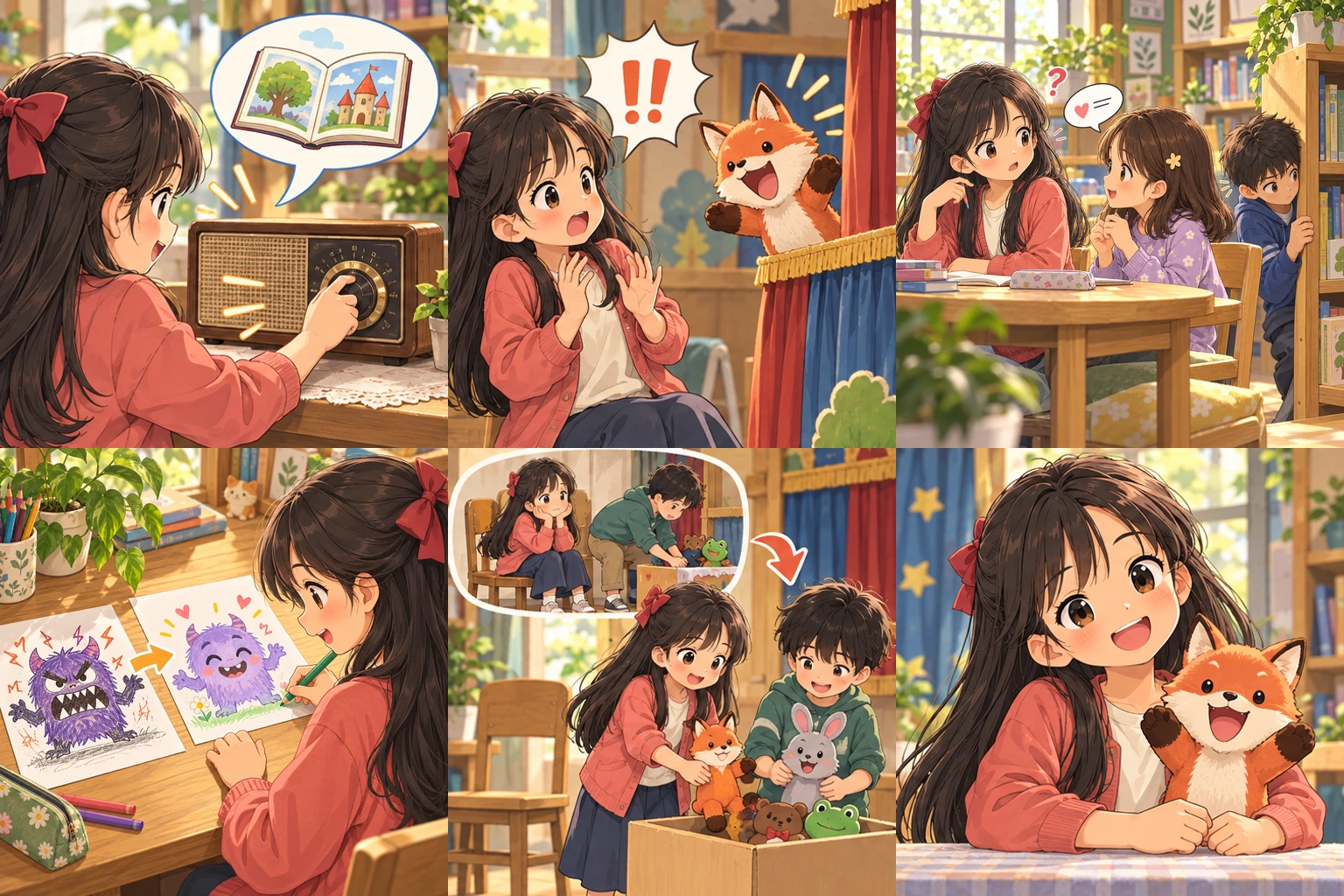
Vy softens a story illustration by changing a fierce sharp-toothed monster into a gentle one.
tone down
She toned down the scary parts of the story.
Read the example again
She toned down the scary parts of the story.
We toned the colours down for a calmer cover.
Read the example again
We toned the colours down for a calmer cover.
View meaning & usage
Make something less intense
tone down somethingtone something down
Reduce the intensity of language, imagery or presentation. It is not limited to lowering a device volume.
Haven't studied yet
Vy initially watches a friend clear the stage, then gets up to help instead of remaining inactive.
sit back
She would not sit back while her friends did all the work.
Read the example again
She would not sit back while her friends did all the work.
We cannot sit back and wait for someone else to help.
Read the example again
We cannot sit back and wait for someone else to help.
View meaning & usage
Remain inactive instead of helping
sit back and do somethingsit back
This lesson emphasises failing to act when help is needed, rather than simply leaning back in a chair.
Haven't studied yet
The examples were written for this course. Usage was checked against Matt Errey’s book, pages 133, 30, 79, 132, 118. A2–B1 is the course’s intended level.
Recall it · Use it
One step forward every day
Practice completed!
Your browser could not save your play history. Results from this session may be lost when you close the page.
Sentences using suggestions are counted as needing more practice. Review schedule based on each phrase's meaning.
Drag a wire from the dot beside a phrase to the dot beside its matching picture. You can also tap a phrase, then a picture. Drag again to change a pair before checking.
Read the picture descriptions for more context. Similar expressions are accepted when they fit the particular scene.
Phrases
Actions in the pictures
Picture description
Vy tunes a radio to a storytelling programme, represented by a book in a sound bubble.
The picture could not load. Try loading it again before matching.
Picture description
Vy gives a startled cry when a puppet suddenly pops up behind a small stage.
The picture could not load. Try loading it again before matching.
Picture description
Vy notices another child listening secretly from behind a shelf while she talks privately with a friend.
The picture could not load. Try loading it again before matching.
Picture description
Vy softens a story illustration by changing a fierce sharp-toothed monster into a gentle one.
The picture could not load. Try loading it again before matching.
Picture description
Vy initially watches a friend clear the stage, then gets up to help instead of remaining inactive.
The picture could not load. Try loading it again before matching.
Choose a phrase to begin.
Your browser could not save your play history. Results from this session may be lost when you close the page.
A conversation in context
Read the conversation and find the expressions you have learned.
Mai
Will you tune in to the storytelling programme tonight?
Read the example again
Will you tune in to the storytelling programme tonight?
Alex
Yes. I enjoy sitting back and listening to it.
Read the example again
Yes. I enjoy sitting back and listening to it.
Mai
Then I will tone down the music in the next room.
Read the example again
Then I will tone down the music in the next room.
Compare the uses
tune in / listen in
“Tune in” means listen to a broadcast; “listen in” means listen to a conversation, sometimes without invitation. A public broadcast and a private exchange give different contexts.
Practice and check your answers
Try answering before revealing the suggested answer. This practice is not scored.
The answers below are models. Other answers can also work if they preserve the facts, meaning and structure requested in the task.
A situation to apply what you have learned
A student follows a public radio broadcast. Next door, two people are having a private conversation.
Describe following the broadcast.
Show the answer and explanation
She tunes in to the radio programme.
Following a public radio programme is “tunes in to”, unlike eavesdropping on a private conversation.
Complete: Do not listen ___ on their private conversation.
Show the answer and explanation
in
“Listen in on” means eavesdrop; “do not” prohibits that action on the neighbours’ private conversation.
Ask for quieter music while listening.
Show the answer and explanation
Could you tone down the music while the programme is on?
“Tone down the music” requests lower volume to hear the programme, without necessarily switching the music off.
The usage comparisons are checked against the Cambridge Dictionary entries linked beside the compared expressions. The additional conversations and exercises are written for this course.
Progress is saved on the device. Sign in with Google to save with the same account and continue on another device.