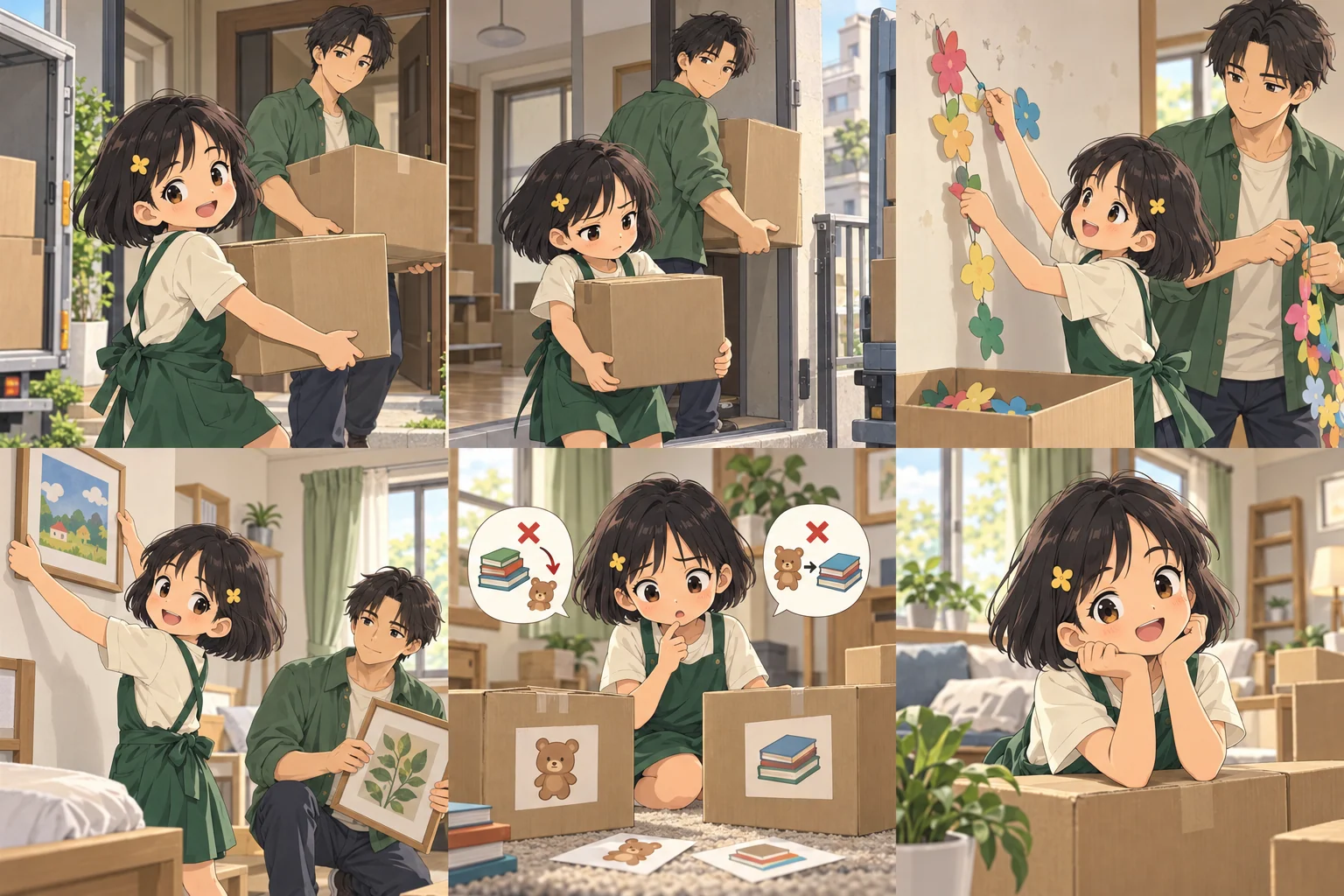
An and Minh removed the paper decorations from the low wall.
take down
Let us take down the paper decorations before we pack.
Read the example again
Let us take down the paper decorations before we pack.
Mum took the picture down from the wall.
Read the example again
Mum took the picture down from the wall.
View meaning & usage
Take down the hanging object
take down somethingtake something down
In the lesson, we are removing the object hanging above. With pronouns, say “take it down”; past tense “took”.
Haven't studied yet
An helped Minh redecorate the room with new paintings and curtains.
do up
We are doing up the living room with new curtains and paint.
Read the example again
We are doing up the living room with new curtains and paint.
They did the old house up before moving in.
Read the example again
They did the old house up before moving in.
View meaning & usage
Renovate / beautify the house
do up a house / roomdo something up
In the lesson, it is about renovating or renovating a house or room; different from buttoning a shirt. Past tense “did”.
Haven't studied yet
An realized she had mistakenly labeled the picture on two boxes and corrected it.
mess up
I mixed up the labels and messed up our packing plan.
Read the example again
I mixed up the labels and messed up our packing plan.
It is all right if you mess it up. We can try again.
Read the example again
It is all right if you mess it up. We can try again.
View meaning & usage
Do wrong / ruin things
mess up somethingmess something upmess up
Informal expressions to make mistakes or cause things to not go well. Not consistent with just making the room messy.
Haven't studied yet
The examples were written for this course. Usage was checked against Matt Errey’s book, pages 88, 88, 127, 37, 87. A2–B1 is the course’s intended level.
Recall it · Use it
One step forward every day
Practice completed!
Your browser could not save your play history. Results from this session may be lost when you close the page.
Sentences using suggestions are counted as needing more practice. Review schedule based on each phrase's meaning.
Drag a wire from the dot beside a phrase to the dot beside its matching picture. You can also tap a phrase, then a picture. Drag again to change a pair before checking.
Read the picture descriptions for more context. Similar expressions are accepted when they fit the particular scene.
Phrases
Actions in the pictures
Picture description
An and Minh carried the box of things into the new house.
The picture could not load. Try loading it again before matching.
Picture description
An and her family carried the last box out of the old house.
The picture could not load. Try loading it again before matching.
Picture description
An and Minh removed the paper decorations from the low wall.
The picture could not load. Try loading it again before matching.
Picture description
An helped Minh redecorate the room with new paintings and curtains.
The picture could not load. Try loading it again before matching.
Picture description
An realized she had mistakenly labeled the picture on two boxes and corrected it.
The picture could not load. Try loading it again before matching.
Choose a phrase to begin.
Your browser could not save your play history. Results from this session may be lost when you close the page.
A conversation in context
Read the conversation and find the expressions you have learned.
Mai
When are you moving into the new flat?
Read the example again
When are you moving into the new flat?
Alex
On Friday. We must move out of this one first.
Read the example again
On Friday. We must move out of this one first.
Mai
I can help you take down the shelves.
Read the example again
I can help you take down the shelves.
Compare the uses
move in / move out
“Move in” means start living somewhere; “move out” means leave that home. Moving a few boxes does not necessarily change where you live.
Practice and check your answers
Try answering before revealing the suggested answer. This practice is not scored.
The answers below are models. Other answers can also work if they preserve the facts, meaning and structure requested in the task.
A situation to apply what you have learned
A family leaves a rented room and begins living in a cottage. Shelves must be removed before leaving.
Describe leaving the old home.
Show the answer and explanation
The family is moving out of the rented room.
Leaving the old rented room is “moving out of”; “out of” introduces the home being vacated.
Replace “the shelves” with “them”: Take down the shelves.
Show the answer and explanation
Take them down.
“Them” replaces the shelves being removed, so use “take them down” with the pronoun before “down”.
Write the next stage using move in.
Show the answer and explanation
We will move into the cottage after we return the old keys.
“Move into the cottage” starts residence in the new home; the following clause places this after returning the old keys.
The usage comparisons are checked against the Cambridge Dictionary entries linked beside the compared expressions. The additional conversations and exercises are written for this course.
Progress is saved on the device. Sign in with Google to save with the same account and continue on another device.