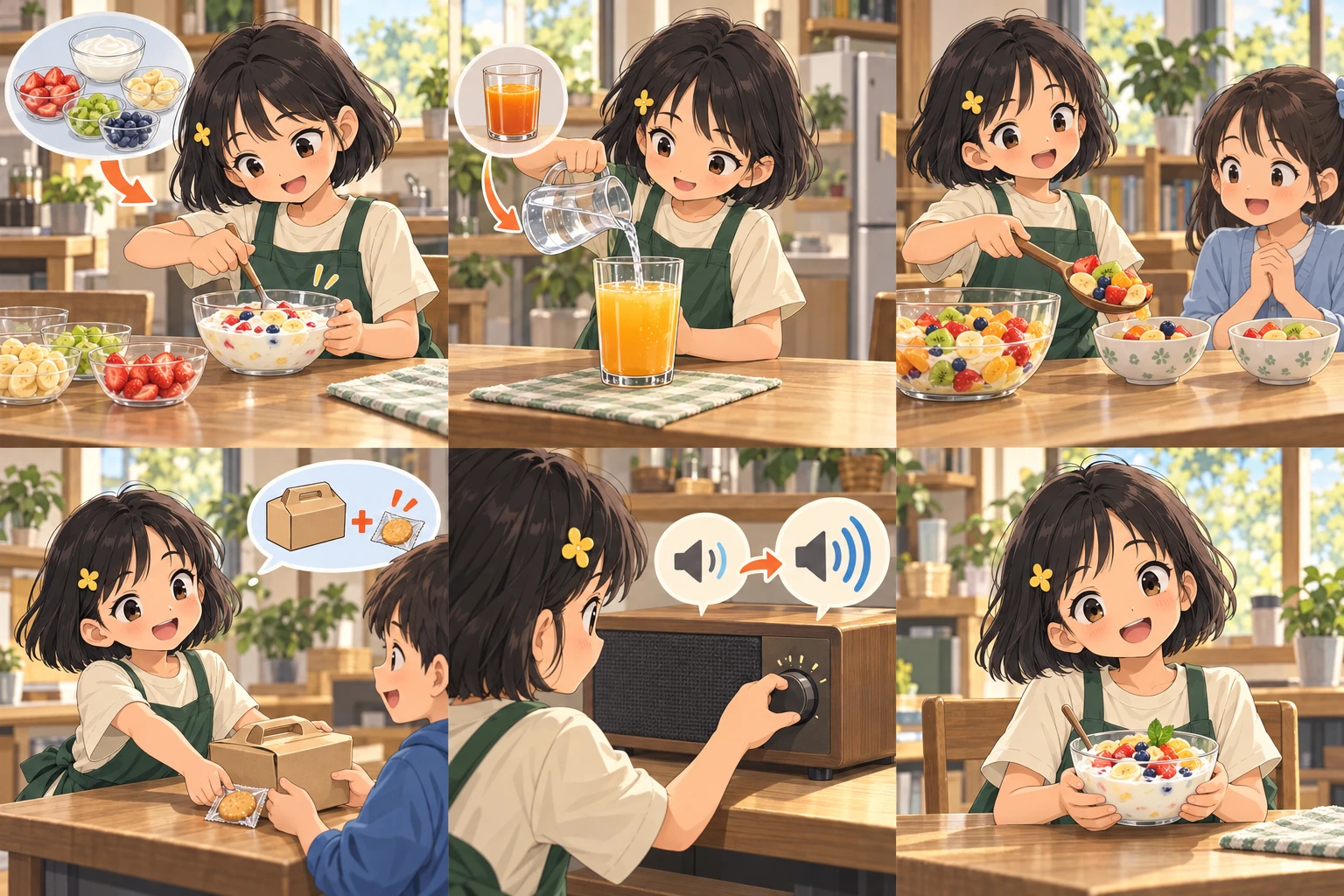
An dishes out fruit from a serving bowl into friends’ smaller bowls.
dish out
She dished out fruit into the smaller bowls.
Read the example again
She dished out fruit into the smaller bowls.
Could you dish the salad out while I set the table?
Read the example again
Could you dish the salad out while I set the table?
View meaning & usage
Serve food in portions
dish out fooddish food out
Informal; here it means serving food. It can also be used figuratively with praise or criticism.
Haven't studied yet
An throws in a free biscuit with a snack box for a friend.
throw in
She threw in a free biscuit with the snack box.
Read the example again
She threw in a free biscuit with the snack box.
The shop will throw a small bag in for free.
Read the example again
The shop will throw a small bag in for free.
View meaning & usage
Include an extra item at no additional cost
throw in somethingthrow something in
Here this describes an extra included to improve an offer, not physically throwing an object. The past form is “threw”.
Haven't studied yet
An cranks up the radio volume at the snack corner.
crank up
She cranked up the radio so we could hear the song.
Read the example again
She cranked up the radio so we could hear the song.
They cranked the heating up when the room got cold.
Read the example again
They cranked the heating up when the room got cold.
View meaning & usage
Increase a volume or level
crank up somethingcrank something up
An informal expression similar to “turn up”, often suggesting a noticeable increase. A mechanical crank is not required.
Haven't studied yet
The examples were written for this course. Usage was checked against Matt Errey’s book, pages 139, 138, 36, 131, 30. A2–B1 is the course’s intended level.
Drag a wire from the dot beside a phrase to the dot beside its matching picture. You can also tap a phrase, then a picture. Drag again to change a pair before checking.
Read the picture descriptions for more context. Similar expressions are accepted when they fit the particular scene.
Phrases
Actions in the pictures
Picture description
An whips up a fruit-yogurt snack from prepared ingredients.
The picture could not load. Try loading it again before matching.
Picture description
An waters down strong fruit juice by adding plain water.
The picture could not load. Try loading it again before matching.
Picture description
An dishes out fruit from a serving bowl into friends’ smaller bowls.
The picture could not load. Try loading it again before matching.
Picture description
An throws in a free biscuit with a snack box for a friend.
The picture could not load. Try loading it again before matching.
Picture description
An cranks up the radio volume at the snack corner.
The picture could not load. Try loading it again before matching.
Choose a phrase to begin.
Your browser could not save your play history. Results from this session may be lost when you close the page.
A conversation in context
Read the conversation and find the expressions you have learned.
Mai
Can we whip up a quick snack for the visitors?
Read the example again
Can we whip up a quick snack for the visitors?
Alex
Yes. Should I water down this juice?
Read the example again
Yes. Should I water down this juice?
Mai
A little, then we can dish out the sandwiches.
Read the example again
A little, then we can dish out the sandwiches.
Compare the uses
whip up / water down
Here “whip up” means prepare food quickly; “water down” means dilute it with water. Quick preparation does not itself mean dilution or lower quality.
Practice and check your answers
Try answering before revealing the suggested answer. This practice is not scored.
The answers below are models. Other answers can also work if they preserve the facts, meaning and structure requested in the task.
A situation to apply what you have learned
Unexpected guests arrive. The host can quickly make noodles, but a fruit drink is too concentrated.
Describe the quick meal preparation.
Show the answer and explanation
She can whip up some noodles.
Unexpected guests call for quickly preparing food: “whip up some noodles”, rather than merely serve an existing dish.
Replace “the juice” with “it”: Water down the juice.
Show the answer and explanation
Water it down.
“It” replaces the over-concentrated juice and goes between “water” and “down”: “water it down”.
Write a serving instruction after preparation.
Show the answer and explanation
Dish out the noodles once the guests are seated.
“Dish out the noodles” portions and serves them after the guests sit down, rather than cooks them.
The usage comparisons are checked against the Cambridge Dictionary entries linked beside the compared expressions. The additional conversations and exercises are written for this course.
Progress is saved on the device. Sign in with Google to save with the same account and continue on another device.