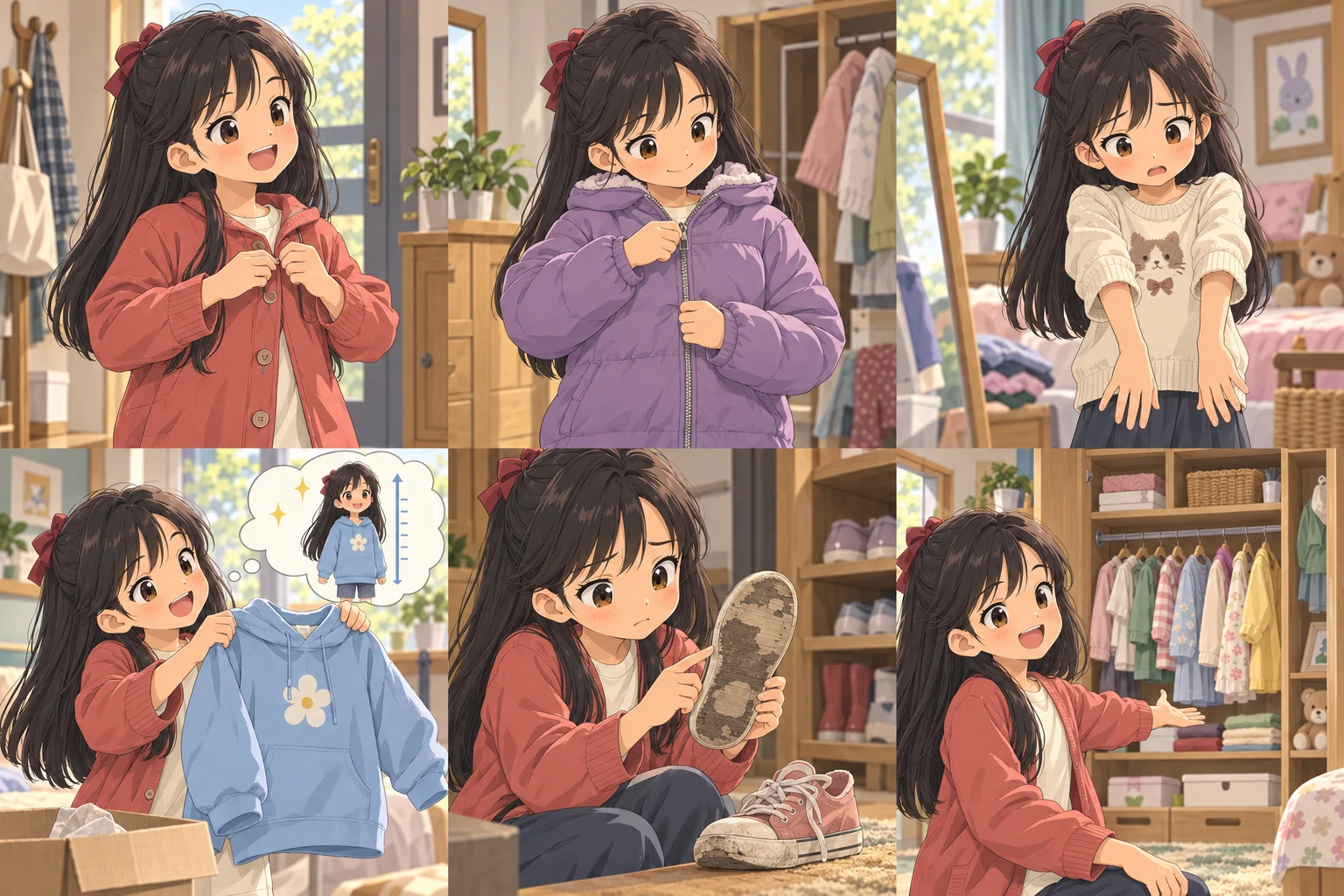
Vy tried on an old shirt whose sleeves were too short.
grow out of
I have grown out of my old coat.
Read the example again
I have grown out of my old coat.
Children often grow out of their shoes quickly.
Read the example again
Children often grow out of their shoes quickly.
View meaning & usage
Growing up makes things no longer fit
grow out of something
Clothes that originally fit but become tight as people grow older. Past tense “grew”, participle “grown”.
Haven't studied yet
Vy held a new shirt that was still loose and imagined that when she was taller she would be able to wear it.
grow into
This coat is big, but you will grow into it.
Read the example again
This coat is big, but you will grow into it.
My brother grew into the boots after a few months.
Read the example again
My brother grew into the boots after a few months.
View meaning & usage
Bigger to fit loose clothes
grow into something
The clothes are too loose; As you grow older, you will fit it. Different direction from “grow out of”.
Haven't studied yet
Vy observed a pair of old shoes whose soles were worn out after many times of wearing.
wear out
I wore out my shoes by walking in them every day.
Read the example again
I wore out my shoes by walking in them every day.
These socks are worn out. I need a new pair.
Read the example again
These socks are worn out. I need a new pair.
View meaning & usage
Making things wear out/broken due to heavy use
wear out somethingwear something outbe worn out
The meaning here is that something is damaged due to overuse. Past tense “wore”, participle “worn”; “Wear someone out” means to make someone tired.
Haven't studied yet
The examples were written for this course. Usage was checked against Matt Errey’s book, pages 36, 142, 58, 57, 138. A2–B1 is the course’s intended level.
Recall it · Use it
One step forward every day
Practice completed!
Your browser could not save your play history. Results from this session may be lost when you close the page.
Sentences using suggestions are counted as needing more practice. Review schedule based on each phrase's meaning.
Drag a wire from the dot beside a phrase to the dot beside its matching picture. You can also tap a phrase, then a picture. Drag again to change a pair before checking.
Read the picture descriptions for more context. Similar expressions are accepted when they fit the particular scene.
Phrases
Actions in the pictures
Picture description
Vy fastened the buttons on her coat before going out.
The picture could not load. Try loading it again before matching.
Picture description
Vy zips up a jacket with clear zippers.
The picture could not load. Try loading it again before matching.
Picture description
Vy tried on an old shirt whose sleeves were too short.
The picture could not load. Try loading it again before matching.
Picture description
Vy held a new shirt that was still loose and imagined that when she was taller she would be able to wear it.
The picture could not load. Try loading it again before matching.
Picture description
Vy observed a pair of old shoes whose soles were worn out after many times of wearing.
The picture could not load. Try loading it again before matching.
Choose a phrase to begin.
Your browser could not save your play history. Results from this session may be lost when you close the page.
A conversation in context
Read the conversation and find the expressions you have learned.
Mai
Can you help me do up these buttons?
Read the example again
Can you help me do up these buttons?
Alex
Yes. Your old coat looks worn out.
Read the example again
Yes. Your old coat looks worn out.
Mai
This new one has room for me to grow into it.
Read the example again
This new one has room for me to grow into it.
Compare the uses
do up / zip up
“Do up” can mean fasten clothing; “zip up” specifically involves a zip. Choose according to how the item closes.
Practice and check your answers
Try answering before revealing the suggested answer. This practice is not scored.
The answers below are models. Other answers can also work if they preserve the facts, meaning and structure requested in the task.
A situation to apply what you have learned
A coat has buttons, while a second coat has a zip. A child needs help fastening the first coat.
Give the request for the buttoned coat.
Show the answer and explanation
Could you help me do up these buttons?
The first coat has buttons, so ask to “do up these buttons”, rather than zip the second coat.
Correct: Please zip up it before going outside.
Show the answer and explanation
Please zip it up before going outside.
“It” refers to the zipped coat and precedes “up”: “zip it up”.
Explain why an old coat needs replacing.
Show the answer and explanation
The old coat is worn out, so we need another one.
“Is worn out” describes damage from use and explains why another coat is needed.
The usage comparisons are checked against the Cambridge Dictionary entries linked beside the compared expressions. The additional conversations and exercises are written for this course.
Progress is saved on the device. Sign in with Google to save with the same account and continue on another device.