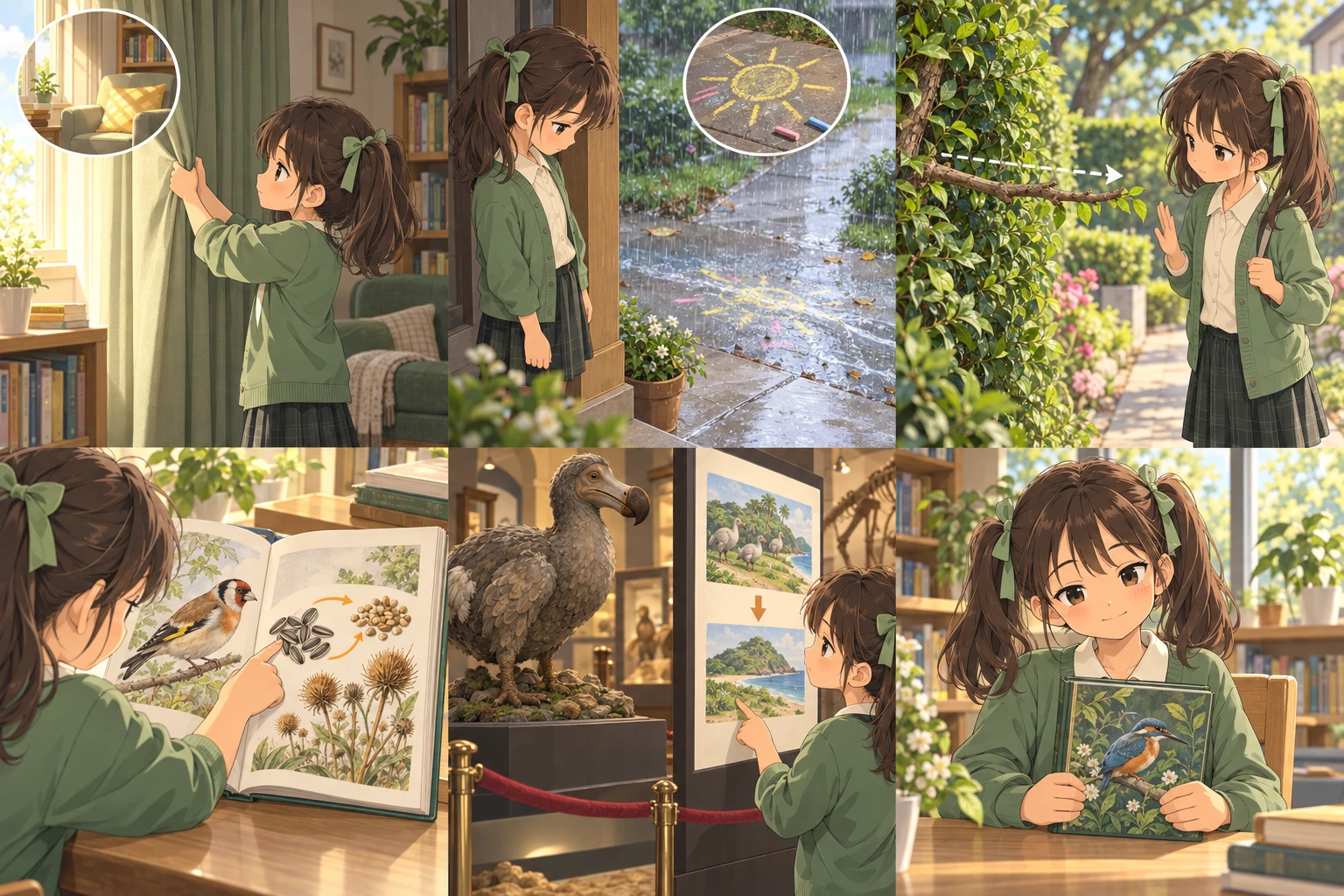
A branch juts out from a hedge beside the path; Nhi notices it from a safe distance.
jut out
A branch juts out from the hedge.
Read the example again
A branch juts out from the hedge.
Be careful of the rock jutting out beside the path.
Read the example again
Be careful of the rock jutting out beside the path.
View meaning & usage
Project beyond a surface or an edge
jut outjut out from something
Describes a part projecting outward. The -ing form is “jutting”, with a double t. This is a position, not a branch growing rapidly.
Haven't studied yet
Nhi learns about a seed-eating bird that lives on seeds.
live on
These small birds live on seeds.
Read the example again
These small birds live on seeds.
During the trip, we lived on rice and beans.
Read the example again
During the trip, we lived on rice and beans.
View meaning & usage
Have a particular food as a main source of nourishment
live on something
Here this describes a main food source. “Live on” can also describe living on an income. It does not mean living on top of the food.
Haven't studied yet
Nhi views a museum display showing that dodos died out.
die out
Dodos died out centuries ago.
Read the example again
Dodos died out centuries ago.
Some old traditions are dying out.
Read the example again
Some old traditions are dying out.
View meaning & usage
Become extinct or disappear completely
something dies out
Use this for a species or custom disappearing, not just one individual dying. The -ing form of “die” is “dying”.
Haven't studied yet
The examples were written for this course. Usage was checked against Matt Errey’s book, pages 12, 137, 69, 79, 36. A2–B1 is the course’s intended level.
Recall it · Use it
One step forward every day
Practice completed!
Your browser could not save your play history. Results from this session may be lost when you close the page.
Sentences using suggestions are counted as needing more practice. Review schedule based on each phrase's meaning.
Drag a wire from the dot beside a phrase to the dot beside its matching picture. You can also tap a phrase, then a picture. Drag again to change a pair before checking.
Read the picture descriptions for more context. Similar expressions are accepted when they fit the particular scene.
Phrases
Actions in the pictures
Picture description
Nhi draws a curtain to block out bright sunlight at her reading corner.
The picture could not load. Try loading it again before matching.
Picture description
Nhi watches rain wash away a chalk drawing on the path from a dry porch.
The picture could not load. Try loading it again before matching.
Picture description
A branch juts out from a hedge beside the path; Nhi notices it from a safe distance.
The picture could not load. Try loading it again before matching.
Picture description
Nhi learns about a seed-eating bird that lives on seeds.
The picture could not load. Try loading it again before matching.
Picture description
Nhi views a museum display showing that dodos died out.
The picture could not load. Try loading it again before matching.
Choose a phrase to begin.
Your browser could not save your play history. Results from this session may be lost when you close the page.
A conversation in context
Read the conversation and find the expressions you have learned.
Mai
That branch blocks out much of the light.
Read the example again
That branch blocks out much of the light.
Alex
The rain washed away the chalk marks below it.
Read the example again
The rain washed away the chalk marks below it.
Mai
Let us check whether any part is jutting out over the path.
Read the example again
Let us check whether any part is jutting out over the path.
Compare the uses
block out / wash away
“Block out” prevents light or sound from entering; “wash away” removes something with water. The causes and results differ.
Practice and check your answers
Try answering before revealing the suggested answer. This practice is not scored.
The answers below are models. Other answers can also work if they preserve the facts, meaning and structure requested in the task.
A situation to apply what you have learned
A screen prevents harsh light entering a greenhouse. Rain outside has removed chalk arrows from the path.
Describe the screen’s effect.
Show the answer and explanation
The screen blocks out the harsh light.
The screen prevents harsh light entering the greenhouse: “blocks out the harsh light”.
Replace “the chalk arrows” with “them”: The rain washed the chalk arrows away.
Show the answer and explanation
The rain washed them away.
“Them” replaces the chalk arrows removed by rain, so use “washed them away”, keeping past-tense “washed”.
Report both effects without confusing their causes.
Show the answer and explanation
The screen blocks out light, while the rain washes away the chalk.
The screen blocks light and rain removes chalk; “while” links the effects without exchanging their causes.
The usage comparisons are checked against the Cambridge Dictionary entries linked beside the compared expressions. The additional conversations and exercises are written for this course.
Progress is saved on the device. Sign in with Google to save with the same account and continue on another device.