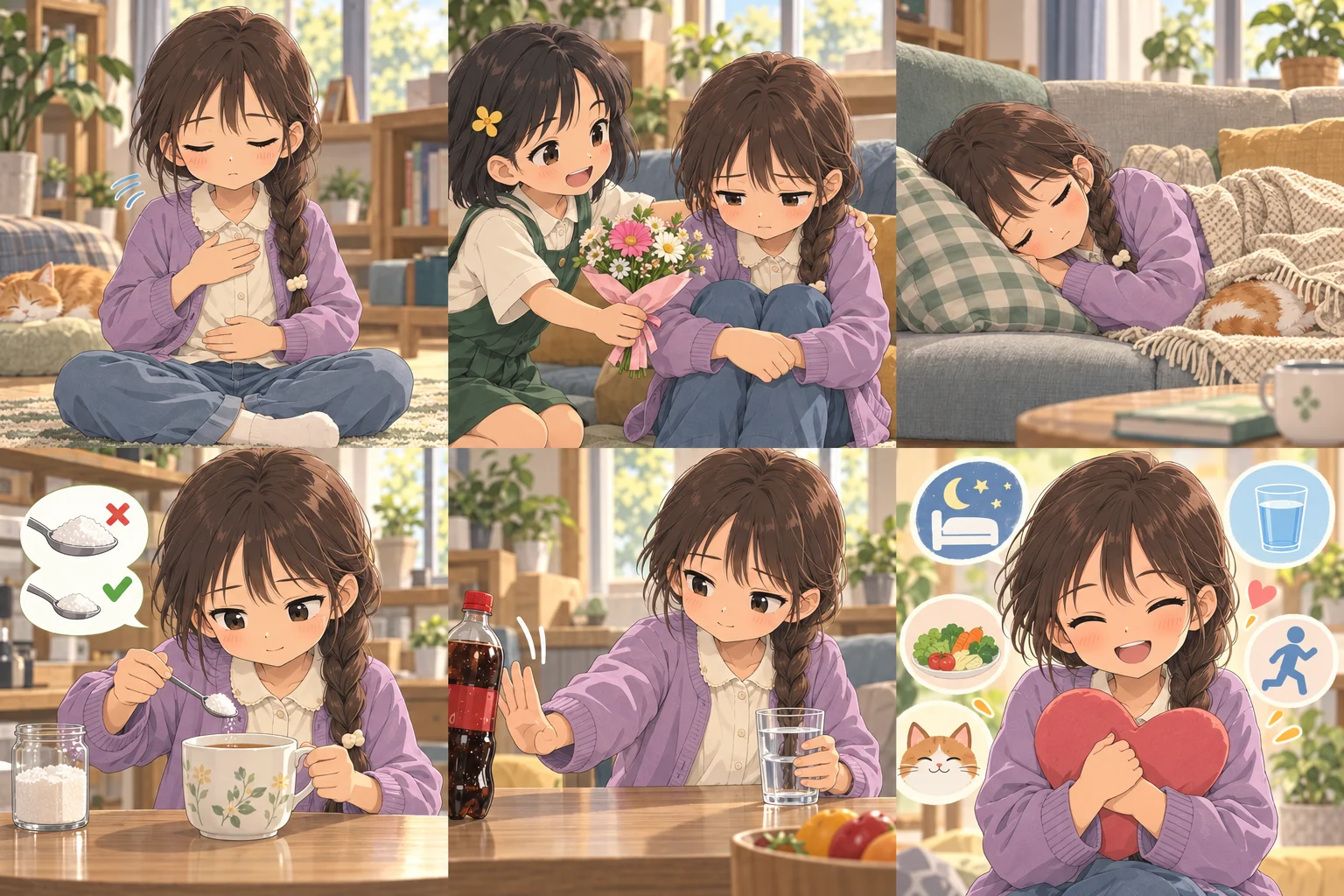
Mây chose to put half a spoon of sugar in her tea instead of a whole spoon.
cut down on
I am trying to cut down on sugary drinks.
Read the example again
I am trying to cut down on sugary drinks.
We should cut down on the amount of food we waste.
Read the example again
We should cut down on the amount of food we waste.
View meaning & usage
Reduce intake
cut down on somethingcut down on doing something
Reduced but not completely eliminated. Use “on” before something that needs to be reduced.
Haven't studied yet
Mây pushed the soft drink bottle aside and chose a glass of water.
give up
I want to give up drinking soda every day.
Read the example again
I want to give up drinking soda every day.
He gave up late-night snacks last month.
Read the example again
He gave up late-night snacks last month.
View meaning & usage
Give up a habit
give up somethinggive up doing something
With actions, use the -ing form: “give up drinking”, do not use “give up to drink”.
Haven't studied yet
The examples were written for this course. Usage was checked against Matt Errey’s book, pages 19, 22, 79, 31, 54. A2–B1 is the course’s intended level.
Recall it · Use it
One step forward every day
Practice completed!
Your browser could not save your play history. Results from this session may be lost when you close the page.
Sentences using suggestions are counted as needing more practice. Review schedule based on each phrase's meaning.
Drag a wire from the dot beside a phrase to the dot beside its matching picture. You can also tap a phrase, then a picture. Drag again to change a pair before checking.
Read the picture descriptions for more context. Similar expressions are accepted when they fit the particular scene.
Phrases
Actions in the pictures
Picture description
Mây sits down and breathes slowly to calm herself when she feels anxious.
The picture could not load. Try loading it again before matching.
Picture description
A friend gives Mây flowers and comforts her when she feels sad.
The picture could not load. Try loading it again before matching.
Picture description
Mây lies down on the sofa with a pillow because she feels tired.
The picture could not load. Try loading it again before matching.
Picture description
Mây chose to put half a spoon of sugar in her tea instead of a whole spoon.
The picture could not load. Try loading it again before matching.
Picture description
Mây pushed the soft drink bottle aside and chose a glass of water.
The picture could not load. Try loading it again before matching.
Choose a phrase to begin.
Your browser could not save your play history. Results from this session may be lost when you close the page.
A conversation in context
Read the conversation and find the expressions you have learned.
Mai
I am upset about the result. I need a moment to calm down.
Read the example again
I am upset about the result. I need a moment to calm down.
Alex
Would a short walk help, or would you rather lie down?
Read the example again
Would a short walk help, or would you rather lie down?
Mai
A walk might cheer me up. Thank you for asking.
Read the example again
A walk might cheer me up. Thank you for asking.
Compare the uses
calm down / cheer up
“Calm down” means become less angry, worried, or excited; “cheer up” means become happier. Someone can be calmer while still feeling sad.
Practice and check your answers
Try answering before revealing the suggested answer. This practice is not scored.
The answers below are models. Other answers can also work if they preserve the facts, meaning and structure requested in the task.
A situation to apply what you have learned
A player is angry after losing. Later she is calmer, but still disappointed and not smiling.
Which change has already happened?
Show the answer and explanation
She has calmed down.
She is less angry but still disappointed; “calmed down” does not claim that she is happy.
Correct: The news cheered up her yesterday.
Show the answer and explanation
The news cheered her up yesterday.
“Her” is the person made happier by the news and goes between “cheered” and “up”.
Offer support without claiming she is already happy.
Show the answer and explanation
Take a short break; perhaps a walk will cheer you up.
“Perhaps” suggests that walking may help her feel happier; it does not claim her sadness has already gone.
The usage comparisons are checked against the Cambridge Dictionary entries linked beside the compared expressions. The additional conversations and exercises are written for this course.
Progress is saved on the device. Sign in with Google to save with the same account and continue on another device.