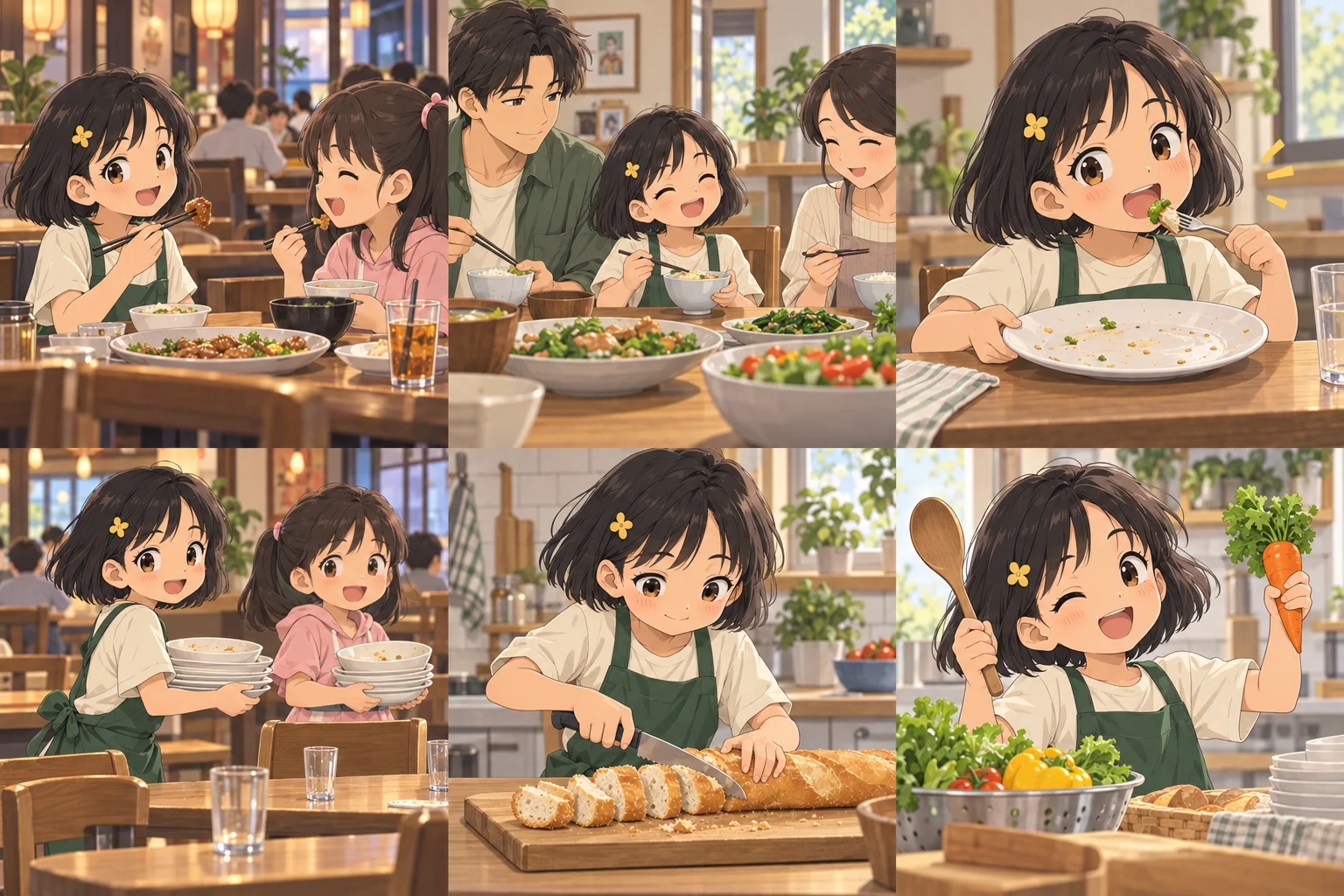
Emphasize eating all the food and not leaving any leftovers.
Haven't studied yet
An helped her friend set the table by bringing the dishes.
help out
Can you help out in the kitchen for a few minutes?
Read the example again
Can you help out in the kitchen for a few minutes?
My brother helped me out with the dishes.
Read the example again
My brother helped me out with the dishes.
View meaning & usage
Lend a hand when needed
help outhelp someone outhelp out with something
Used to support others, especially when they are busy or need more help.
Haven't studied yet
An cuts bread into small pieces on a cutting board.
cut up
Cut up the bread so everyone can have a piece.
Read the example again
Cut up the bread so everyone can have a piece.
I cut the fruit up for the children.
Read the example again
I cut the fruit up for the children.
View meaning & usage
Cut into small pieces
cut up somethingcut something upcut it up
Close to the meaning of "chop up", but "cut up" does not emphasize the consecutive chopping action.
Haven't studied yet
The examples were written for this course. Usage was checked against Matt Errey’s book, pages 40, 40, 40, 63, 31. A2–B1 is the course’s intended level.
Recall it · Use it
One step forward every day
Practice completed!
Your browser could not save your play history. Results from this session may be lost when you close the page.
Sentences using suggestions are counted as needing more practice. Review schedule based on each phrase's meaning.
Drag a wire from the dot beside a phrase to the dot beside its matching picture. You can also tap a phrase, then a picture. Drag again to change a pair before checking.
Read the picture descriptions for more context. Similar expressions are accepted when they fit the particular scene.
Phrases
Actions in the pictures
Picture description
An and her friend had dinner at a table in the restaurant.
The picture could not load. Try loading it again before matching.
Picture description
An and her family sat and ate at the dining table in the house.
The picture could not load. Try loading it again before matching.
Picture description
An ate the last bites of food on her plate.
The picture could not load. Try loading it again before matching.
Picture description
An helped her friend set the table by bringing the dishes.
The picture could not load. Try loading it again before matching.
Picture description
An cuts bread into small pieces on a cutting board.
The picture could not load. Try loading it again before matching.
Choose a phrase to begin.
Your browser could not save your play history. Results from this session may be lost when you close the page.
A conversation in context
Read the conversation and find the expressions you have learned.
Mai
Shall we eat out tonight?
Read the example again
Shall we eat out tonight?
Alex
I would rather eat in. We still have vegetables.
Read the example again
I would rather eat in. We still have vegetables.
Mai
All right. I can help out by cutting them up.
Read the example again
All right. I can help out by cutting them up.
Compare the uses
eat out / eat in
“Eat out” usually means eat at a restaurant; “eat in” means eat at home. They concern where you eat, rather than finishing or cutting food.
Practice and check your answers
Try answering before revealing the suggested answer. This practice is not scored.
The answers below are models. Other answers can also work if they preserve the facts, meaning and structure requested in the task.
A situation to apply what you have learned
A family has already cooked. Another family has booked a restaurant table. Neither plan says who finishes every bite.
Which family plans to eat out?
Show the answer and explanation
The family with the restaurant booking.
The family with the restaurant booking will “eat out”; the plan says nothing about how much they finish.
Complete: We can eat ___ and use the food we cooked.
Show the answer and explanation
in
Using the food cooked at home means “eat in”; here “in” refers to eating at home.
Offer to help with preparing the home meal.
Show the answer and explanation
I can help out by cutting up the vegetables.
“Help out by cutting up” offers the specific help of chopping vegetables; “by” takes “cutting”.
The usage comparisons are checked against the Cambridge Dictionary entries linked beside the compared expressions. The additional conversations and exercises are written for this course.
Progress is saved on the device. Sign in with Google to save with the same account and continue on another device.