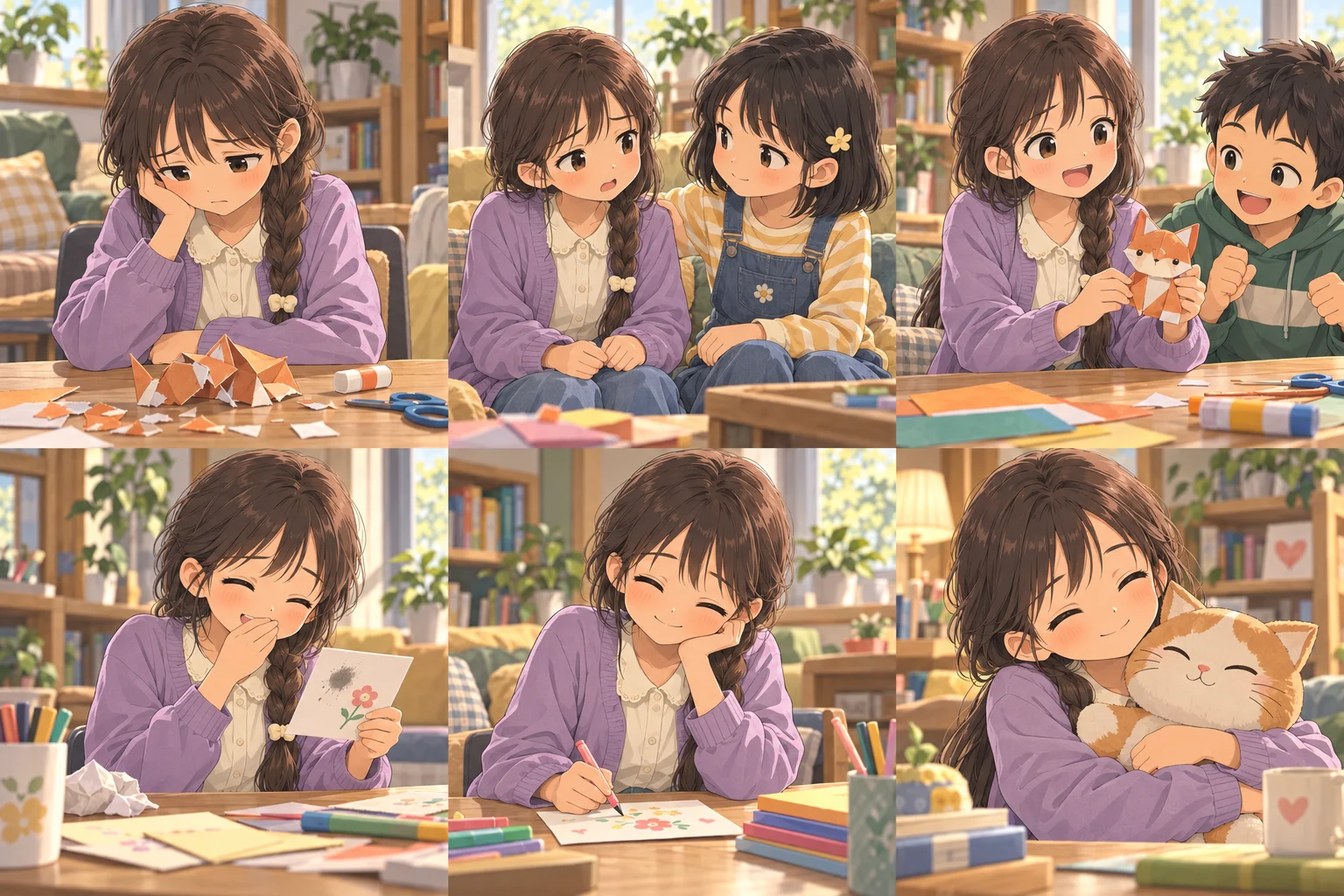
Mây brightens and sits more upright when a friend arrives to play with the repaired model.
perk up
She perked up when her friend arrived.
Read the example again
She perked up when her friend arrived.
A short walk helped me perk up.
Read the example again
A short walk helped me perk up.
View meaning & usage
Become more cheerful or lively
perk upperk someone up
This often describes becoming brighter after feeling sad, tired or uninterested. It can be used without an object.
Haven't studied yet
Mây looks at a small smudge on a card and laughs gently, no longer overly concerned.
laugh off
I laughed off the little mistake and tried again.
Read the example again
I laughed off the little mistake and tried again.
She laughed the mix-up off because no one was hurt.
Read the example again
She laughed the mix-up off because no one was hurt.
View meaning & usage
Treat a minor problem lightly by laughing
laugh off somethinglaugh something off
This can describe taking a minor issue less seriously. It should not imply dismissing another person’s feelings or ignoring a serious mistake.
Haven't studied yet
Mây relaxes her shoulders, smiles and continues making the card after worrying too much.
lighten up
I was taking the game too seriously, so I tried to lighten up.
Read the example again
I was taking the game too seriously, so I tried to lighten up.
A friendly joke helped everyone lighten up.
Read the example again
A friendly joke helped everyone lighten up.
View meaning & usage
Become less tense or serious
lighten up
An informal way to describe becoming less tense or serious. Saying “Lighten up!” directly to someone who is upset can sound unsympathetic.
Haven't studied yet
The examples were written for this course. Usage was checked against Matt Errey’s book, pages 50, 77, 96, 76, 79. A2–B1 is the course’s intended level.
Recall it · Use it
One step forward every day
Practice completed!
Your browser could not save your play history. Results from this session may be lost when you close the page.
Sentences using suggestions are counted as needing more practice. Review schedule based on each phrase's meaning.
Drag a wire from the dot beside a phrase to the dot beside its matching picture. You can also tap a phrase, then a picture. Drag again to change a pair before checking.
Read the picture descriptions for more context. Similar expressions are accepted when they fit the particular scene.
Phrases
Actions in the pictures
Picture description
Mây looks sadly at a broken paper model, with lowered shoulders and downcast eyes.
The picture could not load. Try loading it again before matching.
Picture description
Mây shares her worries with a friend beside her, who listens carefully and offers support.
The picture could not load. Try loading it again before matching.
Picture description
Mây brightens and sits more upright when a friend arrives to play with the repaired model.
The picture could not load. Try loading it again before matching.
Picture description
Mây looks at a small smudge on a card and laughs gently, no longer overly concerned.
The picture could not load. Try loading it again before matching.
Picture description
Mây relaxes her shoulders, smiles and continues making the card after worrying too much.
The picture could not load. Try loading it again before matching.
Choose a phrase to begin.
Your browser could not save your play history. Results from this session may be lost when you close the page.
A conversation in context
Read the conversation and find the expressions you have learned.
Mai
The delays are getting me down.
Read the example again
The delays are getting me down.
Alex
You can lean on us when things are difficult.
Read the example again
You can lean on us when things are difficult.
Mai
Thanks. Talking about it has helped me perk up.
Read the example again
Thanks. Talking about it has helped me perk up.
Compare the uses
get down / lean on
“Get someone down” means make them sad or discouraged; here “lean on” means rely on someone for support. It can also mean pressure someone, so context matters.
Practice and check your answers
Try answering before revealing the suggested answer. This practice is not scored.
The answers below are models. Other answers can also work if they preserve the facts, meaning and structure requested in the task.
A situation to apply what you have learned
Repeated cancellations discourage a volunteer. Her friends offer support without pressuring her to continue immediately.
Describe the effect of cancellations.
Show the answer and explanation
The cancellations are getting her down.
Repeated cancellations discourage the volunteer: “getting her down”, with “her” in the middle.
Complete: You can lean ___ us for support.
Show the answer and explanation
on
“Lean on us for support” offers the friends’ help; “on” introduces those providing support.
Write a supportive response.
Show the answer and explanation
You can lean on us and take time before deciding what to do next.
The reply offers support and decision time without demanding an immediate return to the activity.
The usage comparisons are checked against the Cambridge Dictionary entries linked beside the compared expressions. The additional conversations and exercises are written for this course.
Progress is saved on the device. Sign in with Google to save with the same account and continue on another device.