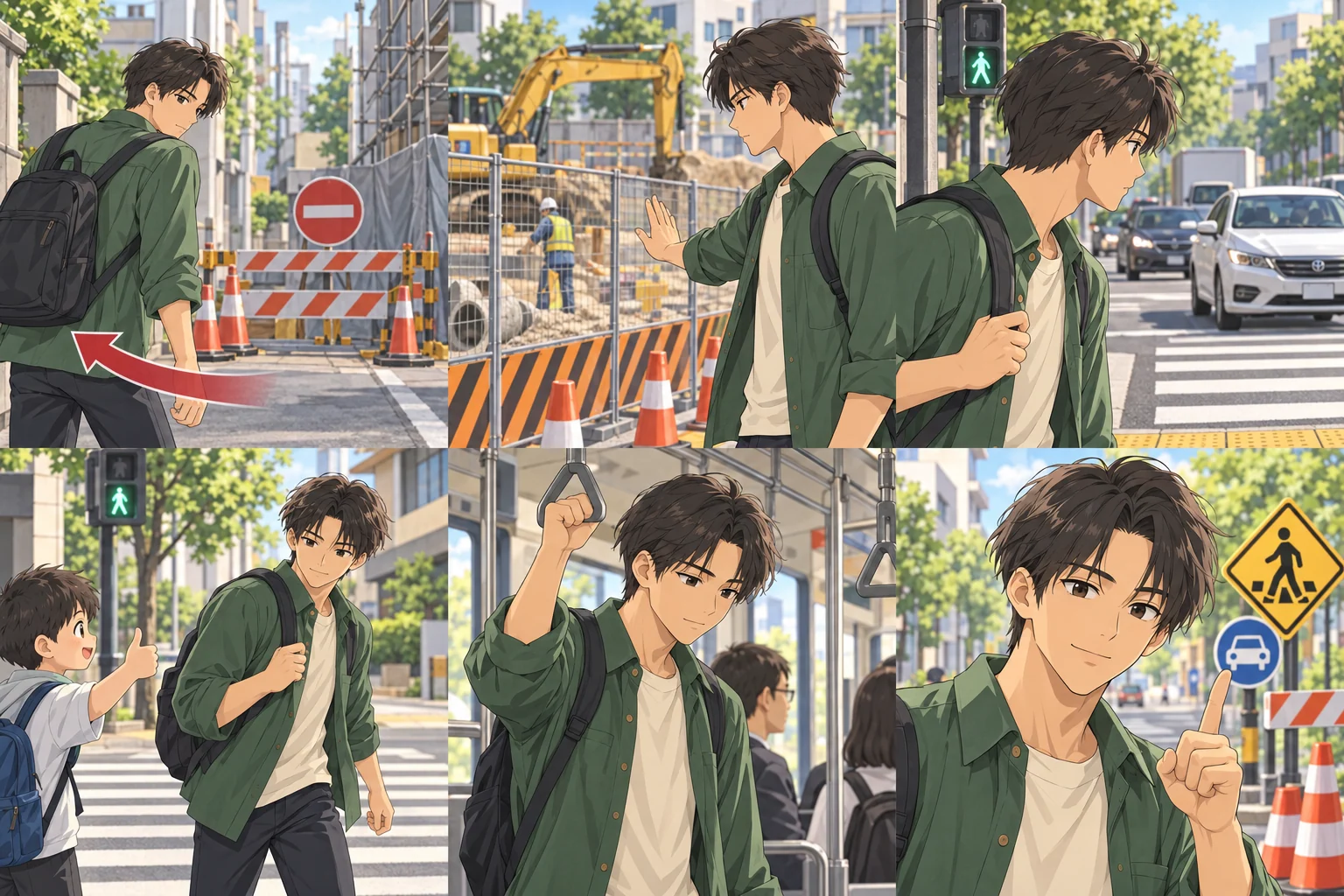
Minh started walking again after his friend signaled his agreement.
go ahead
The path is open now. We can go ahead.
Read the example again
The path is open now. We can go ahead.
May I open this window? Yes, go ahead.
Read the example again
May I open this window? Yes, go ahead.
View meaning & usage
Proceed / keep going
go aheadgo ahead and do something
Can be used when something is authorized or ready to be done.
Haven't studied yet
Minh stood on the train and held the handrail firmly.
hold on to
Hold on to the rail while the train is moving.
Read the example again
Hold on to the rail while the train is moving.
He held on to the rope with both hands.
Read the example again
He held on to the rope with both hands.
View meaning & usage
Hold / cling tightly
hold on to something
The meaning in the lesson is to hold the physical; Different from “hold on” when asking someone else to wait.
Haven't studied yet
The examples were written for this course. Usage was checked against Matt Errey’s book, pages 55, 71, 138, 54, 63. A2–B1 is the course’s intended level.
Recall it · Use it
One step forward every day
Practice completed!
Your browser could not save your play history. Results from this session may be lost when you close the page.
Sentences using suggestions are counted as needing more practice. Review schedule based on each phrase's meaning.
Drag a wire from the dot beside a phrase to the dot beside its matching picture. You can also tap a phrase, then a picture. Drag again to change a pair before checking.
Read the picture descriptions for more context. Similar expressions are accepted when they fit the particular scene.
Phrases
Actions in the pictures
Picture description
Minh turned back to the previous street because the path ahead was closed.
The picture could not load. Try loading it again before matching.
Picture description
Minh kept his distance from the fenced construction site area.
The picture could not load. Try loading it again before matching.
Picture description
Minh paid attention to the car at a crossroads.
The picture could not load. Try loading it again before matching.
Picture description
Minh started walking again after his friend signaled his agreement.
The picture could not load. Try loading it again before matching.
Picture description
Minh stood on the train and held the handrail firmly.
The picture could not load. Try loading it again before matching.
Choose a phrase to begin.
Your browser could not save your play history. Results from this session may be lost when you close the page.
A conversation in context
Read the conversation and find the expressions you have learned.
Mai
Watch out for loose stones on this path.
Read the example again
Watch out for loose stones on this path.
Alex
Should we go back instead?
Read the example again
Should we go back instead?
Mai
We can go ahead slowly, but keep away from the damaged fence.
Read the example again
We can go ahead slowly, but keep away from the damaged fence.
Compare the uses
keep away from / watch out for
“Keep away from” means maintain distance from danger; “watch out for” means stay alert to notice it. Noticing a danger does not itself keep you away.
Practice and check your answers
Try answering before revealing the suggested answer. This practice is not scored.
The answers below are models. Other answers can also work if they preserve the facts, meaning and structure requested in the task.
A situation to apply what you have learned
Children are walking beside a building site. A broken gate and loose stones are ahead.
Give a distance instruction about the gate.
Show the answer and explanation
Keep away from the broken gate.
The broken gate is the object to avoid; “keep away from” asks for physical distance.
Complete: Watch out ___ loose stones.
Show the answer and explanation
for
Because the loose stones are named, use “watch out for loose stones”, including “for”.
Tell the group when it is sensible to return.
Show the answer and explanation
We should go back if the path becomes unsafe.
“If the path becomes unsafe” gives the condition for returning; “go back” reverses the group’s progress.
The usage comparisons are checked against the Cambridge Dictionary entries linked beside the compared expressions. The additional conversations and exercises are written for this course.
Progress is saved on the device. Sign in with Google to save with the same account and continue on another device.