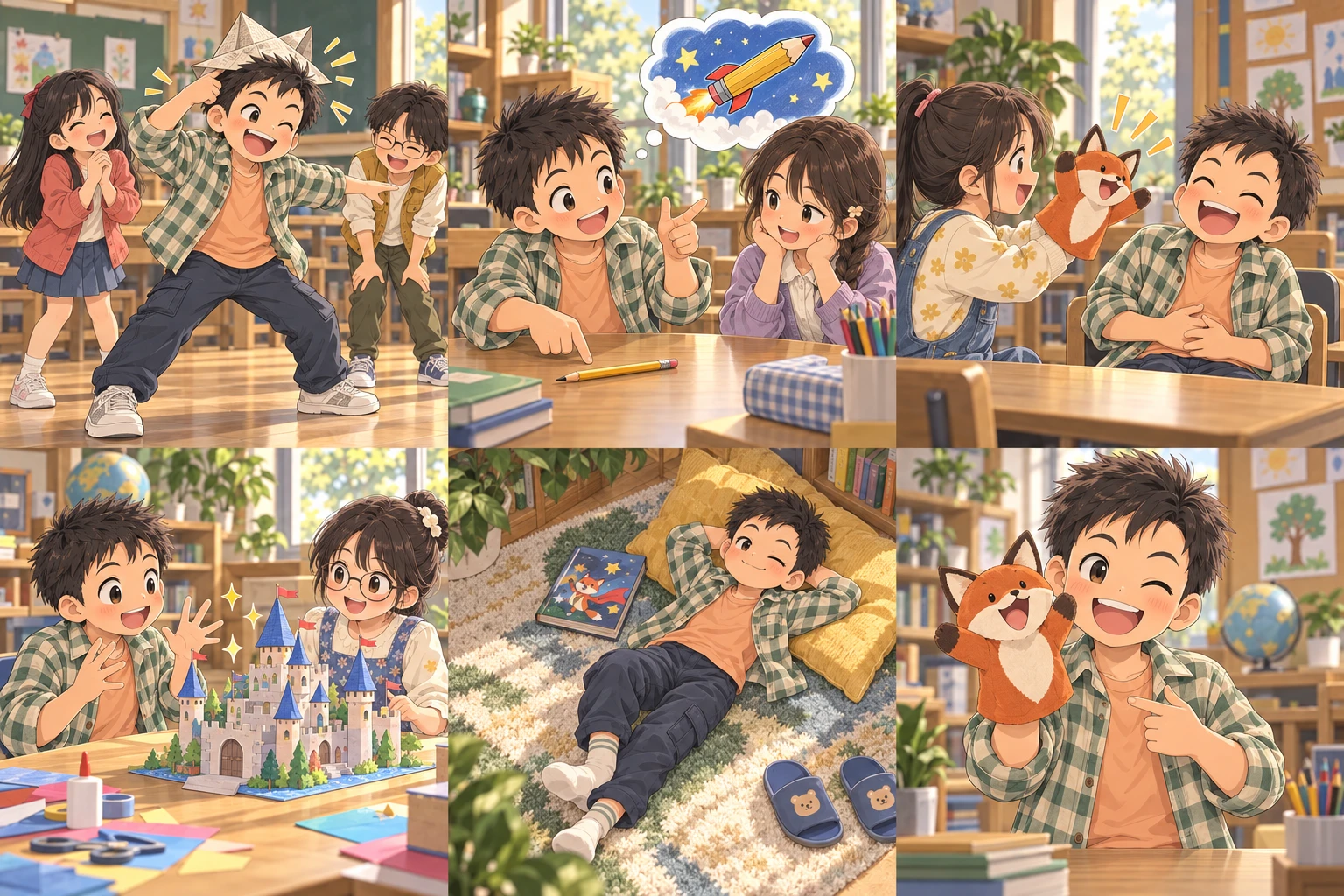
Phúc cracks up at a friend’s funny fox puppet act.
crack up
We cracked up at the funny puppet show.
Read the example again
We cracked up at the funny puppet show.
That silly voice always cracks me up.
Read the example again
That silly voice always cracks me up.
View meaning & usage
Suddenly laugh a lot
crack upcrack someone up
Here this means laughing a lot or making someone laugh. “Crack up” can also mean have a mental breakdown, but not in this scene.
Haven't studied yet
Phúc is bowled over by a friend’s beautiful handmade paper castle.
bowl over
I was bowled over by the beautiful paper castle.
Read the example again
I was bowled over by the beautiful paper castle.
Her kind message really bowled me over.
Read the example again
Her kind message really bowled me over.
View meaning & usage
Greatly surprise and impress someone
bowl someone overbe bowled over by something
The figurative sense here is being deeply impressed or pleasantly surprised. Nobody is physically knocked down or bowling.
Haven't studied yet
Phúc lazes around on a soft rug with a closed comic book beside him.
laze around
We lazed around at home on Sunday.
Read the example again
We lazed around at home on Sunday.
He likes lazing around with a comic after lunch.
Read the example again
He likes lazing around with a comic after lunch.
View meaning & usage
Relax without doing much
laze around
Suggests a very unhurried, inactive time and may sound a little lazy in context. It does not necessarily mean sleeping.
Haven't studied yet
The examples were written for this course. Usage was checked against Matt Errey’s book, pages 23, 73, 29, 13, 77. A2–B1 is the course’s intended level.
Recall it · Use it
One step forward every day
Practice completed!
Your browser could not save your play history. Results from this session may be lost when you close the page.
Sentences using suggestions are counted as needing more practice. Review schedule based on each phrase's meaning.
Drag a wire from the dot beside a phrase to the dot beside its matching picture. You can also tap a phrase, then a picture. Drag again to change a pair before checking.
Read the picture descriptions for more context. Similar expressions are accepted when they fit the particular scene.
Phrases
Actions in the pictures
Picture description
Phúc clowns around with a paper hat while two friends laugh.
The picture could not load. Try loading it again before matching.
Picture description
Phúc kids around about his pencil being a rocket; a thought bubble shows the joke.
The picture could not load. Try loading it again before matching.
Picture description
Phúc cracks up at a friend’s funny fox puppet act.
The picture could not load. Try loading it again before matching.
Picture description
Phúc is bowled over by a friend’s beautiful handmade paper castle.
The picture could not load. Try loading it again before matching.
Picture description
Phúc lazes around on a soft rug with a closed comic book beside him.
The picture could not load. Try loading it again before matching.
Choose a phrase to begin.
Your browser could not save your play history. Results from this session may be lost when you close the page.
A conversation in context
Read the conversation and find the expressions you have learned.
Mai
Are you two clowning around again?
Read the example again
Are you two clowning around again?
Alex
Just kidding around while we wait for the others.
Read the example again
Just kidding around while we wait for the others.
Mai
That story really cracked everyone up.
Read the example again
That story really cracked everyone up.
Compare the uses
clown around / kid around
When friends are fooling around, both “clown around” and “kid around” can fit. “Clown around” often emphasises behaviour that makes other people laugh.
Practice and check your answers
Try answering before revealing the suggested answer. This practice is not scored.
The answers below are models. Other answers can also work if they preserve the facts, meaning and structure requested in the task.
A situation to apply what you have learned
During a break, two friends perform silly impressions for fun. A third person initially thinks they are serious.
Give one suitable description of their behaviour.
Show the answer and explanation
They are clowning around or kidding around.
Both “clowning around” and “kidding around” can describe the friends’ deliberately silly behaviour.
Complete: That funny impression really cracked us ___.
Show the answer and explanation
up
“Cracked us up” means the impression made the group laugh; “us” precedes “up”.
Reassure the person who misunderstood.
Show the answer and explanation
We are only kidding around; we are not making a serious proposal.
“Only kidding around” corrects the misunderstanding; denying a serious proposal clarifies the friends’ intention.
The usage comparisons are checked against the Cambridge Dictionary entries linked beside the compared expressions. The additional conversations and exercises are written for this course.
Progress is saved on the device. Sign in with Google to save with the same account and continue on another device.