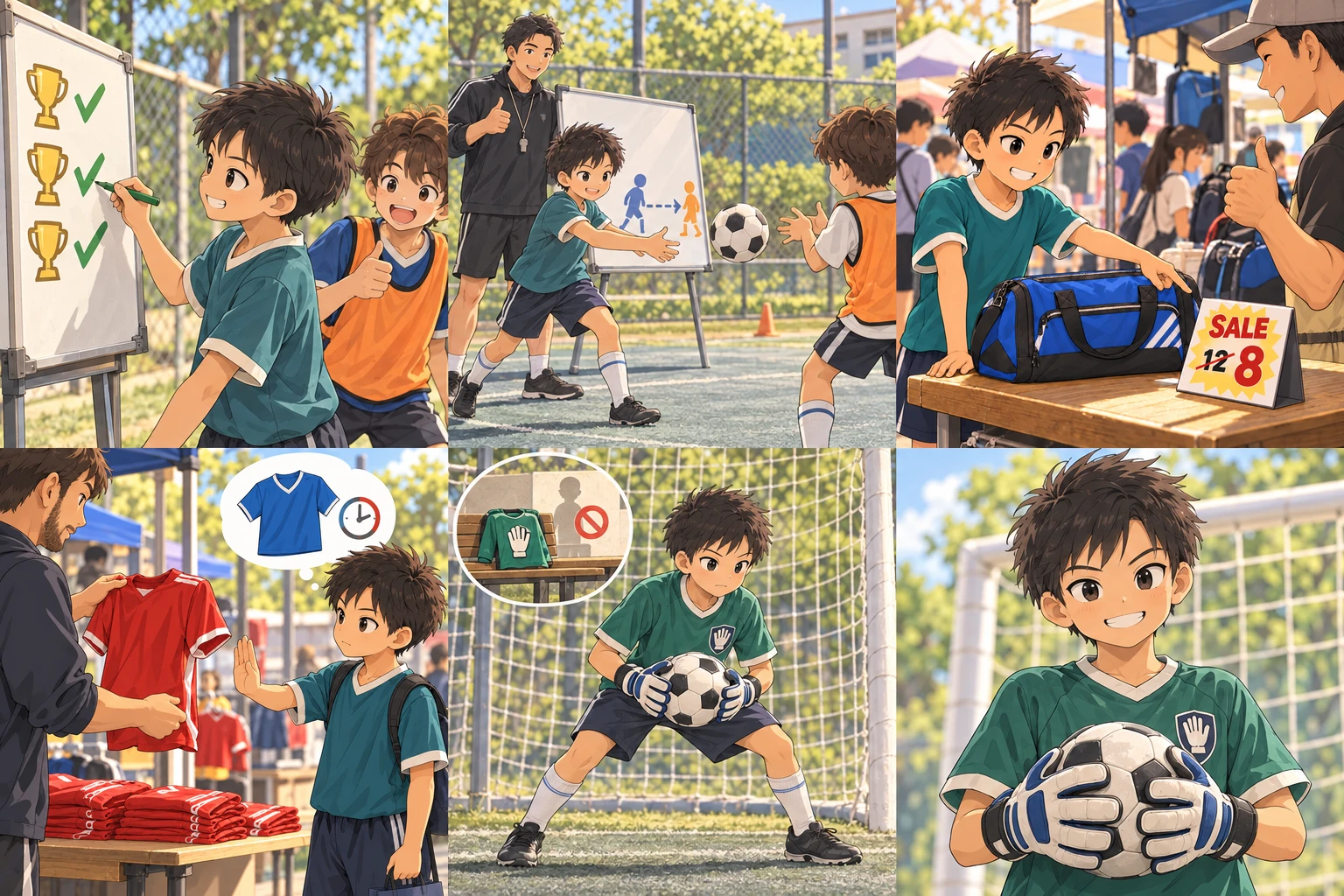
Nam snaps up a sports bag offered at a good price.
snap up
He snapped up a sports bag at a good price.
Read the example again
He snapped up a sports bag at a good price.
The tickets were snapped up within minutes.
Read the example again
The tickets were snapped up within minutes.
View meaning & usage
Quickly take a good bargain or opportunity
snap up somethingsnap something up
Emphasises acting quickly on an attractive purchase or opportunity. The -ing form is “snapping”; no biting is involved.
Haven't studied yet
Nam holds out for the blue jersey he wants instead of accepting the red one offered.
hold out for
He held out for the blue jersey he wanted.
Read the example again
He held out for the blue jersey he wanted.
They held out for a better offer.
Read the example again
They held out for a better offer.
View meaning & usage
Refuse less and wait for what you want
hold out for something
Keep both “out for”. You decline what is offered while waiting for something different or better, rather than simply waiting at random.
Haven't studied yet
Nam stands in for an absent goalkeeper during practice.
stand in
He stood in for the absent goalkeeper.
Read the example again
He stood in for the absent goalkeeper.
Could you stand in for me at practice?
Read the example again
Could you stand in for me at practice?
View meaning & usage
Temporarily take someone’s role
stand instand in for someone
Put the person being replaced after “for”. The past form is “stood”; this is more than physically standing in a place.
Haven't studied yet
The examples were written for this course. Usage was checked against Matt Errey’s book, pages 90, 80, 119, 64, 121. A2–B1 is the course’s intended level.
Recall it · Use it
One step forward every day
Practice completed!
Your browser could not save your play history. Results from this session may be lost when you close the page.
Sentences using suggestions are counted as needing more practice. Review schedule based on each phrase's meaning.
Drag a wire from the dot beside a phrase to the dot beside its matching picture. You can also tap a phrase, then a picture. Drag again to change a pair before checking.
Read the picture descriptions for more context. Similar expressions are accepted when they fit the particular scene.
Phrases
Actions in the pictures
Picture description
Nam notches up another win for the team, adding a new victory mark.
The picture could not load. Try loading it again before matching.
Picture description
Nam’s team lives up to expectations by passing the ball as planned.
The picture could not load. Try loading it again before matching.
Picture description
Nam snaps up a sports bag offered at a good price.
The picture could not load. Try loading it again before matching.
Picture description
Nam holds out for the blue jersey he wants instead of accepting the red one offered.
The picture could not load. Try loading it again before matching.
Picture description
Nam stands in for an absent goalkeeper during practice.
The picture could not load. Try loading it again before matching.
Choose a phrase to begin.
Your browser could not save your play history. Results from this session may be lost when you close the page.
A conversation in context
Read the conversation and find the expressions you have learned.
Mai
The team has notched up another win.
Read the example again
The team has notched up another win.
Alex
They really lived up to the coach’s expectations today.
Read the example again
They really lived up to the coach’s expectations today.
Mai
The substitute stood in well for the injured player.
Read the example again
The substitute stood in well for the injured player.
Compare the uses
notch up / live up to
“Notch up” adds an achievement or score; “live up to” meets expectations. An additional win does not by itself show that every expectation was met.
Practice and check your answers
Try answering before revealing the suggested answer. This practice is not scored.
The answers below are models. Other answers can also work if they preserve the facts, meaning and structure requested in the task.
A situation to apply what you have learned
A club adds another tournament win. Supporters had expected a strong performance, and a substitute filled a missing player’s role.
Describe the extra achievement.
Show the answer and explanation
The club has notched up another tournament win.
Adding another win to the club’s record is “has notched up another tournament win”.
Complete: The result lived up ___ the supporters’ expectations.
Show the answer and explanation
to
“Lived up to the supporters’ expectations” means met their expected standard; keep both “up to”.
Write a message about the substitute’s role.
Show the answer and explanation
Our substitute stood in for the absent player during the final.
“Stood in for” identifies the substitute taking the absent player’s role, rather than standing beside that player.
The usage comparisons are checked against the Cambridge Dictionary entries linked beside the compared expressions. The additional conversations and exercises are written for this course.
Progress is saved on the device. Sign in with Google to save with the same account and continue on another device.