Please hang up your coat instead of leaving it on the chair.
Read the example again
Please hang up your coat instead of leaving it on the chair.
I hung my shirt up after washing it.
Read the example again
I hung my shirt up after washing it.
View meaning & usage
Hang up your clothes
hang up somethinghang something up
The meaning in the lesson is to hang things. The past tense of “hang” in this usage is “hung.”
Haven't studied yet
Minh locked the door before leaving.
lock up
Remember to lock up before you leave.
Read the example again
Remember to lock up before you leave.
The last person in the office locks it up.
Read the example again
The last person in the office locks it up.
View meaning & usage
Lock the door / lock it for safety
lock uplock up a placelock something up
Often used when locking the door of a house, store or workplace after use.
Haven't studied yet
Minh opened the door to let a friend enter the house.
let in
Mai is waiting outside. Let her in, please.
Read the example again
Mai is waiting outside. Let her in, please.
I opened the door to let the cat in.
Read the example again
I opened the door to let the cat in.
View meaning & usage
Let someone in
let someone inlet someone into a place
Put the person or thing after “let”, then “in”: “let him in”.
Haven't studied yet
The examples were written for this course. Usage was checked against Matt Errey’s book, pages 101, 101, 61, 80, 78. A2–B1 is the course’s intended level.
Recall it · Use it
One step forward every day
Practice completed!
Your browser could not save your play history. Results from this session may be lost when you close the page.
Sentences using suggestions are counted as needing more practice. Review schedule based on each phrase's meaning.
Drag a wire from the dot beside a phrase to the dot beside its matching picture. You can also tap a phrase, then a picture. Drag again to change a pair before checking.
Read the picture descriptions for more context. Similar expressions are accepted when they fit the particular scene.
Phrases
Actions in the pictures
Picture description
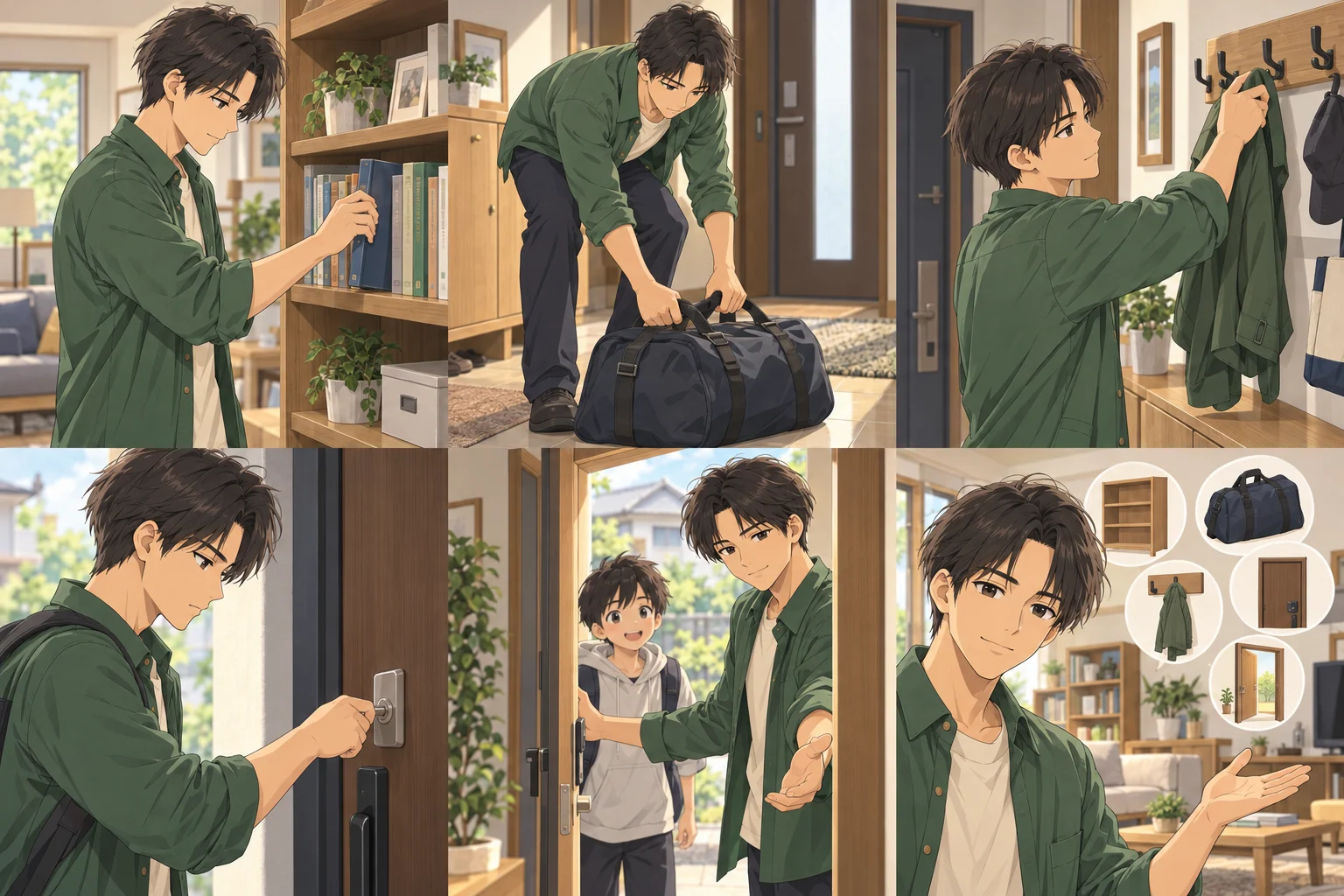
Minh put the book back in its original position on the shelf.
The picture could not load. Try loading it again before matching.
Picture description
Minh placed a heavy bag on the floor.
The picture could not load. Try loading it again before matching.
Picture description
Minh hung his coat on a hook next to the door.
The picture could not load. Try loading it again before matching.
Picture description
Minh locked the door before leaving.
The picture could not load. Try loading it again before matching.
Picture description
Minh opened the door to let a friend enter the house.
The picture could not load. Try loading it again before matching.
Choose a phrase to begin.
Your browser could not save your play history. Results from this session may be lost when you close the page.
A conversation in context
Read the conversation and find the expressions you have learned.
Mai
Where should I put down these bags?
Read the example again
Where should I put down these bags?
Alex
By the door, please. Put the key back in the drawer.
Read the example again
By the door, please. Put the key back in the drawer.
Mai
All right. I will hang up my coat before I let the guests in.
Read the example again
All right. I will hang up my coat before I let the guests in.
Compare the uses
put back / put down
“Put down” means set down something you are holding; “put back” means return it to its previous place. Setting an item down does not necessarily return it.
Practice and check your answers
Try answering before revealing the suggested answer. This practice is not scored.
The answers below are models. Other answers can also work if they preserve the facts, meaning and structure requested in the task.
A situation to apply what you have learned
A cleaner is holding a heavy plant pot. Its usual place is a shelf that is not ready yet.
Give a temporary instruction using put down.
Show the answer and explanation
Put the pot down on the floor for now.
The cleaner is holding a heavy pot; “put down” places it temporarily on the floor while the shelf is unavailable.
Correct: Put back it on the shelf later.
Show the answer and explanation
Put it back on the shelf later.
“It” refers to the plant pot and precedes “back”: “put it back on the shelf”.
Explain the final position clearly.
Show the answer and explanation
Put the plant pot back where it was after the shelf is ready.
“Back where it was” identifies the original shelf position, unlike the temporary place on the floor.
The usage comparisons are checked against the Cambridge Dictionary entries linked beside the compared expressions. The additional conversations and exercises are written for this course.
Progress is saved on the device. Sign in with Google to save with the same account and continue on another device.