The examples were written for this course. Usage was checked against Matt Errey’s book, pages 47, 20, 90, 56, 118. A2–B1 is the course’s intended level.
Recall it · Use it
One step forward every day
Practice completed!
Your browser could not save your play history. Results from this session may be lost when you close the page.
Sentences using suggestions are counted as needing more practice. Review schedule based on each phrase's meaning.
Drag a wire from the dot beside a phrase to the dot beside its matching picture. You can also tap a phrase, then a picture. Drag again to change a pair before checking.
Read the picture descriptions for more context. Similar expressions are accepted when they fit the particular scene.
Phrases
Actions in the pictures
Picture description
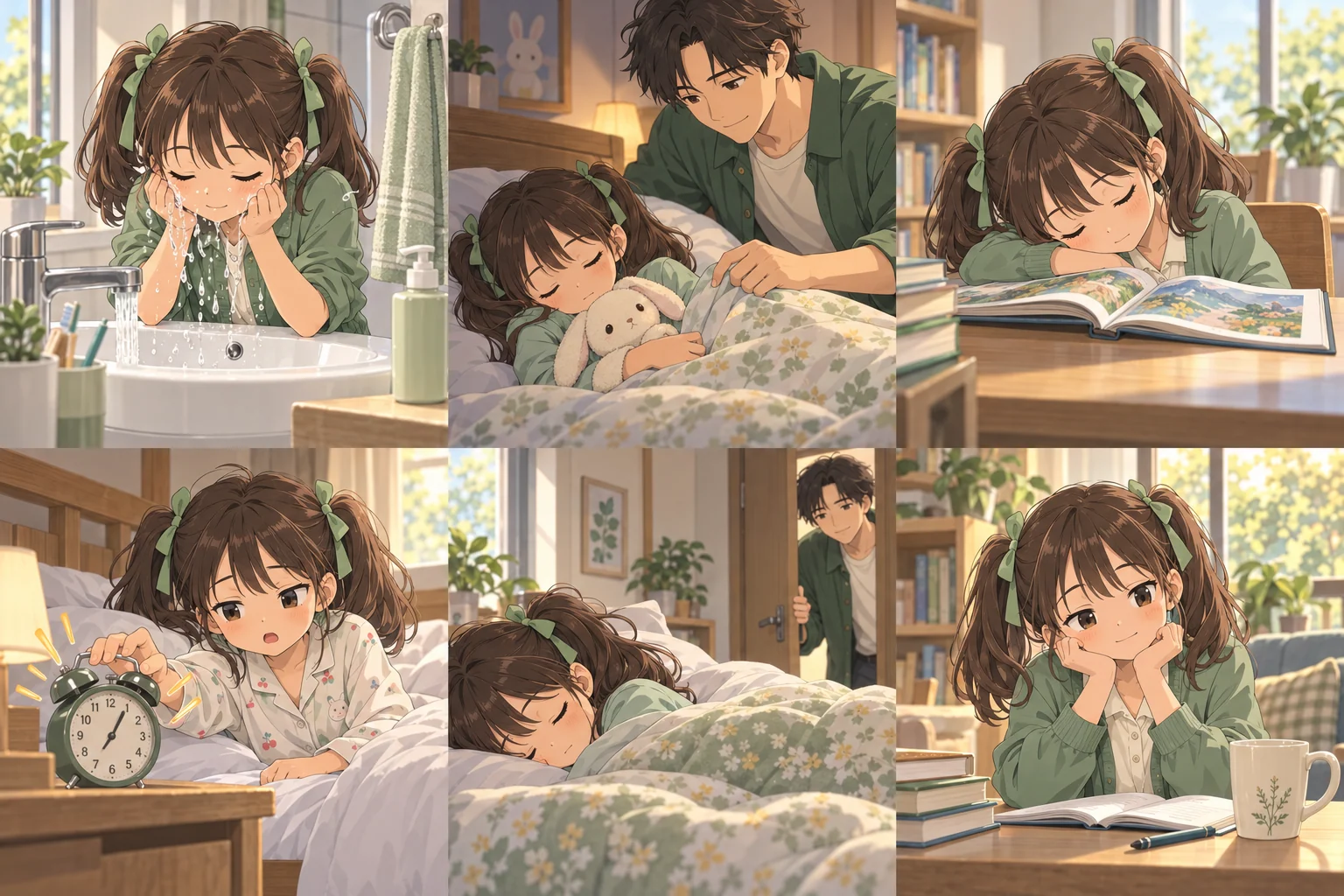
Nhi washes her face in the sink after playing outside to feel more refreshed.
The picture could not load. Try loading it again before matching.
Picture description
Nhi goes to bed early to catch up on missed sleep. Minh pulls a blanket over her.
The picture could not load. Try loading it again before matching.
Picture description
Nhi fell asleep on the chair, her head tilted down while holding a picture book.
The picture could not load. Try loading it again before matching.
Picture description
Nhi hears the alarm clock ringing next to her bed in the morning.
The picture could not load. Try loading it again before matching.
Picture description
Nhi was still sleeping when it was dawn on her day off, when Minh gently opened the door.
The picture could not load. Try loading it again before matching.
Choose a phrase to begin.
Your browser could not save your play history. Results from this session may be lost when you close the page.
A conversation in context
Read the conversation and find the expressions you have learned.
Mai
I nearly nodded off during the film.
Read the example again
I nearly nodded off during the film.
Alex
You can sleep in tomorrow; there is no early class.
Read the example again
You can sleep in tomorrow; there is no early class.
Mai
First I will freshen up and turn off the television.
Read the example again
First I will freshen up and turn off the television.
Compare the uses
nod off / sleep in
“Nod off” means begin sleeping, often unintentionally; “sleep in” means sleep later than usual in the morning. Dozing in the evening differs from a late morning.
Practice and check your answers
Try answering before revealing the suggested answer. This practice is not scored.
The answers below are models. Other answers can also work if they preserve the facts, meaning and structure requested in the task.
A situation to apply what you have learned
A reader unintentionally falls asleep on a train. On her day off, she can stay in bed later than usual.
Describe the train incident.
Show the answer and explanation
She nodded off while reading on the train.
Falling asleep unintentionally while reading on the train is “nodded off”, rather than choosing a lie-in.
Complete: Tomorrow I can sleep ___ because I am not working.
Show the answer and explanation
in
With no work tomorrow, she can “sleep in”: stay asleep later than usual.
Write a short plan after she reaches home.
Show the answer and explanation
I will freshen up and catch up on my reading later.
“Freshen up” refreshes her on arrival; “catch up on my reading” addresses reading she has missed.
The usage comparisons are checked against the Cambridge Dictionary entries linked beside the compared expressions. The additional conversations and exercises are written for this course.
Progress is saved on the device. Sign in with Google to save with the same account and continue on another device.