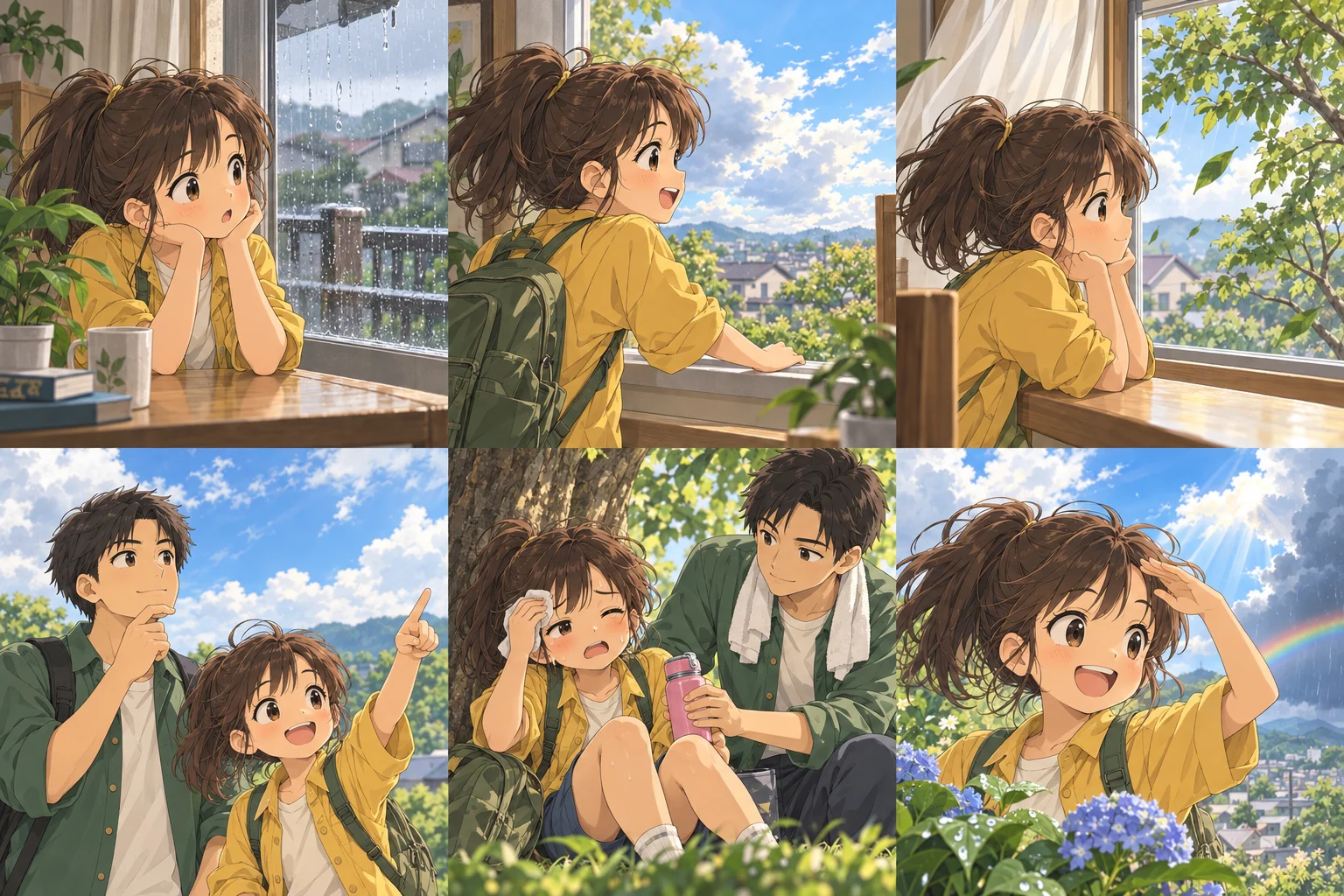
Hạ and Minh looked at the sky to decide whether they could go on a picnic or not.
depend on
Our picnic depends on the weather.
Read the example again
Our picnic depends on the weather.
The time we leave depends on when the bus arrives.
Read the example again
The time we leave depends on when the bus arrives.
View meaning & usage
Depends on a condition
depend on somethingdepend on when / whether / how
In the lesson, the result changes according to conditions, not trusting one person.
Haven't studied yet
Hạ was uncomfortable because of the heat and was helped by Minh to rest under the shade of a tree with some water to drink.
put up with
I find it hard to put up with this heat.
Read the example again
I find it hard to put up with this heat.
We should find some shade instead of putting up with the hot sun.
Read the example again
We should find some shade instead of putting up with the hot sun.
View meaning & usage
Endure unpleasant things
put up with someone / something
Talk about enduring unpleasant things; does not mean forced to accept all problems. Do not split phrases.
Haven't studied yet
The examples were written for this course. Usage was checked against Matt Errey’s book, pages 78, 23, 35, 35, 103. A2–B1 is the course’s intended level.
Recall it · Use it
One step forward every day
Practice completed!
Your browser could not save your play history. Results from this session may be lost when you close the page.
Sentences using suggestions are counted as needing more practice. Review schedule based on each phrase's meaning.
Drag a wire from the dot beside a phrase to the dot beside its matching picture. You can also tap a phrase, then a picture. Drag again to change a pair before checking.
Read the picture descriptions for more context. Similar expressions are accepted when they fit the particular scene.
Phrases
Actions in the pictures
Picture description
Hạ watched from inside the house as the heavy rain reduced to a few drops.
The picture could not load. Try loading it again before matching.
Picture description
Hạ happily watched the rain clouds disappear and the blue sky began to appear outside the window.
The picture could not load. Try loading it again before matching.
Picture description
Hạ watched as the wind outside the window calmed down and the tree branches moved less.
The picture could not load. Try loading it again before matching.
Picture description
Hạ and Minh looked at the sky to decide whether they could go on a picnic or not.
The picture could not load. Try loading it again before matching.
Picture description
Hạ was uncomfortable because of the heat and was helped by Minh to rest under the shade of a tree with some water to drink.
The picture could not load. Try loading it again before matching.
Choose a phrase to begin.
Your browser could not save your play history. Results from this session may be lost when you close the page.
A conversation in context
Read the conversation and find the expressions you have learned.
Mai
Has the rain let up yet?
Read the example again
Has the rain let up yet?
Alex
A little, but we should wait for the wind to die down.
Read the example again
A little, but we should wait for the wind to die down.
Mai
Our route will depend on how wet the paths are.
Read the example again
Our route will depend on how wet the paths are.
Compare the uses
let up / die down
“Let up” describes rain or a situation becoming less intense; “die down” often describes wind, noise, or emotion gradually decreasing. Consider the subject because uses can overlap.
Practice and check your answers
Try answering before revealing the suggested answer. This practice is not scored.
The answers below are models. Other answers can also work if they preserve the facts, meaning and structure requested in the task.
A situation to apply what you have learned
Rain is becoming less intense, but the wind remains strong. A group has not chosen a safe departure time.
What change has happened to the rain?
Show the answer and explanation
The rain has let up a little.
The rain has become less intense, so it “has let up”; this does not imply weaker wind.
Complete: We should wait for the wind to die ___.
Show the answer and explanation
down
“Die down” describes weakening wind; “wait for” shows the group is still awaiting that change.
Explain why the departure is still uncertain.
Show the answer and explanation
Our departure depends on the wind as well as the rain.
“Depends on the wind as well as the rain” retains both conditions, so lighter rain alone does not settle departure.
The usage comparisons are checked against the Cambridge Dictionary entries linked beside the compared expressions. The additional conversations and exercises are written for this course.
Progress is saved on the device. Sign in with Google to save with the same account and continue on another device.