The examples were written for this course. Usage was checked against Matt Errey’s book, pages 87, 16, 96, 96, 106. A2–B1 is the course’s intended level.
Recall it · Use it
One step forward every day
Practice completed!
Your browser could not save your play history. Results from this session may be lost when you close the page.
Sentences using suggestions are counted as needing more practice. Review schedule based on each phrase's meaning.
Drag a wire from the dot beside a phrase to the dot beside its matching picture. You can also tap a phrase, then a picture. Drag again to change a pair before checking.
Read the picture descriptions for more context. Similar expressions are accepted when they fit the particular scene.
Phrases
Actions in the pictures
Picture description
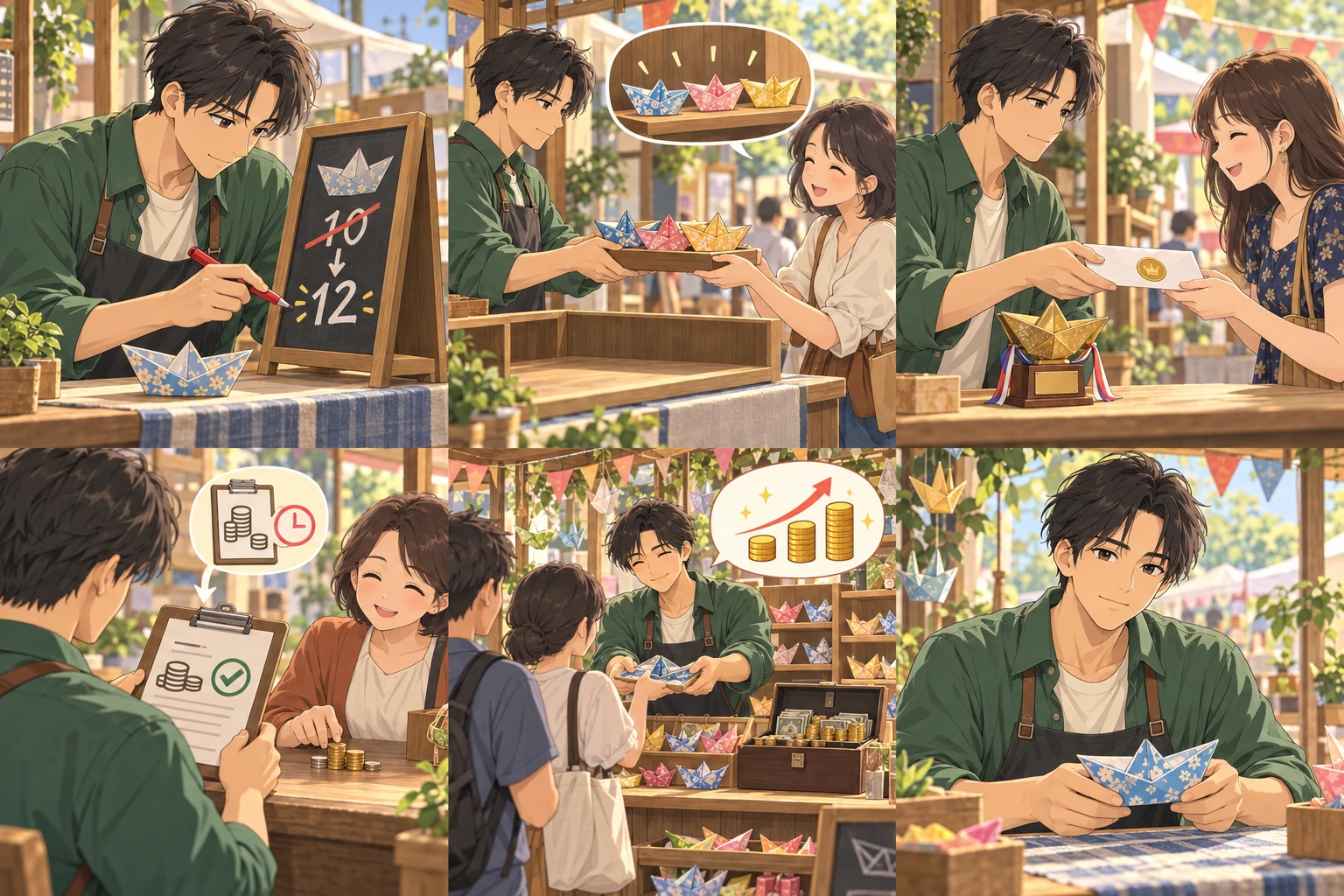
Minh marks a craft item’s price up from 10 to 12.
The picture could not load. Try loading it again before matching.
Picture description
One customer buys up all three remaining paper boats at Minh’s stall.
The picture could not load. Try loading it again before matching.
Picture description
Minh pays out a craft competition prize in an envelope.
The picture could not load. Try loading it again before matching.
Picture description
A customer finally pays up an outstanding bill at Minh’s stall.
The picture could not load. Try loading it again before matching.
Picture description
Minh’s busy stall is raking in money, with many sold items and a well-filled takings box.
The picture could not load. Try loading it again before matching.
Choose a phrase to begin.
Your browser could not save your play history. Results from this session may be lost when you close the page.
A conversation in context
Read the conversation and find the expressions you have learned.
Mai
Did the stall mark up the price of those notebooks?
Read the example again
Did the stall mark up the price of those notebooks?
Alex
Yes, but one customer still bought up the remaining stock.
Read the example again
Yes, but one customer still bought up the remaining stock.
Mai
They will pay out the prize money after the fair.
Read the example again
They will pay out the prize money after the fair.
Compare the uses
mark up / buy up
“Mark up” increases a selling price; “buy up” acquires all or much of a supply. Raising a price is a seller’s action, while buying up is usually a buyer’s.
Practice and check your answers
Try answering before revealing the suggested answer. This practice is not scored.
The answers below are models. Other answers can also work if they preserve the facts, meaning and structure requested in the task.
A situation to apply what you have learned
A stall increases a price. One customer later purchases nearly all the remaining notebooks.
Describe the seller’s price action.
Show the answer and explanation
The stall marked up the notebook price.
The seller increased notebook prices with “marked up”; the subject is the stall rather than the customer.
Replace “the notebooks” with “them”: Buy up the notebooks.
Show the answer and explanation
Buy them up.
“Them” replaces the notebooks being purchased, so say “buy them up” with the pronoun before “up”.
Write a report about the customer rather than the seller.
Show the answer and explanation
One customer bought up most of the notebooks despite the higher price.
“Bought up most” reports one customer taking nearly all the notebooks; “despite” retains the higher price.
The usage comparisons are checked against the Cambridge Dictionary entries linked beside the compared expressions. The additional conversations and exercises are written for this course.
Progress is saved on the device. Sign in with Google to save with the same account and continue on another device.