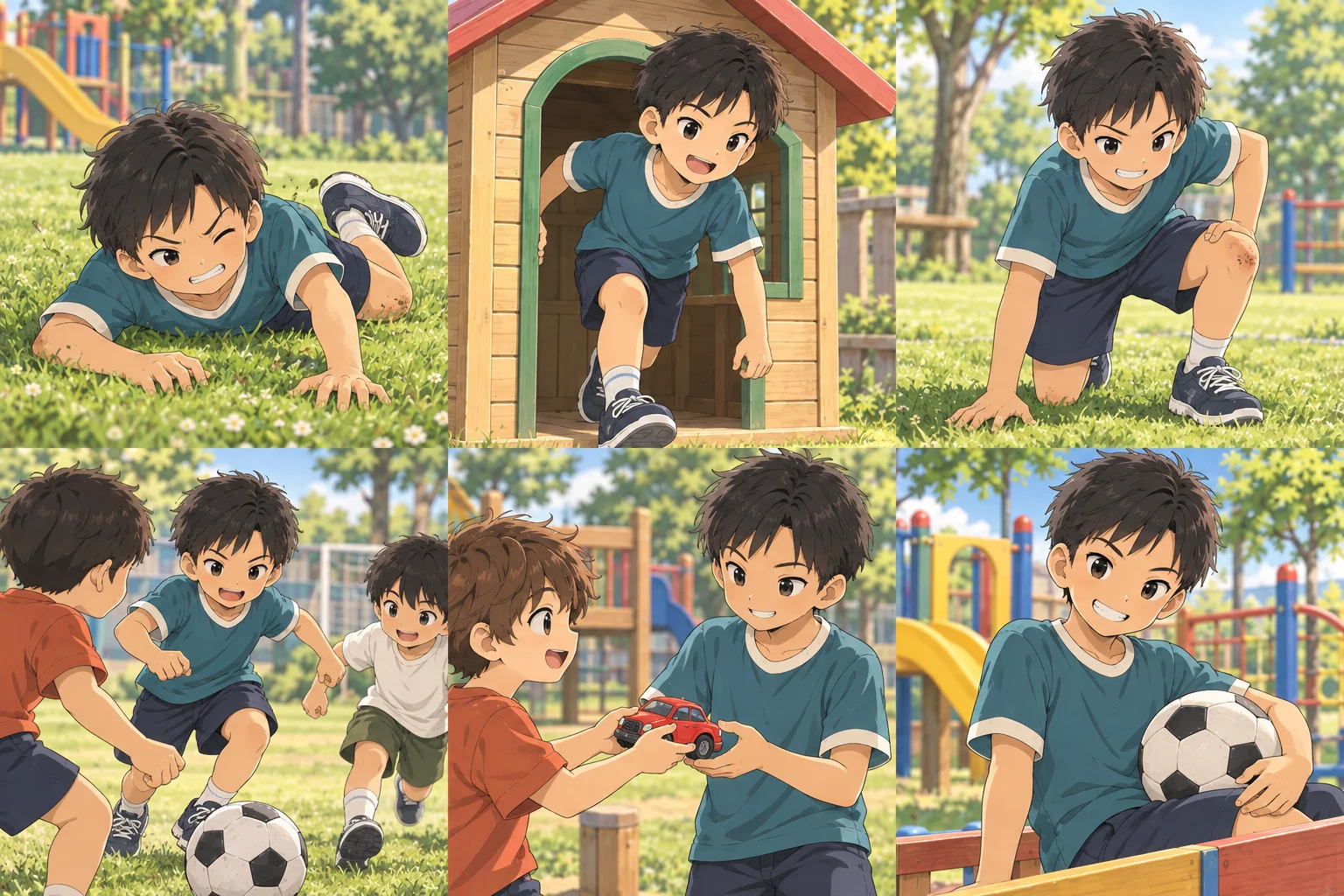
Nam excitedly joined a group of friends playing a simple game.
jump in
If you know the answer, jump in and help us.
Read the example again
If you know the answer, jump in and help us.
Everyone jumped in to help finish the game board.
Read the example again
Everyone jumped in to help finish the game board.
View meaning & usage
Join now / contribute to the activity
jump injump in and do something
The meaning in the lesson is to participate or give suggestions immediately, not jump into the water.
Haven't studied yet
Nam received back the toy car he lent to his friend.
get back
Can I get my toy car back before we go home?
Read the example again
Can I get my toy car back before we go home?
He got the ball back after the game.
Read the example again
He got the ball back after the game.
View meaning & usage
Receive / get your things back
get something backget something back from someone
Needs objects between “get” and “back”. Different from "go back" which means to return to a place.
Haven't studied yet
The examples were written for this course. Usage was checked against Matt Errey’s book, pages 44, 52, 53, 69, 50. A2–B1 is the course’s intended level.
Recall it · Use it
One step forward every day
Practice completed!
Your browser could not save your play history. Results from this session may be lost when you close the page.
Sentences using suggestions are counted as needing more practice. Review schedule based on each phrase's meaning.
Drag a wire from the dot beside a phrase to the dot beside its matching picture. You can also tap a phrase, then a picture. Drag again to change a pair before checking.
Read the picture descriptions for more context. Similar expressions are accepted when they fit the particular scene.
Phrases
Actions in the pictures
Picture description
Nam tripped and fell slightly on the soft grass.
The picture could not load. Try loading it again before matching.
Picture description
Nam walked out of the low toy house.
The picture could not load. Try loading it again before matching.
Picture description
Nam stood up from the grass after sitting or stumbling slightly.
The picture could not load. Try loading it again before matching.
Picture description
Nam excitedly joined a group of friends playing a simple game.
The picture could not load. Try loading it again before matching.
Picture description
Nam received back the toy car he lent to his friend.
The picture could not load. Try loading it again before matching.
Choose a phrase to begin.
Your browser could not save your play history. Results from this session may be lost when you close the page.
A conversation in context
Read the conversation and find the expressions you have learned.
Mai
Did you fall over near the slide?
Read the example again
Did you fall over near the slide?
Alex
Yes, but I can get up on my own.
Read the example again
Yes, but I can get up on my own.
Mai
Take your time. We can get back to the game later.
Read the example again
Take your time. We can get back to the game later.
Compare the uses
fall over / get up
“Fall over” means fall; here “get up” means rise after falling. The playground context differs from getting out of bed in the morning.
Practice and check your answers
Try answering before revealing the suggested answer. This practice is not scored.
The answers below are models. Other answers can also work if they preserve the facts, meaning and structure requested in the task.
A situation to apply what you have learned
During a playground game, a child loses balance, lands on the grass, and then stands again. Another child has borrowed her ball.
Describe the first event.
Show the answer and explanation
The child fell over on the grass.
Losing balance and landing on the grass is “fell over”; “fell” is the past of “fall”.
Give the past form: The child gets up without help.
Show the answer and explanation
The child got up without help.
“Gets” changes to irregular past “got”; “got up” here means standing after a fall.
Ask for the borrowed ball using get back.
Show the answer and explanation
Can I get my ball back before the next game?
“Get my ball back” retrieves the borrowed ball, matching the taught sense of “get back” rather than resuming play.
The usage comparisons are checked against the Cambridge Dictionary entries linked beside the compared expressions. The additional conversations and exercises are written for this course.
Progress is saved on the device. Sign in with Google to save with the same account and continue on another device.