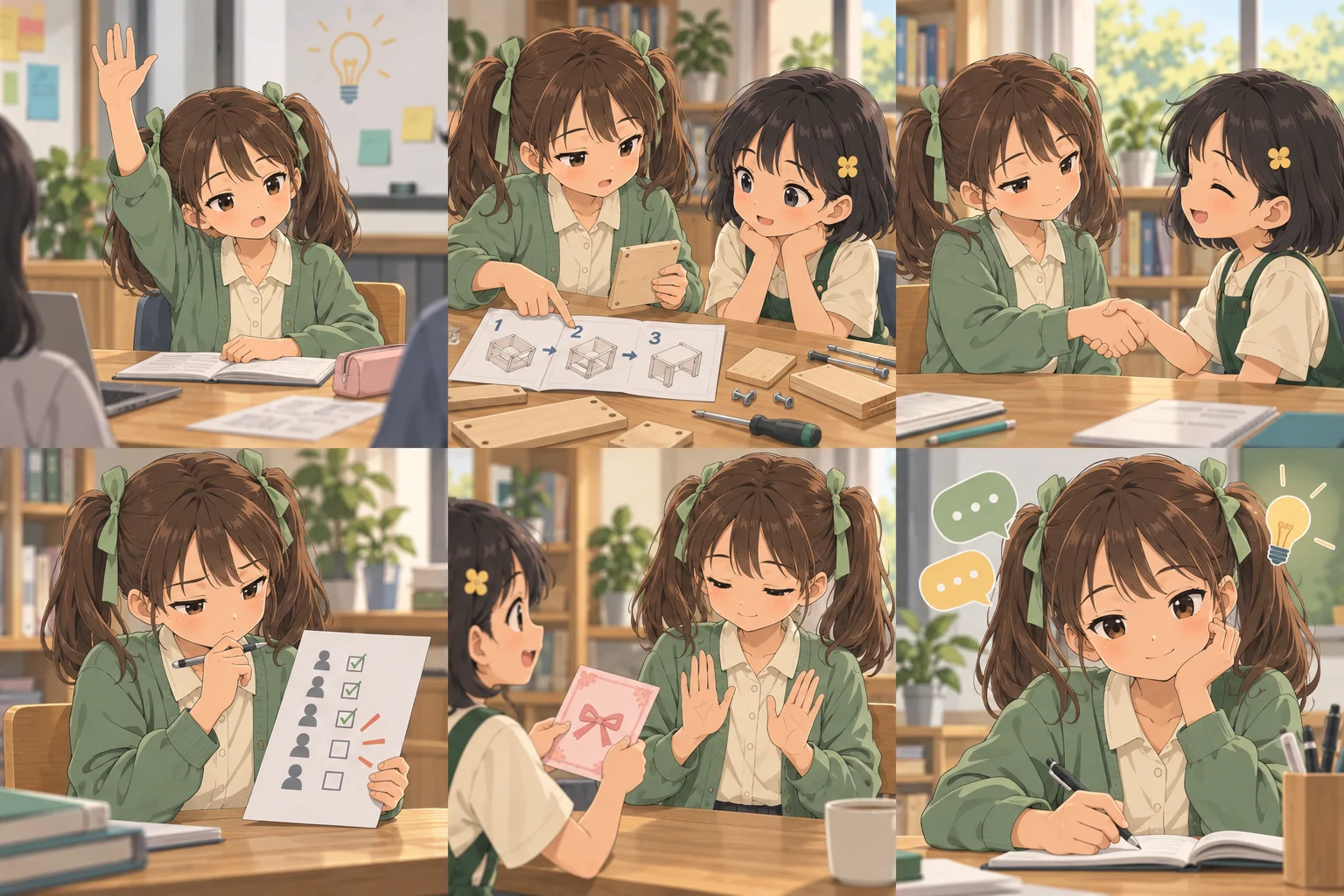
The two friends talked calmly and then shook hands after understanding the problem.
clear up
Let us clear up this misunderstanding before we leave.
Read the example again
Let us clear up this misunderstanding before we leave.
Your message cleared up my confusion about the date.
Read the example again
Your message cleared up my confusion about the date.
View meaning & usage
Clarifying the misunderstanding
clear up somethingclear something upclear it up
In this lesson, it means to explain and resolve a misunderstanding, rather than tidy up or describe improving weather.
Haven't studied yet
Nhi scanned the invitation list and left a position blank that was not included.
leave out
Do not leave out the date when you write the invitation.
Read the example again
Do not leave out the date when you write the invitation.
I left her name out by mistake.
Read the example again
I left her name out by mistake.
View meaning & usage
Omitted / not included
leave out something / someoneleave something out
May be accidentally omitted or intentionally not included. The past tense of “leave” is “left”.
Haven't studied yet
Nhi politely declined the invitation with a gentle gesture.
turn down
I had to turn down the invitation because I was busy.
Read the example again
I had to turn down the invitation because I was busy.
It is a good offer, but I may turn it down.
Read the example again
It is a good offer, but I may turn it down.
View meaning & usage
Refuse the offer
turn down an offer / invitationturn something downturn it down
Here is refusal, different from turning down the volume in “turn the music down”.
Haven't studied yet
The examples were written for this course. Usage was checked against Matt Errey’s book, pages 15, 130, 22, 77, 133. A2–B1 is the course’s intended level.
Recall it · Use it
One step forward every day
Practice completed!
Your browser could not save your play history. Results from this session may be lost when you close the page.
Sentences using suggestions are counted as needing more practice. Review schedule based on each phrase's meaning.
Drag a wire from the dot beside a phrase to the dot beside its matching picture. You can also tap a phrase, then a picture. Drag again to change a pair before checking.
Read the picture descriptions for more context. Similar expressions are accepted when they fit the particular scene.
Phrases
Actions in the pictures
Picture description
Nhi raised her hand to bring up a new topic in the meeting.
The picture could not load. Try loading it again before matching.
Picture description
Nhi explains each step of assembling an object to you.
The picture could not load. Try loading it again before matching.
Picture description
The two friends talked calmly and then shook hands after understanding the problem.
The picture could not load. Try loading it again before matching.
Picture description
Nhi scanned the invitation list and left a position blank that was not included.
The picture could not load. Try loading it again before matching.
Picture description
Nhi politely declined the invitation with a gentle gesture.
The picture could not load. Try loading it again before matching.
Choose a phrase to begin.
Your browser could not save your play history. Results from this session may be lost when you close the page.
A conversation in context
Read the conversation and find the expressions you have learned.
Mai
May I bring up a concern about the timetable?
Read the example again
May I bring up a concern about the timetable?
Alex
Of course. Let us talk it through before deciding.
Read the example again
Of course. Let us talk it through before deciding.
Mai
That should clear up the misunderstanding about Friday.
Read the example again
That should clear up the misunderstanding about Friday.
Compare the uses
bring up / talk through
“Bring up” introduces a topic; “talk through” involves discussing or explaining its parts. Introducing a problem is only the start of the conversation.
Practice and check your answers
Try answering before revealing the suggested answer. This practice is not scored.
The answers below are models. Other answers can also work if they preserve the facts, meaning and structure requested in the task.
A situation to apply what you have learned
A team has not discussed wheelchair access yet. The organiser wants to introduce it before choosing a venue.
Introduce the topic using bring up.
Show the answer and explanation
Could I bring up the question of wheelchair access?
Wheelchair access has not been discussed, so “bring up” introduces it to the meeting.
Replace “the plan” with “it”: Talk the plan through.
Show the answer and explanation
Talk it through.
Replacing “the plan” with “it” gives “talk it through”, with the pronoun before “through”.
Request a detailed discussion rather than a quick mention.
Show the answer and explanation
Please talk the access arrangements through with the whole team.
“Talk the arrangements through” requests detailed discussion, beyond simply mentioning the topic.
The usage comparisons are checked against the Cambridge Dictionary entries linked beside the compared expressions. The additional conversations and exercises are written for this course.
Progress is saved on the device. Sign in with Google to save with the same account and continue on another device.